组成图示
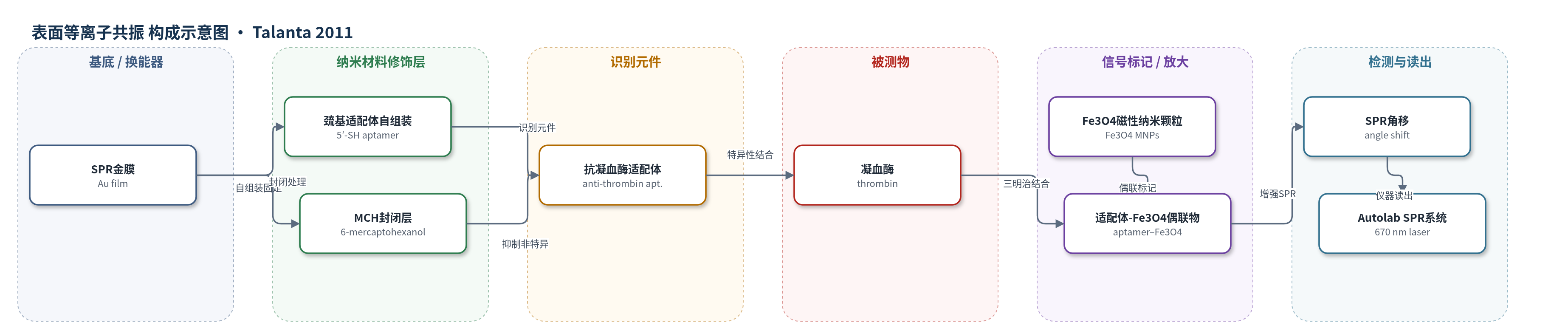
点击图片查看大图 · 依据论文自动绘制
传感器类型
表面等离子共振(SPR)生物传感器
检测对象
凝血酶(thrombin);样品基质:血清/血液(文中提及血清中痕量,实验在 PBS 缓冲液中进行)
检测原理
5′-巯基抗凝血酶适配体通过 Au–S 键自组装在 SPR 金膜上,MCH 封闭未覆盖金表面。凝血酶与表面适配体特异性结合,引起金膜界面质量与折射率变化,产生 SPR 角移。随后加入氨基适配体–Fe3O4 MNPs 偶联物,利用凝血酶与适配体的第二个结合位点形成三明治结构。Fe3O4 具有高折射率、高分子量,且聚合物包覆使其光学损耗较低,因此结合后 SPR 角移显著放大。凝血酶浓度越高,表面结合的放大偶联物越多,SPR 角移越大;在 0.27–27 nM 范围内,SPR 角移与凝血酶浓度对数呈线性关系。最终由 670 nm 激光 SPR 系统读出角移(m°)。
检测灵敏度
LOD: 0.017 nM;线性范围: 0.27–27 nM(logarithms of thrombin concentrations);斜率: 71.33 m°/log(nM);R^2 = 0.998。
效应效果
选择性方面,BSA、人IgM和人IgE在抗凝血酶适配体修饰金膜上的SPR角移很小,加入aptamer–Fe3O4偶联物后其放大信号仍远低于凝血酶;100 μg/mL凝血酶可产生118.6 m°角移。检出限与多数适配体传感器相当。文中未报告RSD、长期稳定性或实际样品加标回收率,仅给出三次测量的平均标准误差。作者认为Fe3O4 MNPs成本低、光学损耗小,可作为SPR三明治免疫分析的高效放大试剂,并有望用于磁性纳米颗粒生物分离产物的原位检测。
传感器的构成
- 基底/换能器:SPR 金膜(Au film),25 mm 金传感器盘,提供表面等离子共振换能表面
- 识别元件固定层:5′-巯基抗凝血酶适配体(5′-SH anti-thrombin aptamer),通过 Au–S 键自组装于金膜并捕获凝血酶
- 封闭层:6-巯基-1-己醇(6-mercaptohexan-1-ol, MCH),封闭未覆盖金表面,降低非特异吸附
- 纳米放大载体:羧基修饰 Fe3O4 磁性纳米颗粒(carboxyl-modified Fe3O4 MNPs),约 10.46 nm,提供高折射率与高分子量 SPR 信号放大
- 信号标记/识别元件:氨基抗凝血酶适配体–Fe3O4 偶联物(aptamer–Fe3O4 MNPs conjugates),与凝血酶第二结合位点结合形成三明治结构
- 偶联/封闭试剂:EDC 与 NHS 活化 Fe3O4 表面羧基,乙醇胺封闭未反应羧基
- 读出系统:Eco Chemie Autolab SPR 系统,670 nm 激光,测量 SPR 角移(m°)
中文摘要
磁性纳米颗粒(MNPs)因在生物分离中的巨大潜力而受到关注,但其分离产物因尺寸极小,难以用常规方法检测。本文证明 MNPs 可显著增强表面等离子共振(SPR)光谱信号,并首次报道 MNPs–适配体偶联物作为超灵敏免疫分析的放大试剂。为评价其传感能力,作者以凝血酶为模型分析物构建了三明治 SPR 传感器:凝血酶先被固定在 SPR 金膜上的抗凝血酶适配体捕获,再加入 MNPs–适配体偶联物作为放大试剂,使 SPR 检测的最低检出限达到 0.017 nM。同时,以牛血清白蛋白(BSA)、人 IgM 和人 IgE 作为对照蛋白,证实该传感器具有优异选择性。结果表明,MNPs 是 SPR 三明治免疫分析中强效的三明治元件和优秀放大试剂,SPR 也具备检测 MNPs 基生物分离产物的潜力。
英文摘要
Magnetic nanoparticles (MNPs) have been receiving increasing attention because of its great potentials in bioseparation. However, the separation products are difficult to be detected by general method due to their extremely small size. Here, we demonstrate that MNPs can greatly enhance the signal of surface plasmon resonance spectroscopy (SPR). Features of MNPs-aptamer conjugates as a powerful amplification reagent for ultrasensitive immunoassay are reported in this work for the first time. In order to evaluate the sensing ability of MNPs-aptamer conjugates as an amplification reagent, a sandwich SPR sensor is constructed by using thrombin as model analyte. Thrombin, captured by immobilized anti-thrombin aptamer on SPR gold film, is sensitively detected by SPR spectroscopy with a lowest detection limit of 0.017 nM after MNPs-aptamer conjugates is used as amplification reagent. At the same time, the excellent selectivity of the present biosensor is also confirmed by using three kinds of proteins (BSA, human IgM and human IgE) as controls. These results confirm that MNPs is a powerful sandwich element and an excellent amplification reagent for SPR based sandwich immunoassay and SPR has a great potential for the detection of MNPs-based bioseparation products.