组成图示
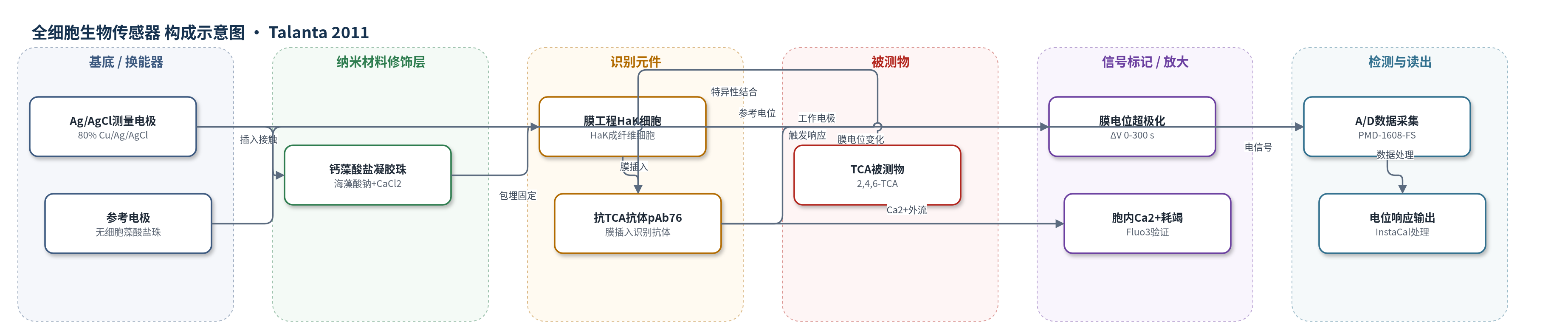
点击图片查看大图 · 依据论文自动绘制
传感器类型
全细胞生物传感器
检测对象
2,4,6-三氯苯甲醚(TCA, 2,4,6-trichloroanisole);样品基质:PBS 标准溶液、白葡萄酒/软木塞浸泡提取液(cork soaks in white wine)
检测原理
传感器以膜工程 HaK 细胞为识别单元,细胞膜上经渗透法插入抗 TCA 多克隆抗体 pAb76。当样品中的 TCA 与膜表面 pAb76 结合时,触发细胞膜电生理响应,表现为膜电位超极化,并伴随胞内 Ca2+ 耗竭/外流。细胞包埋于钙藻酸盐凝胶珠中,Ag/AgCl 测量电极接触含细胞珠,参考电极置于样品或无细胞珠中,形成电位测量回路。PMD-1608-FS 采集 0–300 s 内最大电位变化,信号随 TCA 浓度增加而增强。该体系无酶催化或核酸放大,依靠全细胞膜工程识别与电生理换能实现痕量检测。
检测灵敏度
LOD: 0.1 ppt(PBS 标准溶液);LOD: 1.02 ppt(白葡萄酒/软木塞浸泡液);线性范围: 1.02–12.0 ppt;标准溶液检测范围: 10^-1–10^7 ppt
效应效果
该传感器在 3–5 min 内完成检测,标准 PBS 中 TCA 响应呈浓度依赖性超极化,未插入抗体的对照细胞出现相反的去极化,说明响应依赖 pAb76 识别。对 2,4,6-TCP、TBA、2,6-DCA、2,3-DCA、3,5-DCA 和 TeCA 等干扰物均有信号,但 TCA 响应数倍更高,选择性较好。实际白葡萄酒软木塞浸泡样品中,1.02–12.0 ng/L 范围内线性响应,变异 2.81–17.31%,覆盖葡萄酒感官/监管阈值 1.4–10 ng/L,无需复杂前处理,并与 GC/MS 按 ISO 20752:2007/OIV 296/2009 双盲验证。作者称多细胞-电极阵列可实现 >1150 次测试/小时,适合软木、葡萄酒及其他食品中 TCA 快速筛查。
传感器的构成
- 换能器电极:80% Cu 基底电化学镀 Ag/AgCl 层(直径 0.75 mm),作为测量电极采集细胞-凝胶珠电位
- 参考电极:无细胞藻酸盐珠/样品中参考电极,提供稳定参考电位
- 包埋基质:2% (w/v) 海藻酸钠(sodium alginate)与 0.2 M CaCl2 交联形成钙藻酸盐凝胶珠(直径约 2 mm),固定细胞并允许小分子扩散
- 识别元件:膜工程 HaK 仓鼠肾成纤维细胞(HaK cells),作为全细胞识别单元
- 识别分子:抗 TCA 多克隆抗体 pAb76,经高渗/低渗处理插入细胞膜,特异性结合 TCA
- 信号标记物:无外源标记物;细胞膜电位超极化及胞内 Ca2+ 变化为内源电生理信号
中文摘要
2,4,6-三氯苯甲醚(TCA)是软木塞、葡萄酒、水和酒精饮料中产生霉味/泥土味“软木污染”的主要化合物。现有色谱和电化学方法难以在低浓度下快速检测 TCA。本研究开发了一种基于生物电识别检测(BERA)的新型细胞生物传感器。通过渗透法将抗 TCA 多克隆抗体 pAb76 插入 HaK 仓鼠肾成纤维细胞膜,制备膜工程细胞,并将其包埋于钙藻酸盐凝胶珠中。传感器通过测量电极记录细胞膜电位变化,在 TCA 存在时发生浓度依赖性超极化。该传感器可在 3–5 min 内检测 10^-1 ppt 的 TCA,灵敏度高于人类感官阈值,并对结构相关卤代苯甲醚/卤代酚具有选择性。实际白葡萄酒软木塞浸泡样品中,可在 1.02–12 ng/L 范围内快速检测 TCA,覆盖葡萄酒检测阈值 1.4–10 ng/L,为软木和葡萄酒中 TCA 的超快速、超灵敏、低成本监测提供新途径。
英文摘要
2,4,6-trichloroanisole (TCA) is a microbial metabolite formed from chlorophenols through the activity of several natural fungal strains present on the cork oak bark. TCA is the primary compound responsible for the mousty/mould off-odour known as "cork taint" present in cork stoppers, wine, water and alcoholic beverages. Chromatographic and electrochemical methods are currently used for the determination of TCA, however its detection at low concentrations remains a technical challenge. The aim of this study was the development of a rapid novel biosensor system based on the Bioelectric Recognition Assay (BERA). The sensor measured the electric response of cultured membrane-engineered fibroblast cells suspended in an alginate gel matrix due to the change of their membrane potential in the presence of the analyte. Membrane-engineered cells were prepared by osmotic insertion of 0.5 μg/l of specific TCA antibodies into the membrane of the cells. The BERA-based sensor was able to detect TCA in a few minutes (3-5 min) at extremely low concentrations (10(-1)ppt), thus demonstrating higher sensitivity than the human sensory threshold. In addition, the assay was quite selective against other haloanisoles and halophenols structurally related to or co-occurring with TCA. Finally the sensor was tested against real white wine samples from cork soaks. At this real test, the BERA sensor was able to detect TCA from cork soaks rapidly (3-5 min) at very low concentrations (1.02-12 ng/l), covering the whole range for the detection threshold for wines (1.4-10 ng/l). Therefore, this novel biosensor offers new perspectives for ultra-rapid, ultra-sensitive and low-cost monitoring of TCA presence in cork and wine and possibly also other food commodities.