组成图示
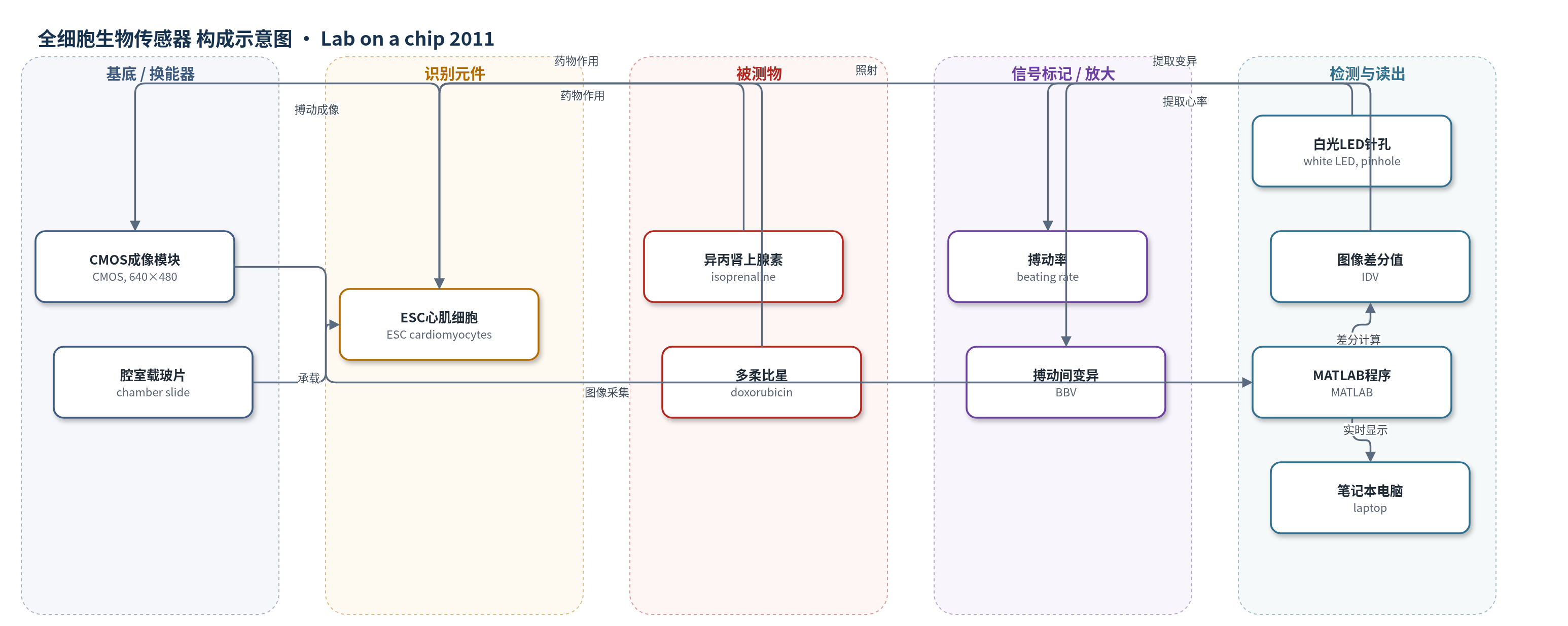
点击图片查看大图 · 依据论文自动绘制
传感器类型
全细胞生物传感器
检测对象
异丙肾上腺素(isoprenaline)、多柔比星(doxorubicin);样品基质为含细胞培养液的腔室载玻片(culture medium in chamber slide)
检测原理
该传感器以活体ESC来源心肌细胞为识别与传感元件,药物进入培养液后作用于细胞,改变其收缩节律。异丙肾上腺素作为β肾上腺素能激动剂增强细胞兴奋性,使搏动率升高;多柔比星引起心肌毒性,使搏动率下降并增加节律不规整。细胞搏动导致成像区域像素变化,CMOS模块无透镜采集实时帧;程序将参考帧与实时帧二值化并逐像素相减,得到图像差分值。图像差分值呈类心电脉冲,峰间期平均值反映搏动率,峰间期标准差反映搏动间变异。系统无额外化学放大,药物浓度越高,搏动率或变异变化越大,从而实现实时心脏毒性检测。
检测灵敏度
—
效应效果
系统可区分促心率与减心率药物:未加药细胞150 min内搏动率约100次/min,波动<3%;处理速率29帧/s。异丙肾上腺素1、5、10、100 nM处理12 min后搏动率增加24%、44%、70%,上升时间3、4、5 min;多柔比星100、200 μM处理100 min后搏动率下降26%、54%,300 μM处理20 min后停止,350 μM致细胞脱落。每种药物3次独立实验。相比电影分析、MEA和LAPS,系统便携、低成本、实时,可用于高通量筛选和iPS细胞个性化心脏毒性评估。
传感器的构成
- 成像换能器:CMOS imaging module(Logitech C160,640×480像素),无透镜采集心肌细胞搏动图像
- 光源:white LED与pinhole(300 μm直径),形成点光源用于无透镜成像
- 样品基底:chamber slide(Nalge Nunc International Corp.),承载细胞培养与成像
- 识别元件:ESC-derived cardiomyocytes(小鼠胚胎干细胞来源心肌细胞),以搏动节律作为生物识别信号
- 样品基质:culture medium(含isoprenaline或doxorubicin),提供细胞培养与药物接触
- 信号读出:MATLAB image processing program与laptop computer,比较reference image与live frame images并计算image difference value
中文摘要
本研究开发了一种便携且低成本的实时心脏毒性生物传感器,采用从商用网络摄像头中提取的CMOS成像模块、白色LED和针孔构成检测系统。通过比较参考帧与实时帧图像进行实时图像处理,以监测胚胎干细胞(ESC)来源心肌细胞的搏动率和搏动间变异。系统用于评价异丙肾上腺素和多柔比星两种药物对心肌细胞的影响。结果表明,两种药物处理均使搏动间变异增加;异丙肾上腺素使搏动率升高,而多柔比星使搏动率降低。此外,异丙肾上腺素处理下搏动率和搏动间变异的响应时间短于多柔比星,尽管实验中异丙肾上腺素用量比多柔比星低三个数量级。该系统能够以简单、廉价的方式实时监测细胞,可应用于多种基于细胞的生物传感场景。
英文摘要
A portable and cost-effective real-time cardiotoxicity biosensor was developed using a CMOS imaging module extracted from a commercially available webcam. The detection system consists of a CMOS imaging module, a white LED and a pinhole. Real-time image processing was conducted by comparing reference and live frame images. To evaluate the engineered system, the effects of two different drugs, isoprenaline and doxorubicin, on the beating rate and beat-to-beat variations of ESC-derived cardiomyocytes were measured. The detection system was used to conclude that the beat-to-beat variability increased under treatment with both isoprenaline and doxorubicin. However, the beating rates increased upon the addition of isoprenaline but decreased for cultures supplemented with doxorubicin. Moreover, the response time for both the beating rates and the beat-to-beat variability of ESC-derived cardiomyocytes under treatment of isoprenaline was shorter than for doxorubicin, although the amount of isoprenaline used in the measurement was three orders of magnitude lower than that of doxorubicin. Given its ability to perform real-time cell monitoring in a simple and inexpensive manner, the proposed system may be useful for a range of cell-based biosensing applications.