组成图示
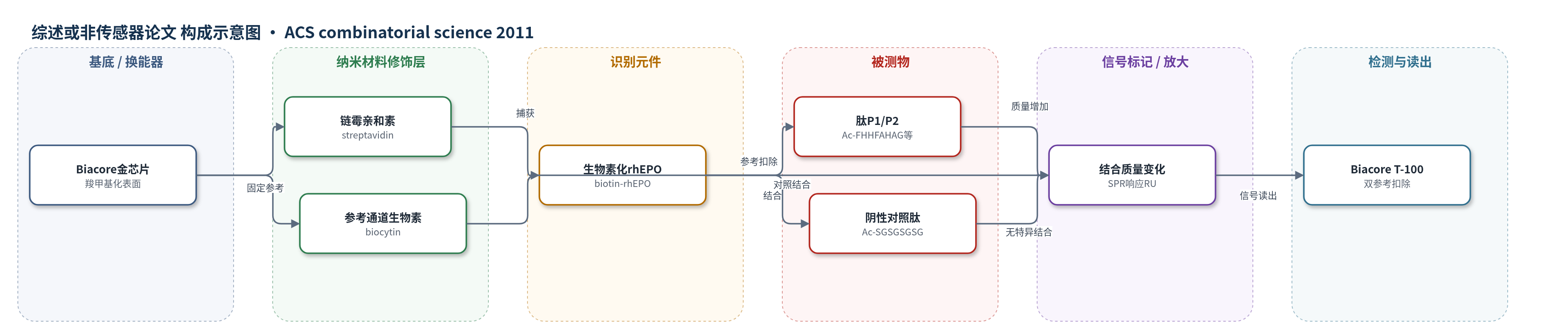
点击图片查看大图 · 依据论文自动绘制
传感器类型
综述或非传感器论文
检测对象
重组人促红细胞生成素(rhEPO),样品基质:CHO 细胞培养上清加标 rhEPO;SPR 待测物:合成八肽 P1/P2 及阴性对照,基质:10 mM HEPES pH 7.4、150 mM NaCl
检测原理
本文核心为亲和色谱配体发现,SPR 仅用于无标记亲和力检测。生物素化 rhEPO 通过链霉亲和素固定于 Biacore 芯片表面,待测肽在流动相中注入;肽与 rhEPO 特异性结合后,芯片界面质量增加,引起表面等离子体共振条件变化,Biacore T-100 以共振单位(RU)实时记录响应。稳态 RU 随肽浓度升高而增大,经参考通道与零浓度双参考扣除后,按 1:1 Langmuir 模型拟合得到 Kd。亲和色谱中,P1/P2 肽经 Lys 侧链固定于 NHS-Sepharose,rhEPO 在 pH 4.0 被选择性吸附,BSA 不吸附;随后用 pH 3.0 醋酸缓冲液温和洗脱,UV280、ELISA 和 SDS-PAGE 定量纯度。
检测灵敏度
原文未报告 LOD、线性范围、灵敏度斜率或相关系数。
效应效果
SPR 中阴性对照肽 Ac-SGSGSGSG-NH2 无特异结合,表明 P1/P2 选择性良好。固定化后 P1-Sepharose 和 P2-Sepharose 的 Kd 为 1.8±0.1 μM 和 2.7±0.7 μM,qm 为 0.38±0.01 和 0.40±0.03 μmol/mL,表观结合常数 5.2×10^5 和 3.7×10^5 L/mol。pH 4.0 时 rhEPO 100% 吸附,BSA 100% 通过。CHO 上清加标 rhEPO 实验中,ELISA 显示 P1 洗脱 44.0 μg、穿柱 2.9 μg,P2 洗脱 43.5 μg、穿柱 1.8 μg,回收率均为 90%;SDS-PAGE 纯度分别为 95% 和 97%。作者认为短肽配体成本低、稳定、可温和洗脱,适合工业放大。
传感器的构成
- SPR基底:Biacore 羧甲基化金表面芯片,提供固定化表面并作为 SPR 换能器
- 捕获层:链霉亲和素(streptavidin)预固定于芯片,用于高亲和捕获生物素化 rhEPO
- 固定目标:生物素化 rhEPO(biotin-rhEPO),作为固定配体识别待测肽
- 待测识别配体:合成八肽 Ac-FHHFAHAG-NH2(P1)或 Ac-FHNFAHAG-NH2(P2),与 rhEPO 结合
- 参考通道:生物素化生物素(biocytin)固定于参考通道,用于扣除折射率与非特异结合
- 亲和色谱载体:NHS-Sepharose 琼脂糖微球,提供 NHS 活性基团用于肽固定化
- 固定化识别配体:P1/P2 肽经 C 端 Lys 侧链偶联于 Sepharose,形成 rhEPO 亲和色谱填料
- 封闭剂:乙醇胺(EA)封闭未反应 NHS 基团,制备 EA-Sepharose 对照并降低非特异结合
中文摘要
少于10个氨基酸的小肽是工业蛋白纯化亲和色谱系统的有前景配体。组合肽合成策略有助于发现目标蛋白的合适配体。本研究旨在鉴定与重组人促红细胞生成素(rhEPO)亲和的肽配体。作者用分-偶联-重组(DCR)法在 HMBA-ChemMatrix 树脂上合成八肽库 X-X-X-Phe-X-X-Ala-Gly,X 为 Ala、Asp、Glu、Phe、His、Leu、Asn、Pro、Ser 或 Thr。筛选时 rhEPO 偶联 Texas Red 或生物素,分离荧光珠或链霉亲和素-过氧化物酶阳性珠,切割后以 MALDI-TOF 质谱测序,57个珠阳性。作者合成更多共识肽,并用表面等离子共振生物传感器评估亲和力,Kd 为 1–18 μM。最佳两个肽固定于 Sepharose,Kd 为 1.8–2.7 μM。CHO 上清加标 rhEPO 后上柱,回收率 90%,P1 和 P2 纯度分别为 95% 和 97%。
英文摘要
Small peptides containing fewer than 10 amino acids are promising ligand candidates with which to build affinity chromatographic systems for industrial protein purification. The application of combinatorial peptide synthesis strategies greatly facilitates the discovery of suitable ligands for any given protein of interest. Here we sought to identify peptide ligands with affinity for recombinant human erythropoietin (rhEPO), which is used for the treatment of anemia. A combinatorial library containing the octapeptides X-X-X-Phe-X-X-Ala-Gly, where X = Ala, Asp, Glu, Phe, His, Leu, Asn, Pro, Ser, or Thr, was synthesized on HMBA-ChemMatrix resin by the divide-couple-recombine method. For the library screening, rhEPO was coupled to either Texas Red or biotin. Fluorescent beads or beads showing a positive reaction with streptavidin-peroxidase were isolated. After cleavage, peptides were sequenced by matrix-assisted laser desorption/ionization time-of-flight mass spectrometry (MALDI-TOF MS). Fifty-seven beads showed a positive reaction. Peptides showing more consensuses were synthesized, and their affinity to rhEPO was assessed using a plasma resonance biosensor. Dissociation constant values in the range of 1-18 μM were obtained. The best two peptides were immobilized on Sepharose, and the resultant chromatographic matrixes showed affinity for rhEPO with dissociation constant values between 1.8 and 2.7 μM. Chinese hamster ovary (CHO) cell culture supernatant was spiked with rhEPO, and the artificial mixture was loaded on Peptide-Sepharose columns. The rhEPO was recovered in the elution fraction with a yield of 90% and a purity of 95% and 97% for P1-Sepharose and P2-Sepharose, respectively.