组成图示
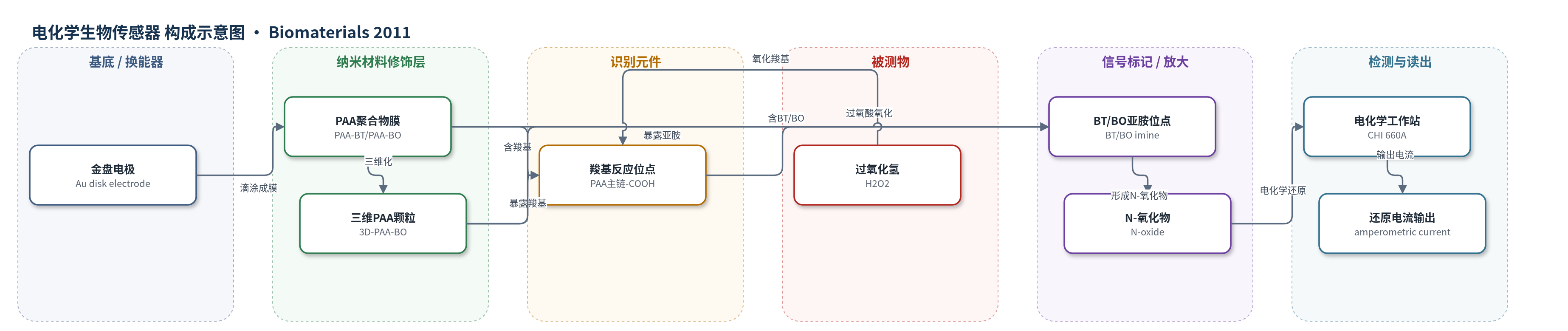
点击图片查看大图 · 依据论文自动绘制
传感器类型
电化学生物传感器
检测对象
过氧化氢(Hydrogen peroxide, H2O2);样品基质:磷酸盐缓冲液(PBS)及人尿液(健康人与非浸润性膀胱癌患者)
检测原理
该传感器为无酶电化学生物传感器。H2O2首先与PAA-BT或PAA-BO主链上的羧基发生化学反应,生成过氧酸;过氧酸作为内源氧化剂,将侧链苯并噻唑(BT)或苯并噁唑(BO)上的电活性亚胺位点氧化为N-氧化物。在-0.5 V恒电位下,N-氧化物接受电子和质子被还原为原始亚胺,产生还原电流。H2O2浓度越高,生成的N-氧化物越多,稳态还原电流越大,从而实现定量检测。由于检测电位为负电位,尿酸和抗坏血酸等常见干扰物不易被氧化,选择性较高。三维PAA-BO结构增大电极表面积并改善H2O2扩散,使灵敏度和检测限进一步提升。
检测灵敏度
PAA-BT/Au: 灵敏度 280.6 mA/mM-cm2;线性范围 0.025–5.0 mM;LOD 4.9 mM;R = 0.997;PAA-BO/Au: 灵敏度 311.2 mA/mM-cm2;线性范围 0.025–2.5 mM;LOD 5.0 mM;R = 0.998;3D-PAA-BO/Au: 灵敏度 1394.9 mA/mM-cm2;线性范围 0.00625–2.5 mM;LOD 1.4 mM(摘要报告1.43 mM);R = 0.997
效应效果
该传感器响应迅速,平面PAA-BT/Au和PAA-BO/Au达到稳态95%电流分别需<5.2 s和<3.9 s,3D-PAA-BO/Au约1.9 s。在-0.5 V负电位下,尿酸(UA)和抗坏血酸(AA)不产生干扰,选择性高。相对标准偏差(RSD)分别为3.9%、4.1%和3.7%,重现性良好。作者结论称其具有良好稳定性、选择性和准确性,但全文未给出具体长期稳定性或加标回收率数据。实际尿液检测中,健康人H2O2平均约0.1 mM,非浸润性膀胱癌患者平均0.59 mM,结果与经典HPLC法相当,作者认为该无酶传感器可用于膀胱癌相关H2O2分析。
传感器的构成
- 基底/换能器电极:金盘电极(Au disk electrode,0.196 cm²),提供导电基底与电子转移界面
- 聚合物修饰层:PAA-BT或PAA-BO薄膜(含苯并噻唑BT/苯并噁唑BO侧基及主链羧基),由NMP溶液滴涂干燥形成
- 三维增强层:3D-PAA-BO颗粒结构(仅3D-PAA-BO/Au),由PAA-BO丙酮沉淀分散滴涂形成,增大表面积
- 识别/反应元件:PAA主链羧基(-COOH),与H2O2反应生成过氧酸(peroxy acid)
- 信号标记/放大元件:BT/BO侧链亚胺位点(imine),被过氧酸氧化为N-氧化物(N-oxide),还原时产生电流
- 检测介质:0.2 M磷酸盐缓冲液(PBS,pH 7.0),提供质子与离子环境
- 信号读出:三电极电化学工作站(CHI 660A),工作电极为PAA/Au,对电极为裸Au,参比电极为Ag/AgCl,恒电位-0.5 V安培检测
中文摘要
本研究成功合成了含苯并噻唑(BT)和苯并噁唑(BO)侧基的聚酰胺酸衍生物(PAA-BT和PAA-BO),二者均具有电活性。H2O2可化学氧化PAA主链中的固有羧基,生成过氧酸;过氧酸进一步氧化BT和BO侧链上的电活性亚胺位点,形成N-氧化物。N-氧化物可通过电化学还原恢复为原始亚胺结构,从而使还原电流增大。基于该机制,作者将PAA-BT或PAA-BO修饰在金电极上,制备了无酶过氧化氢(H2O2)生物传感器(PAA-BT/Au和PAA-BO/Au)。这些传感器响应迅速(3.9–5.2 s),并具有较高的选择性和灵敏度(280.6–311.2 mA/mM-cm2)。与不含羧基的聚酰胺-BT或聚酰胺-BO电极对比,验证了PAA衍生物检测H2O2的机制。将电极表面由平面改为三维结构后,PAA-BO/Au电极性能显著提升,3D-PAA-BO/Au的灵敏度达1394.9 mA/mM-cm2,约为平面电极的4.5倍,检测限由5.0 mM降至1.43 mM。该传感器用于检测健康人和非浸润性膀胱癌患者尿液中的H2O2,结果与经典HPLC法相当,显示其在膀胱癌分析中的潜在应用价值。
英文摘要
Polyamic acids (PAAs) containing benzothiazole (BT) and benzoxazole (BO) pendent groups (PAA-BT and PAA-BO, respectively) which possessed electroactivity were synthesized successfully. The addition of H(2)O(2) chemically oxidized the intrinsic carboxylic acid groups of PAA to form peroxy acid groups, and the peroxy acid further oxidized the electroactive sites of BT and BO to form N-oxides. The N-oxides could be reverted to their original form by electrochemical reduction, thus increasing the electrochemical reductive current. Based on this mechanism, enzyme-free hydrogen peroxide (H(2)O(2)) biosensors were prepared by modifying gold electrodes with the PAA derivatives (PAA-BT/Au and PAA-BO/Au, respectively). These biosensors had rapid response times (3.9-5.2 s) and high selectivity and sensitivity (280.6-311.2 μA/mM-cm(2)). A comparison of the PAA-BT/Au and PAA-BO/Au electrodes with electrodes prepared using polyamide-BT or polyamide-BO (i.e., lacking the carboxylic acid groups) confirmed the mechanism by which PAA derivatives detect H(2)O(2). Modifying the surface morphology of the electrode from a planar to a three-dimensional (3D) configuration enhanced the performance of the PAA-BO/Au electrode. The sensitivity of the 3D-PAA-BO/Au electrode was 1394.9 μA/mM-cm(2), ∼ 4.5 times higher than that of the planar electrode. The detection limit was also enhanced from 5.0 to 1.43 μM. The biosensor was used analytically to detect and measure H(2)O(2) in urine samples collected from healthy individuals and patients suffering from noninvasive bladder cancer. The results were promising and comparable to that measured by a classical HPLC method, which verified the developed biosensor had a potential to provide a usefully analytical approach for bladder cancer.