组成图示
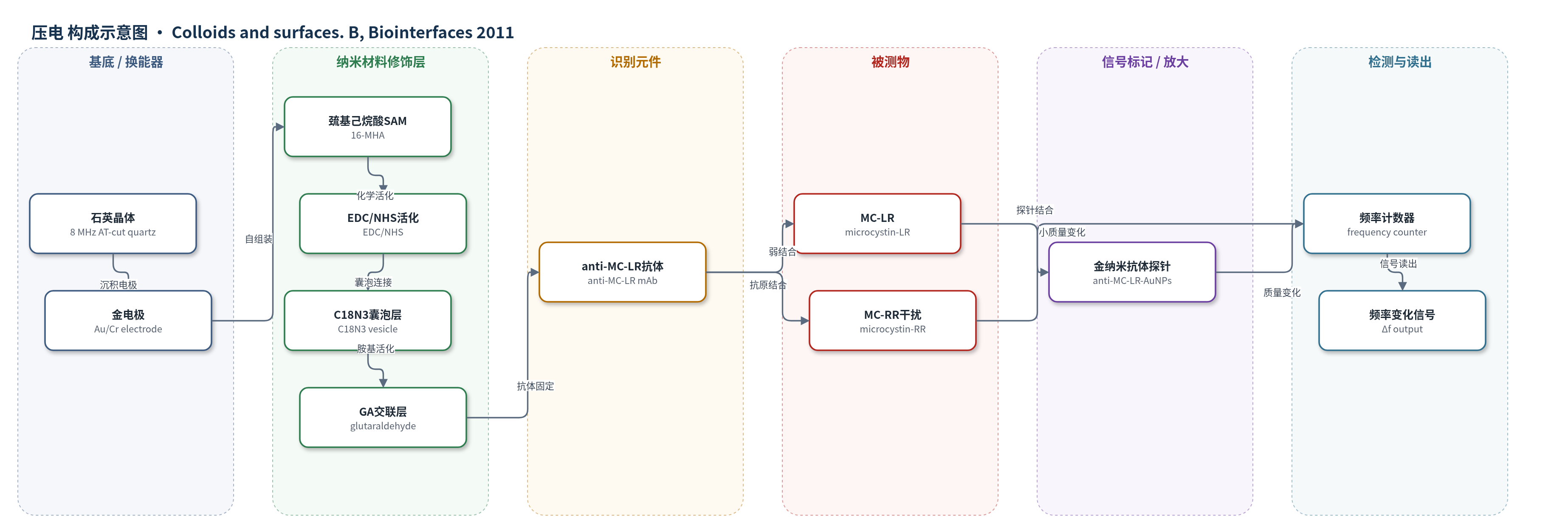
点击图片查看大图 · 依据论文自动绘制
传感器类型
压电(QCM)生物传感器
检测对象
微囊藻毒素-LR(microcystin-LR, MC-LR);样品基质:饮用水/环境水样(实验用PBS缓冲液)
检测原理
该传感器以8 MHz AT-cut石英晶体为压电换能器,依据Sauerbrey方程,界面质量增加引起共振频率下降。首先,16-巯基己烷酸在金电极上形成含羧基自组装单层,经EDC/NHS活化后与C18N3囊泡层连接;C18N3形成仿脂质体双层囊泡阵列,提供高比表面积和三维空间,使anti-MC-LR抗体高负载并保持活性,构成一级放大。样品中MC-LR与固定抗体结合后,再加入anti-MC-LR-AuNPs探针,金纳米颗粒带来显著质量增量,实现二级放大。MC-LR浓度越高,结合事件越多,频率下降越大。实验在气相模式进行,忽略耗散因子,通过频率计数器读出Δf。
检测灵敏度
LOD: 100 ng/mL(一级放大);LOD: 1 ng/mL(双重放大);线性范围: 1 ng/mL–1 μg/mL
效应效果
与裸QCM和硫脲SAM相比,C18N3囊泡修饰表面信号最大,anti-h-IgG固定后频率变化90±3 Hz,识别h-IgG后129±2 Hz。一级放大下500 ng/mL MC-LR引起37±5 Hz,BSA非特异仅8±2 Hz;二级放大后MC-LR达125±5 Hz,纯探针非特异28±4 Hz,MC-RR仅45±3 Hz,选择性良好。无放大SAM在100 ng/mL仅15±3 Hz,一级放大28±5 Hz,双重放大98±2 Hz;1、10、50 ng/mL分别产生45、56、78 Hz。anti-MC-LR-AuNPs在4°C可稳定保存1个月以上。相比HPLC/MS昂贵笨重、ELISA费时及侧流试纸条5 ng/mL,该传感器便携、低成本,适合现场水样监测。
传感器的构成
- 基底/换能器:8 MHz AT-cut石英晶体,两侧镀Cr/Au电极,作为压电换能器
- 自组装单层:16-巯基己烷酸(16-mercaptohexadecanoic acid)在金表面形成含羧基SAM,用于后续化学活化
- 活化层:EDC/NHS活化羧基形成NHS酯,用于连接C18N3囊泡胺基
- 囊泡修饰层:C18N3(bis(amidoethyl-carbamoylethyl) octadecylamine)囊泡层,形成仿脂质体双层阵列,提供高比表面积和一级放大
- 交联层:戊二醛(GA)活化囊泡胺基,用于固定抗体
- 识别元件:抗MC-LR单克隆抗体(anti-MC-LR mAb),特异性识别MC-LR
- 封闭剂:1% BSA封闭非特异结合位点
- 信号标记/二级放大:抗MC-LR金纳米颗粒偶联物(anti-MC-LR-AuNPs,12 nm AuNPs),结合MC-LR后产生质量放大
中文摘要
本文报道了一种基于石英晶体微天平(QCM)的微囊藻毒素-LR(MC-LR)免疫传感器,通过双重放大策略显著提高检测灵敏度。一级放大利用合成树枝状表面活性剂双(酰胺乙基-氨基甲酰乙基)十八烷基胺(C18N3)在QCM表面形成仿脂质体囊泡层,作为高比表面积、生物相容性良好的抗体固定基质;随后以优化浓度的抗MC-LR单克隆抗体(anti-MC-LR)功能化该囊泡界面,使一级放大下MC-LR检出限达到100 ng/mL。为进一步提高灵敏度,采用抗MC-LR金纳米颗粒(AuNPs)偶联物作为二级放大探针,其与MC-LR结合后引入较大质量,使检出限降至1 ng/mL,达到世界卫生组织对饮用水中MC-LR的推荐限值。该QCM免疫传感器具有灵敏度高、便携、操作简便和成本低等优点,适用于现场水样检测,并有望用于环境和食品安全的常规监测。
英文摘要
Enhanced sensitivity for the hepatotoxin microcystin-LR (MC-LR) was achieved in a quartz crystal microbalance (QCM) system via double amplification. For primary amplification, an innovative interface on the QCM was obtained as a matrix by the vesicle layer formed by our synthetic dendritic surfactant, bis (amidoethyl-carbamoylethyl) octadecylamine (C18N3). The vesicle matrix was then functionalised by an optimised concentration of monoclonal antibodies against MC-LR (anti-MC-LR) to detect the analyte. The results showed that a detection limit of 100 ng/mL was achieved by primary amplification. To achieve higher sensitivity, secondary amplification was implemented with anti-MC-LR gold nanoparticle (AuNPs) conjugates as probes, which lowered the detection limit for MC-LR to 1 ng/mL (the maximum concentration recommended by the World Health Organization [WHO] in drinking water for humans). The QCM immunosensor reported here has advantages such as high sensitivity, portability, simplicity, and cost-effectiveness for MC-LR detection. It would be uniquely superior compared with current MC-LR detection techniques for on-the-spot water detection. Furthermore, the methodology described here is also potentially significant in many fields for the routine monitoring of environmental and food safety.