组成图示
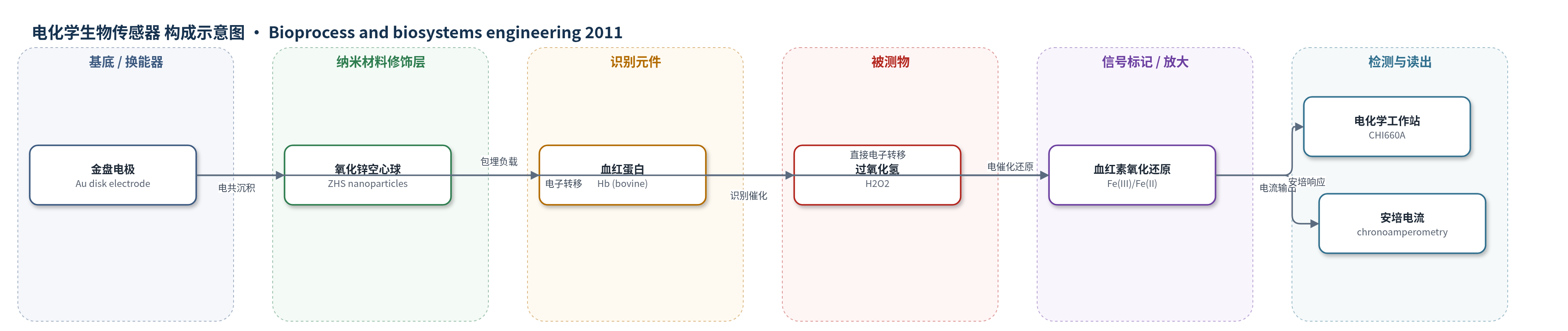
点击图片查看大图 · 依据论文自动绘制
传感器类型
电化学生物传感器
检测对象
过氧化氢(Hydrogen peroxide, H2O2),样品基质为0.1 M磷酸盐缓冲液(PBS,pH 7.0)
检测原理
Hb包埋于ZHS纳米颗粒中并电共沉积于金电极表面。ZHS的高比表面积和生物相容性使Hb保持天然结构,促进血红素中心与电极间直接电子转移,形成准可逆Fe(III)/Fe(II)氧化还原峰。当H2O2加入PBS时,Hb作为血红素蛋白在-0.45 V下电催化还原H2O2,发生质子耦合电子转移(HbFe(III)+H+ + e- → HbFe(II)),还原电流随H2O2浓度增加而增大。ZHS基质提高单位面积Hb负载量、加快电子转移和传质,使安培电流在5 s内达到稳态,并在2.1×10^-6–5.18×10^-3 mol/L范围内线性响应。
检测灵敏度
LOD: 7.0 × 10^-7 M (S/N = 3);线性范围: 2.1 × 10^-6–5.18 × 10^-3 M;灵敏度斜率: -0.936 μA/μM;R^2 = 0.9993 (n = 31)
效应效果
该传感器响应快,5 s内达到稳态电流的95%。与文献H2O2传感器相比,其线性范围更宽、检出限更低,优于Hb–PCL/GC(2×10^-6–3×10^-5 M,LOD 6.07×10^-6 M)、GNSs/APTES/ITO(5×10^-6–1×10^-3 M,LOD 3.4×10^-6 M)和Hb/MCMS/GCE(6.9×10^-5–2.3×10^-2 M,LOD 2.1×10^-5 M)。表1中其LOD为0.7 μM、线性范围2.1–5180 μM,在ZnO纳米复合H2O2传感器中表现突出。抗干扰良好,0.2 mM L-半胱氨酸、L-酪氨酸、乙醇、葡萄糖、乙酸、抗坏血酸与0.2 mM H2O2共存时电流比为0.98、0.96、0.97、1.03、1.00、1.02。4°C PBS保存5天、2周、1个月后响应下降3.5%、8.8%、16.3%,作者认为其具有高灵敏度、良好重现性和长期稳定性。
传感器的构成
- 基底/换能器电极:金盘电极(Au disk electrode,φ=4 mm),经氧化铝抛光和电化学清洗,提供导电基底与电子转移界面。
- 纳米材料修饰层:氧化锌空心球(ZnO hollow spheres, ZHS)纳米颗粒,直径约150 nm,电共沉积于Au表面,形成高比表面积、生物相容性多孔基质,增强Hb负载并促进直接电子转移。
- 识别/催化元件:血红蛋白(Hemoglobin, Hb,牛血来源),包埋于ZHS中,保留天然结构,作为血红素蛋白识别并电催化还原H2O2。
- 信号标记物:无外加标记物;Hb自身Fe(III)/Fe(II)氧化还原对直接产生安培信号。
- 电解质介质:0.1 M磷酸盐缓冲液(PBS,pH 7.0),提供质子耦合电子转移环境,工作电位-0.45 V下实现H2O2还原。
中文摘要
本文首先制备氧化锌空心球(ZnO hollow spheres, ZHS),并将血红蛋白(Hemoglobin, Hb)包埋于ZHS纳米颗粒中,构建新型安培法过氧化氢生物传感器。采用透射电镜研究其组成、形貌和尺寸,原子力显微镜观察膜表面形貌,紫外-可见吸收光谱、循环伏安法和计时电流法表征传感器性能。结果表明ZHS纳米颗粒提高了过氧化氢传感器性能。根据电子转移系数α和表观异相电子转移速率常数Ks计算,Hb在ZHS中的α为0.5,Ks为3.1 s^-1。在优化条件下,传感器对H2O2具有2.1×10^-6至5.18×10^-3 mol/L的宽线性范围,检出限为7.0×10^-7 mol/L(S/N=3)。结果表明ZHS基质可提高蛋白负载量并保持生物活性,显著促进直接电子转移,这归因于其独特形貌、高比表面积和生物相容性。所得传感器具有高灵敏度、良好重现性和长期稳定性。
英文摘要
ZnO hollow spheres were firstly prepared. A new type of amperometric hydrogen peroxide biosensor was fabricated by entrapping Hemoglobin (Hb) through the ZnO hollow spheres (ZHS) nanoparticles. The composition morphology and size were studied by transmission electron microscopy. The surface topography of the prepared films was imaged by atomic force microscope (AFM). Several techniques, including UV-vis absorption spectroscopy, cyclic voltammetry, chronoamperometry were employed to characterize the performance of the biosensor. The results indicated that the ZHS nanoparticles had enhanced the performance of the hydrogen peroxide sensors. The electrochemical parameters of Hb in the ZHS were calculated by the results of the electron-transfer coefficient (α) and the apparent heterogeneous electron-transfer rate constant K (s) as 0.5 and 3.1 s(-1), respectively. The resulting biosensors showed a wide linear range from 2.1 × 10(-6) to 5.18 × 10(-3) M, with a low detection limit of 7.0 × 10(-7) M (S/N = 3) under optimized experimental conditions. The results demonstrated that the ZHS matrix may improve the protein loading with the retention of bioactivity and greatly promote the direct electron transfer, which can be attributed to its unique morphology, high specific surface area, and biocompatibility. The biosensor obtained from this study possesses high sensitivity, good reproducibility, and long-term stability.