组成图示
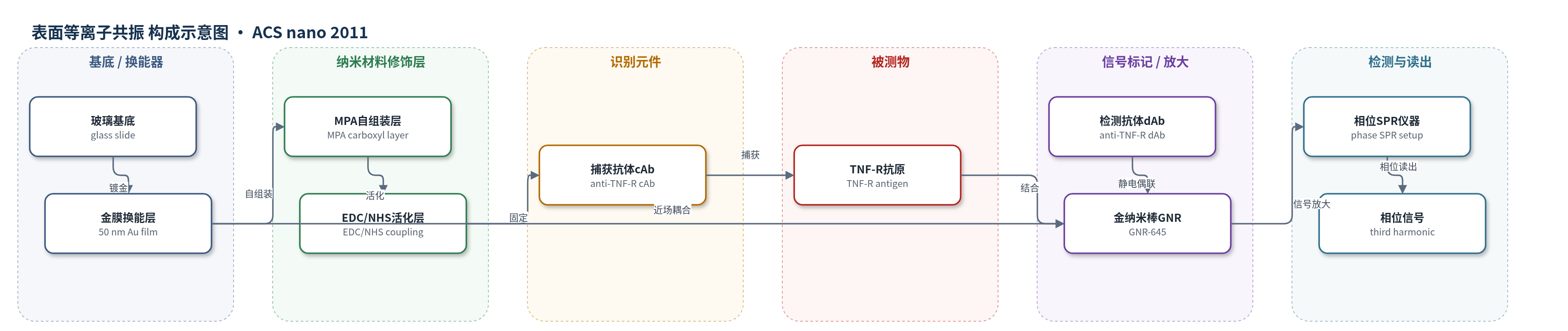
点击图片查看大图 · 依据论文自动绘制
传感器类型
表面等离子共振(SPR)生物传感器
检测对象
肿瘤坏死因子 alpha 抗原(TNF-R,TNF-α);样品基质:PBS 缓冲液(模拟生物流体,如血清)
检测原理
传感膜表面固定捕获抗体 cAb,TNF-R 抗原特异性结合后改变金膜界面折射率,引起 SPR 相位变化;随后加入 dAb 偶联 GNR-645,dAb 与 TNF-R 另一表位结合,使 GNR 靠近金膜。GNR 纵向局域等离激元与金膜表面等离激元发生近场耦合,扩展等离激元场并在 GNR 尖端增强局部场,显著扰动 SPR 相位,实现夹心免疫放大。相位探测 SPR 系统监测反射光相位/第三谐波信号,信号随 TNF-R 浓度增加而增大,GNR 标签使灵敏度提高 14–40 倍。
检测灵敏度
LOD: 0.03 pM (0.5 ng/mL);检测浓度: 0.5, 5, 25, 50 ng/mL;信号变化: 2–30 units;增强倍数: 14–40-fold
效应效果
该传感器通过夹心免疫策略检测 TNF-R,控制实验显示未加抗原时 cAb 与 dAb-GNR 间反应显著降低,表明信号主要来自特异性免疫结合而非非特异吸附。GNR-Ab 放大标签使 SPR 信号增强 14–40 倍,低浓度下增强更明显;最低检测浓度为 0.5 ng/mL(0.03 pM),较传统免疫分析方法高约 1–2 个数量级。文中未报告 RSD、长期稳定性、实际生物样品加标回收率或与 ELISA/HPLC/qPCR 的直接定量对比。作者认为该灵敏度足以监测 TNF-R 微小变化,可用于癌症早期诊断、癌症生物学研究和药物治疗进展评估,并可将 GNR 放大策略推广至其他生物分子相互作用检测。
传感器的构成
- 基底/换能器:玻璃片上 50 nm 金膜(glass/Au film),作为 SPR 换能膜
- 自组装修饰层:3-巯基丙酸(MPA)在金表面形成羧基功能化层,用于后续偶联
- 交联活化层:EDC/NHS 活化羧基形成胺反应性中间体,用于固定抗体
- 识别元件:捕获抗体 cAb(单克隆抗人 TNF-R 抗体)固定于传感膜,特异性捕获 TNF-R
- 信号标记/放大元件:检测抗体 dAb 偶联金纳米棒 GNR-645(GNR-Ab),通过静电作用偶联,结合捕获的 TNF-R 并产生等离激元耦合放大
- 读出:相位探测 SPR 系统(phase-sensitive SPR setup),监测反射光相位/第三谐波信号
中文摘要
本研究报道了一种纳米颗粒增强生物传感器,将纳米颗粒与免疫分析传感技术整合到相位探测表面等离子共振(SPR)系统中,用于检测低至飞摩尔范围的抗原。研究证明,由金膜向金纳米棒(GNR)延伸的等离激元场可显著提高灵敏度。抗体功能化传感膜与抗体偶联 GNR 构成等离激元耦合对,可作为癌症相关疾病检测的超灵敏夹心免疫分析工具。实验发现,生物偶联 GNR 标签使肿瘤坏死因子 alpha(TNF-R)抗原信号较传统 SPR 技术增强 40 倍以上。通过模拟传感膜与 GNR 之间的近场耦合分析了其原理。结果表明 GNR 可作为 SPR 传感技术中有前景的放大标签。
英文摘要
In this study, we report the development of a nanoparticle-enhanced biosensor by integrating both the nanoparticles and immunoassay sensing technologies into a phase interrogation surface plasmon resonance (SPR) system for detecting antigen at a concentration as low as the femtomolar range. Our work has demonstrated that the plasmonic field extension generated from the gold film to gold nanorod (GNR) has led to a drastic sensitivity enhancement. Antibody-functionalized sensing film, together with antibody-conjugated GNRs, was readily served as a plasmonic coupling partner that can be used as a powerful ultrasensitive sandwich immunoassay for cancer-related disease detection. Experimentally, it was found that the bioconjugated GNR labels enhance the tumor necrosis factor alpha (TNF-α) antigen signal with more than 40-fold increase compared to the traditional SPR biosensing technique. The underlying principle was analyzed by simulating the near-field coupling between the sensing film and the GNR. The results have shown that GNRs were readily served as promising amplification labels in SPR sensing technology.