组成图示
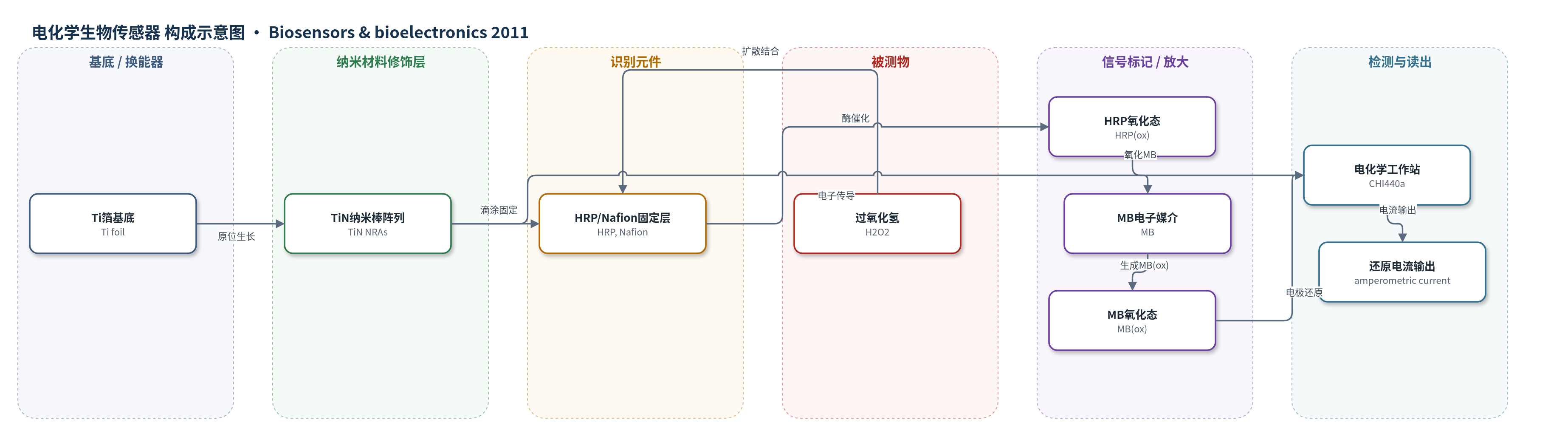
点击图片查看大图 · 依据论文自动绘制
传感器类型
电化学生物传感器
检测对象
过氧化氢(H2O2),样品基质为 0.2 M PBS(pH 7.0)缓冲液
检测原理
TiN NRAs 作为导电纳米结构电极,HRP 经 Nafion 固定于其表面。H2O2 扩散至 HRP 活性中心,被还原态 HRP 催化还原为水,同时 HRP 被氧化为 HRP(ox);HRP(ox) 氧化亚甲基蓝(MB)为 MB(ox),自身再生;MB(ox) 在 TiN NRAs 电极表面接受电子还原为 MB(red),形成安培还原电流。H2O2 浓度升高时,单位时间内生成的 MB(ox) 增多,电极还原电流随之增大。TiN 一维纳米棒阵列具有大比表面积、低电荷转移电阻和良好生物相容性,可促进酶固定、底物扩散与电子传递,从而在低电位下实现高灵敏、高选择性检测。
检测灵敏度
TiN NRAs 直接电化学 H2O2 传感:LOD: 0.5 μM(S/N = 3);线性范围: 0.5 μM–2 mM。HRP/Nafion/TiN NRAs 生物传感器:LOD: 0.05 μM;线性范围: 0.05 μM–2 μM(原文:LOD can reach to 0.05 μM;linear calibration range ... only up to 2 μM)
效应效果
TiN NRAs 直接检测 H2O2 时,-0.05 V 下 0.2 mM 尿酸和抗坏血酸对 0.2 mM H2O2 无明显干扰;线性范围 0.5 μM–2 mM 宽于碳纳米管/壳聚糖(16.7–740 μM)和普鲁士蓝(1–400 μM)电极,LOD 0.5 μM 低于碳纳米管糊电极(60 μM)、碳球/钯复合聚苯胺(5.84 μM)和聚(苯胺-co-对氨基苯酚)(1.25 μM)。HRP/Nafion/TiN NRAs 生物传感器 LOD 达 0.05 μM,30 天后保留 95% 初始电流。LAC/CS/TiN NRAs 锂空气燃料电池开路电压约 3.69 V,稳定放电约 3.19 V,高于有机电解液锂空气电池,显示多功能应用价值。
传感器的构成
- 基底/换能器电极:Ti 箔(Ti foil),提供导电基底与电子传导通路
- 纳米结构修饰层:TiN 纳米棒阵列(TiN NRAs),由 TiO2 纳米棒氨气氮化得到,提供大比表面积、导电性和生物相容界面
- 识别/催化元件:辣根过氧化物酶(HRP),催化 H2O2 还原并实现生物识别
- 固定/封闭层:Nafion,固定 HRP 并维持酶活性
- 电子媒介物:亚甲基蓝(MB),检测时加入 PBS,介导 HRP 与电极间电子传递
中文摘要
本文提出一种简便方法,通过溶剂热合成制备二氧化钛纳米棒阵列,并在氨气氛中高温氮化,原位获得生物相容性氮化钛纳米棒阵列(TiN NRAs)。TiN NRAs 因良好电子导电性和大表面积而成为潜在优异纳米结构电极。该电极对过氧化氢(H2O2)表现出优越电催化活性和高选择性,直接电化学检测 H2O2 的检出限为 0.5 μM。同时,TiN NRAs 与辣根过氧化物酶(HRP)具有优异生物相容性,用于构建高灵敏 H2O2 酶生物传感器,检出限可达 0.05 μM。此外,基于 TiN NRAs 与漆酶(LAC)的组合,探索了新型生物催化阴极锂空气燃料电池(bio-Li–air fuel cell)用于电化学能量转换。结果表明,TiN NRAs 可作为多功能生物电化学应用的优异纳米结构电极。
英文摘要
In this study, a facile method is proposed to fabricate biocompatible TiN nanorod arrays through solvent-thermal synthesis and subsequent nitridation in ammonia atmosphere. The TiN nanorod arrays are potential excellent nanostructured electrodes owing to their good electronic conductivity and large surface area. These nanostructured electrodes not only deliver superior electrocatalytic activity (the limit of detection, LOD is 0.5 μM) and highly selective sensing towards H(2)O(2), but also exhibit excellent biocompatibility with horseradish peroxidase (HRP) in a highly sensitive enzymatic biosensor for H(2)O(2) (the LOD can reach to 0.05 μM). Furthermore, a novel biocatalytic cathode based Li air fuel cell (bio-Li-air fuel cell) is explored based on the combination of TiN nanorod arrays and laccase (LAC) for electrochemical energy conversion. These results demonstrate that TiN nanorod arrays can be served as excellent nanostructured electrodes for multifunctional bioelectrochemical applications.