组成图示
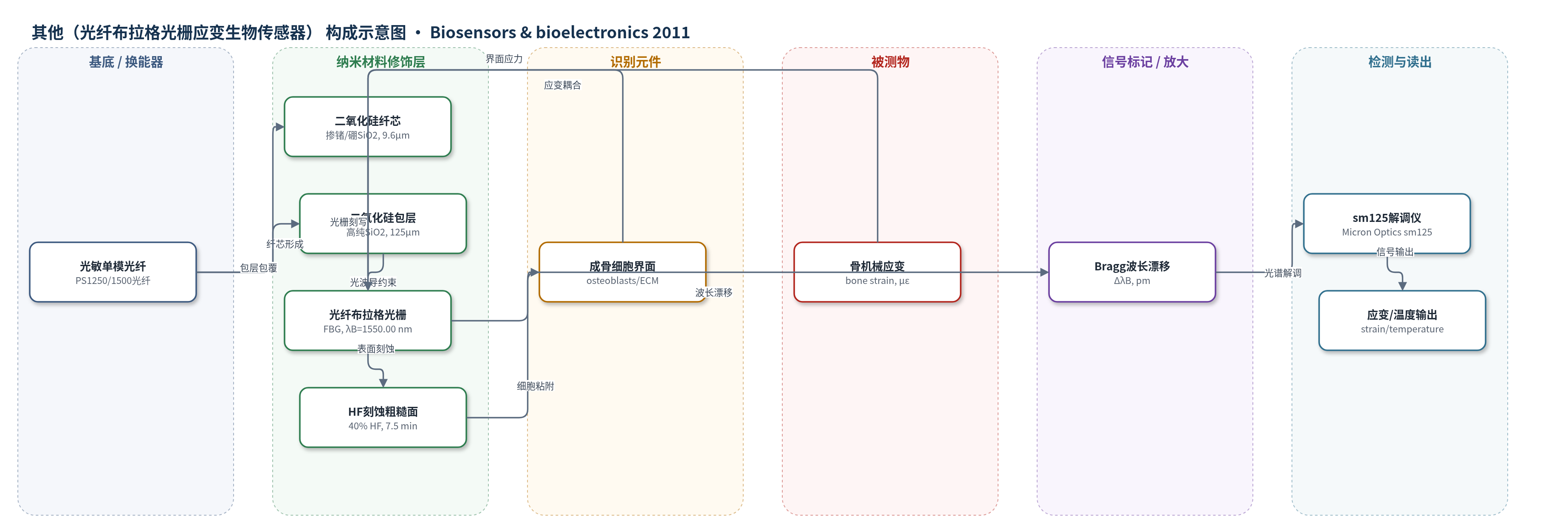
点击图片查看大图 · 依据论文自动绘制
传感器类型
其他(光纤布拉格光栅应变生物传感器)
检测对象
骨机械应变(bone strain, με);样品基质:体外人成骨细胞/骨组织环境(模拟骨力学环境)
检测原理
FBG 是光纤纤芯内的折射率周期调制结构。宽带光入射时,满足布拉格条件 λB=2neffΛ 的波长被反射,其余透射。当光纤受到纵向应变 εz 或温度 T 作用时,纤芯有效折射率 neff 和光栅周期 Λ 发生变化,使反射 Bragg 波长发生漂移 ΔλB。该漂移与应变近似线性,典型锗硅光纤在 1550 nm 附近理论灵敏度约 1.2 pm/με,本文实验斜率为 (1.35±0.01) pm/με。解调仪监测反射光谱峰值波长,即可换算骨组织所受应变;温度会引入交叉敏感,因此实验在 37 ℃恒温下进行。该传感器无生物识别元件和化学放大,属于物理光学换能。
检测灵敏度
理论应变灵敏度: 1.2 pm/με;灵敏度斜率: (1.35 ± 0.01) pm/με;最小可测应变: ±7.4 με;线性范围: 0–2343.8 με;R = 0.99982
效应效果
FBG 在 21 天人骨髓成骨细胞培养中保持物理完整性和传感功能,培养前后反射光谱模式一致;培养期间应变读数低于系统灵敏度限(±7.4 με),说明细胞层未产生足够拉伸。与电阻应变片相比,FBG 具有更宽动态范围、被动工作、抗静电/电磁/射频干扰、化学稳定、长期存活、可多路复用和细径优势。成骨细胞在裸光纤和聚合物涂层上粘附、增殖、ALP 活性、矿化及 Col I、ALP、BMP-2、M-CSF、RANKL、OPG 表达均与标准培养板对照相似,提示其具备体内骨整合和骨机械动力学监测潜力。
传感器的构成
- 换能器基底:光敏单模光纤(FiberCore PS1250/1500),纤芯为掺锗/硼二氧化硅(9.6 μm),包层为高纯二氧化硅(125 μm),承载光栅并传导光信号
- 传感元件:光纤布拉格光栅(FBG),纤芯内折射率周期调制,Bragg 波长 1550.00 nm,将应变/温度转换为反射波长漂移
- 表面修饰层:缓冲氢氟酸(HF, 40%)湿化学刻蚀形成的粗糙二氧化硅表面,用于提高成骨细胞粘附
- 保护涂层:内层聚氨酯丙烯酸酯(urethane acrylate)与外层环氧丙烯酸酯(epoxy acrylate)聚合物,提供机械保护并评估细胞相容性
- 生物界面:人骨髓成骨细胞或 MG63 成骨样细胞及其细胞外基质,模拟骨组织环境并验证生物相容性
- 读出系统:Micron Optics sm125 光栅解调仪,采集反射光谱,波长分辨率 10 pm,输出 Bragg 波长/应变信号
中文摘要
光纤布拉格光栅(FBG)是记录在标准光纤纤芯内的光学传感器,可忠实地响应应变和温度变化,是评估体内骨力学的有前景替代方法。然而,骨细胞/骨组织对 FBG 的响应及其在该环境中的传感能力此前尚未见报道。本研究在长期人成骨细胞培养中考察了这些问题。结果表明,成骨细胞能够在光纤及其保护聚合物涂层上粘附并增殖;RT-PCR 显示培养物表达 Col I、ALP、BMP-2、M-CSF、RANKL 和 OPG,并呈现高 ALP 活性及磷酸钙矿化细胞外基质形成。无论光纤是否带涂层,细胞行为均与标准组织培养板对照组相似。除优异的成骨细胞相容性外,FBG 在培养期间保持物理完整性和传感功能,其传感能力未受影响。结果提示光纤/FBG 具有体内骨整合潜力,可应用于骨机械动力学监测。
英文摘要
Fibre Bragg Grating (FBG) is an optical sensor recorded within the core of a standard optical fibre, which responds faithfully to strain and temperature. FBG sensors are a promising alternative to other sensing methodologies to assess bone mechanics in vivo. However, response of bone cells/bone tissue to FBGs and its sensing capability in this environment have not been recorded yet. The present study addressed these issues in long-term human osteoblastic cell cultures. Results showed that osteoblastic cells were able to adhere and proliferate over the fibre and, also, the protective polymer coating. RT-PCR analysis showed the expression of Col I, ALP, BMP-2, M-CSF, RANKL and OPG. In addition, cultures presented high ALP activity and the formation of a calcium phosphate mineralized extracellular matrix. Cell behavior over the fibre without and with the coating polymer was similar to that found in cultures grown in standard tissue culture plates (control). In addition to the excellent osteoblastic cytocompatibility, FBGs maintained the physical integrity and functionality, as its sensing capability was not affected through the culture period. Results suggest the possibility of in vivo osseointegration of the optical fibre/FBGs anticipating a variety of applications in bone mechanical dynamics.