组成图示
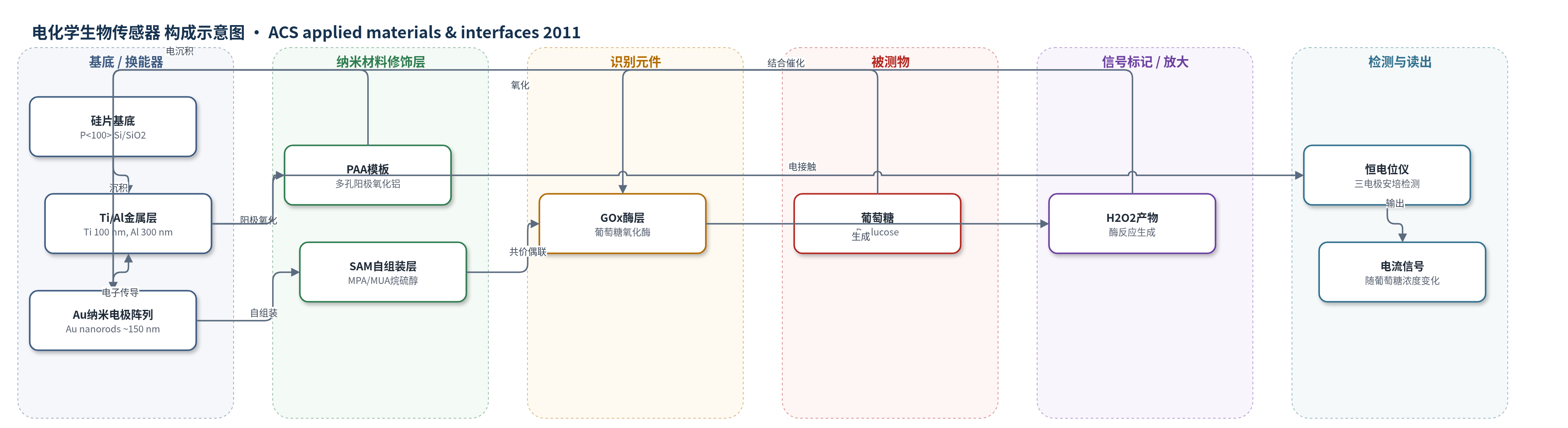
点击图片查看大图 · 依据论文自动绘制
传感器类型
电化学生物传感器
检测对象
葡萄糖(glucose/D-glucose);样品基质:PBS 缓冲液(pH 7.4),文中讨论血液与生物反应器应用
检测原理
葡萄糖生物传感器以 GOx 为识别元件。GOx 催化 D-葡萄糖与 O2 反应生成 D-葡萄糖酸和 H2O2;H2O2 在 Au NEA 工作电极表面于 +500 mV 下发生氧化反应,释放电子并产生安培电流。电子经 Au 纳米电极、Ti 导电底层传输至恒电位仪,电流大小随葡萄糖浓度增加而增大。SAM 的链长和组成决定酶固定密度及电极/溶液界面的电子转移阻力:短链 MPA 形成的 SAM 较疏松,电子转移阻力小,灵敏度高;长链 MUA 形成更致密的绝缘层,显著降低电流;MPA/MUA 混合比例可系统调节灵敏度、线性范围和检出限,从而实现面向不同浓度区间的传感设计。
检测灵敏度
LOD: 0.1 mM(GOx-MPA-Au NEA-PAA);线性范围: 1–21 mM;灵敏度: 0.47 nA mM^-1 cm^-2。LOD: 3.1 mM(GOx-MPA/MUA 6:1-Au NEA-PAA);线性范围: 15–45 mM;灵敏度: 0.11 nA mM^-1 cm^-2。LOD: 12.4 mM(GOx-MPA/MUA 3:1-Au NEA-PAA);线性范围: 28–65 mM;灵敏度: 0.04 nA mM^-1 cm^-2。H2O2 灵敏度: 裸 Au NEA 144 nA mM^-1 cm^-2;MPA 69.2 nA mM^-1 cm^-2;MUA 23.9 nA mM^-1 cm^-2。
效应效果
实验在 PBS(pH 7.4)中进行,三电极安培检测。GOx-MPA-Au NEA-PAA 的葡萄糖检出限为 0.1 mM,线性范围 1–21 mM,灵敏度 0.47 nA mM^-1 cm^-2,可覆盖健康人血糖 3.6–7.5 mM 和糖尿病 1.1–19.4 mM;MPA/MUA 6:1 传感器 LOD 3.1 mM、线性范围 15–45 mM、灵敏度 0.11 nA mM^-1 cm^-2;MPA/MUA 3:1 传感器 LOD 12.4 mM、线性范围 28–65 mM、灵敏度 0.04 nA mM^-1 cm^-2,适合生物反应器 20–50 mM 葡萄糖监测。与文献中 Au 宏盘、微盘和纳米电极阵列相比,其线性范围具有优势。文中未报告实际样品回收率、长期稳定性或选择性实验,但提出后续可加入阴离子排斥层降低电活性内源干扰。
传感器的构成
- 基底/换能器电极:P<100> Si 硅片(5 μm)与 SiO2(500 nm),Ti(100 nm)导电底层和 Al(300 nm)阳极氧化层,Ti 提供电接触
- 模板/绝缘间隔层:多孔阳极氧化铝(PAA),孔径约20 nm,作为绝缘介质分隔金纳米电极
- 纳米电极:Au 纳米棒/纳米电极阵列(NEA),长度约150 nm,电沉积于 PAA 孔中并经 Ar 离子刻蚀露出尖端
- 识别/固定层:烷硫醇自组装单分子层(SAM),短链 MPA(3-mercaptopropionic acid)、长链 MUA(11-mercaptoundecanoic acid)或 MPA/MUA 6:1、3:1 混合层,通过 Au-S 键固定并提供羧基
- 识别元件:葡萄糖氧化酶(GOx),经 EDC/NHS 活化 SAM 末端羧基后共价偶联,催化葡萄糖氧化
- 信号产物:H2O2,GOx 催化葡萄糖与 O2 反应生成,在 Au NEA 表面氧化产生安培电流
中文摘要
高密度导电纳米电极阵列(NEA)已被用于多种电化学传感体系,但可扩展的制备方法和稳健的生物功能化方案仍不足,限制了其在生物传感中的商业可行性。本文提出一种无光刻纳米制备方案,利用多孔阳极氧化铝(PAA)模板在硅片上制备大面积金纳米电极阵列(Au NEA)。为验证其作为电化学葡萄糖生物传感器的有效性,采用烷硫醇自组装单分子层(SAM)将葡萄糖氧化酶(GOx)共价固定于 Au NEA 表面,用于葡萄糖检测。通过在酶固定体系中引入不同比例的长链 SAM(11-巯基十一烷酸,MUA)与短链 SAM(3-巯基丙酸,MPA),可调控传感器的灵敏度与线性检测范围。该简便的 Au NEA 制备工艺适合与电子器件集成,且基于混合长度酶偶联 SAM 的性能可调性,使 Au NEA 转变为通用型葡萄糖生物传感器,有望用于医疗健康和生物能源等需要不同传感能力的实际场景。
英文摘要
High-density arrays of conducting nanoelectrodes (i.e., nanoelectrode arrays [NEAs]) have been developed on the surface of a single electrode for numerous electrochemical sensing paradigms. However, a scalable fabrication technique and robust biofunctionalization protocol are oftentimes lacking and thus many NEA designs have limited efficacy and overall commercial viability in biosensing applications. In this report, we develop a lithography-free nanofabrication protocol to create large arrays of Au nanoelectrodes on a silicon wafer via a porous anodic alumina template. To demonstrate their effectiveness as electrochemical glucose biosensors, alkanethiol self-assembled monolayers (SAMs) are used to covalently attach the enzyme glucose oxidase to the Au NEA surface for subsequent glucose sensing. The sensitivity and linear sensing range of the biosensor is controlled by introducing higher concentrations of long-chain SAMs (11-mercaptoundecanoic acid: MUA) with short-chain SAMs (3-mercaptopropionic acid: MPA) into the enzyme immobilization scheme. This facile NEA fabrication protocol (that is well-suited for integration into electronic devices) and biosensor performance controllability (via the mixed-length enzyme-conjugated SAMs) transforms the Au NEAs into versatile glucose biosensors. Thus these Au NEAs could potentially be used in important real-word applications such as in health-care and bioenergy where biosensors with very distinct sensing capabilities are needed.