组成图示
点击图片查看大图 · 依据论文自动绘制
传感器类型
电化学生物传感器
检测对象
迷迭香酸(Rosmarinic acid, RA);样品基质:药物样品(留兰香提取物糖浆)及磷酸盐缓冲液标准溶液
检测原理
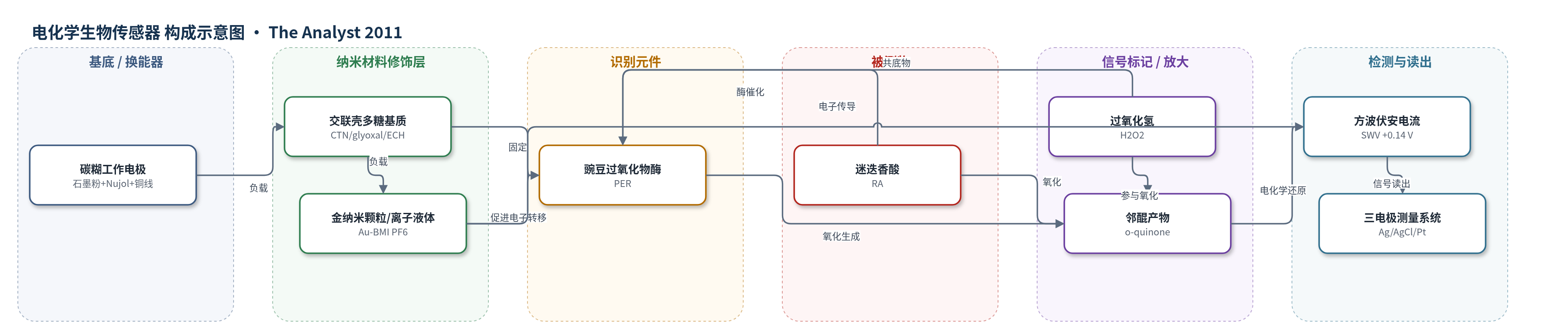
该传感器以固定于Au-BMI PF6-CTN基质中的豌豆过氧化物酶(PER)为识别元件。样品中的迷迭香酸(RA)在电极表面与PER接触,并在过氧化氢(H2O2)存在下被酶催化氧化为邻醌(o-quinone)。该氧化反应使RA浓度转化为可电化学还原的邻醌量;邻醌在+0.14 V(vs Ag/AgCl)处接受电子还原,产生方波伏安峰电流。电流大小与RA浓度成正比。Au纳米颗粒促进酶与电极间的电子转移,BMI PF6离子液体提供高导电微环境,交联壳多糖稳定酶并维持其催化活性,从而增强信号响应。
检测灵敏度
LOD: 70.09 nM;LOQ: 0.23 mM;线性范围: 0.50–23.70 mM;斜率: 8.56(±0.03)×10^5 mA M^-1;R = 0.9993
效应效果
传感器对药物样品中抗坏血酸、苯甲酸、七叶苷、木犀草素、芦丁、绿原酸和没食子酸选择性良好:1:1时信号变化<±3.0%,1:3或1:10时<±6.5%。室温保存120天响应保持85.0%,前30天>96.1%,60天90.5%;重复性RSD 2.7%,重现性RSD 4.9%。标准加入法测定三种药物糖浆,RA回收率98.4%–106.3%,含量分别为1.77±0.001、1.80±0.001、1.72±0.002 mM,与标签值1.79 mM相对误差<±3.9%。相比文献漆酶/BMI PF6传感器(LOD 0.19 mM,斜率5.63×10^5 mA M^-1),本方法检出限更低、斜率更高,适合药物样品中RA快速低成本测定。
传感器的构成
- 工作电极基底:石墨粉(graphite powder)与Nujol碳糊,压入塑料管并插入铜线,提供导电基底与电接触。
- 纳米材料修饰层:金纳米颗粒/1-丁基-3-甲基咪唑六氟磷酸盐离子液体(Au-BMI PF6),负载于CTN中,促进电子转移并提供催化微环境。
- 生物聚合物基质:化学交联壳多糖(CTN,经glyoxal和epichlorohydrin交联),作为酶固定化载体并稳定PER。
- 识别元件:豌豆过氧化物酶(PER,Pisum sativum),固定于Au-BMI PF6-CTN中,催化RA氧化。
- 共底物/反应试剂:过氧化氢(H2O2),驱动PER催化RA氧化为邻醌。
- 信号产物:邻醌(o-quinone),在+0.14 V vs Ag/AgCl处电化学还原,产生与RA浓度成正比的电流。
- 支持电解质:0.1 M磷酸盐缓冲液(PBS,pH 7.0),维持酶活性和离子导电。
中文摘要
将金纳米颗粒分散于1-丁基-3-甲基咪唑六氟磷酸盐离子液体(BMI PF6)中形成Au-BMI PF6,并负载于经乙二醛和环氧氯丙烷化学交联的壳多糖(CTN)中,获得新型负载离子液体相(SILP)催化材料。该材料具有高催化活性,并为酶固定化提供优良微环境。以Au-BMI PF6-CTN为基质固定豌豆(Pisum sativum)过氧化物酶(PER),构建用于方波伏安法测定药物样品中迷迭香酸(RA)的电化学生物传感器。在过氧化氢存在下,PER催化RA氧化为相应邻醌,邻醌在+0.14 V(vs Ag/AgCl)处发生电化学还原。优化条件下,峰电流在RA浓度0.50–23.70 mM范围内线性增加,检出限为70.09 nM。传感器具有较高灵敏度、良好重复性与重现性,以及长期稳定性(120天响应下降15%)。方法成功用于药物样品中RA含量测定,回收率为98.3%–106.2%。其良好分析性能归因于PER在改性CTN基质中的有效固定、离子液体的高导电性、金纳米颗粒促进电子转移以及材料固有催化能力。
英文摘要
Gold nanoparticles dispersed in 1-butyl-3-methylimidazolium hexafluorophosphate ionic liquid (Au-BMI·PF(6)) were supported in chitin (CTN) chemically crosslinked with glyoxal and epichlorohydrin to obtain a new supported ionic liquid phase (SILP) catalyst with high catalytic activity, and providing an excellent environment for enzyme immobilization. This modified biopolymer matrix (Au-BMI·PF(6)-CTN) was used as a support for the immobilization of the enzyme peroxidase (PER) from pea (Pisum sativum), and employed to develop a new biosensor for rosmarinic acid (RA) determination in pharmaceutical samples by square-wave voltammetry. In the presence of hydrogen peroxide, the PER catalyzes the oxidation of RA to the corresponding o-quinone, which is electrochemically reduced at a potential of +0.14 V vs. Ag/AgCl. Under optimized conditions, the resulting peak current increased linearly for the RA concentration range of 0.50 to 23.70 μM with a detection limit of 70.09 nM. The biosensor demonstrated high sensitivity, good repeatability and reproducibility, and long-term stability (15% decrease in response over 120 days). The method was successfully applied to the determination of RA content in pharmaceutical samples, with recovery values being in the range of 98.3 to 106.2%. The efficient analytical performance of the proposed biosensor can be attributed to the effective immobilization of the PER enzyme in the modified CTN matrix, the significant contribution of the high conductivity of the ionic liquid, the facilitation of electron transfer promoted by gold nanoparticles, and the inherent catalytic ability of these materials.