组成图示
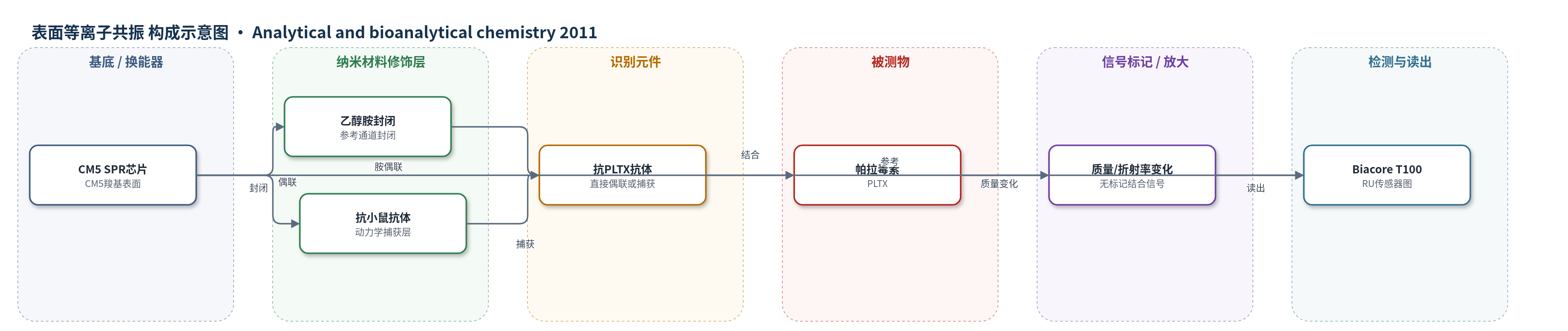
点击图片查看大图 · 依据论文自动绘制
传感器类型
表面等离子共振(SPR)生物传感器
检测对象
帕拉毒素(palytoxin, PLTX);样品基质:HBS-EP+ 缓冲液、石斑鱼(grouper)和蛤(clam)的 80% 乙醇提取液(10× 稀释)
检测原理
SPR 检测基于表面固定识别元件与目标物结合引起界面质量/折射率变化。动力学模式将抗小鼠抗体共价偶联到 CM5 表面,再捕获小鼠 anti-PLTX mAb,降低表面密度以减少多结合,获得真实亲和力;浓度模式将 anti-PLTX mAb 直接胺偶联到 CM5,提高表面密度和灵敏度。PLTX 流过表面后与抗体结合,结合量随浓度增加,SPR 共振信号以 RU 增大;停止注入后 PLTX 解离,解离速率反映亲和力。方法采用 HBS-EP+ 缓冲液、50 μL/min 流速、120 s 结合和 15 s 解离,并用 10 mM glycine-HCl pH 2.0 再生。无酶或核酸放大,主要依靠高亲和力抗体(KD 2.14×10⁻⁹ M)和高表面密度实现低 ng/mL 检测。
检测灵敏度
LOD: 0.52 ng/mL(HBS-EP+)、2.8 ng/mL(10% grouper)、1.4 ng/mL(10% clam)
效应效果
该 SPR 方法对可能共存的海产品毒素(saxitoxin、tetrodotoxin、maitotoxin、pectenotoxin、okadaic acid、dinophysistoxin 1)在 0.025 μg/mL 下无交叉反应;与 0.05 μg/mL PLTX 混合时响应与单独 PLTX 相当,无加和或竞争干扰。缓冲液、10% 石斑鱼和 10% 蛤基质中 LOD 分别为 0.52、2.8 和 1.4 ng/mL,基质中标准差较高,提示需基质匹配。检测限接近现有方法(细胞法约 5 ng/mL,溶血中和法 1 pg/mL),若提取效率足够,可低于 EFSA 建议的 30 μg/kg 贝肉限值。作者认为该方法可用于快速、灵敏、定量的 PLTX 筛查和抗体动力学表征。
传感器的构成
- 基底/换能器:CM5 SPR 芯片(羧基化表面),提供 SPR 换能与胺偶联位点
- 修饰层:乙醇胺(ethanolamine)封闭参考通道,降低非特异结合
- 捕获层(动力学模式):抗小鼠抗体(anti-mouse substrate)共价偶联,用于捕获小鼠 anti-PLTX 并便于再生
- 识别元件:小鼠单克隆抗 palytoxin 抗体(anti-PLTX mAb),直接胺偶联于 CM5 或捕获于 anti-mouse 表面
- 运行缓冲液:HBS-EP+(10 mM HEPES、150 mM NaCl、3 mM EDTA、0.05% P20),维持结合并减少非特异吸附
- 再生剂:10 mM glycine-HCl pH 2.0,洗脱 PLTX 并恢复抗体表面
- 信号标记物:无外源标记,PLTX 结合引起表面质量/折射率变化,以 RU 读出
中文摘要
帕拉毒素(palytoxin, PLTX)是从管水母 Palythoa toxica 分离的多醚类海洋毒素,为已知毒性最强的非蛋白物质之一。摄入含 PLTX 海产品可致致命中毒,皮肤和吸入暴露也与人体效应相关;PLTX 与其他海产品毒素(ciguatoxins、saxitoxins、tetrodotoxin)共存,阻碍将其与海产品疾病直接关联。目前尚无经验证的 PLTX 定量检测方法,需要稳健、特异的分析技术用于源生物、周围水体和临床样品。表面等离子共振(SPR)生物传感器适合抗体表征和定量免疫检测。本文报道新开发的 PLTX SPR 检测方法:使用抗小鼠底物表征小鼠单克隆抗 PLTX 抗体动力学参数,并将该抗体整合为快速、灵敏、选择性的 PLTX 检测。研究优化缓冲液类型、流速、结合时间和再生条件,并评估对共存海产品毒素的交叉反应。结果显示优化方法可在缓冲液及石斑鱼、蛤两种海产品基质中测定低至亚 ng/mL 的 PLTX。初步结果表明该 SPR 生物传感器可实现快速抗体表征和快速、灵敏的海产品基质 PLTX 浓度测定,方法开发信息可广泛适用于未来 PLTX 检测和抗体表征。
英文摘要
Palytoxin (PLTX), a polyether marine toxin originally isolated from the zoanthid Palythoa toxica, is one of the most toxic non-protein substances known. Fatal poisonings have been linked to ingestion of PLTX-contaminated seafood, and effects in humans have been associated with dermal and inhalational exposure to PLTX containing organisms and waters. Additionally, PLTX co-occurrence with other well-characterized seafood toxins (e.g., ciguatoxins, saxitoxins, tetrodotoxin) has hindered direct associations of PLTX to seafood-borne illnesses. There are currently no validated methods for the quantitative detection of PLTX(s). As such, a well-characterized, robust, specific analytical technique is needed for the detection of PLTX(s) in source organisms, surrounding waters, and clinical samples. Surface plasmon resonance (SPR) biosensors are ideally suited for antibody characterization and quantitative immunoassay detection. Herein, we describe a newly developed SPR assay for PLTX. An anti-mouse substrate was used to characterize the kinetic values for a previously developed monoclonal anti-PLTX. The characterized antibody was then incorporated into a sensitive, rapid, and selective PLTX assay. Buffer type, flow rate, analyte-binding time, and regeneration conditions were optimized for the antibody-PLTX system. Cross-reactivity to potentially co-occurring seafood toxins was also evaluated. We show that this optimized assay is capable of measuring low- to sub-ng/mL PLTX levels in buffer and two seafood matrices (grouper and clam). Preliminary results indicate that this SPR biosensor assay allows for (1) rapid characterization of antibodies and (2) rapid, sensitive PLTX concentration determination in seafood matrices. Method development information contained herein may be broadly applied to future PLTX detection and/or antibody characterization efforts.