组成图示
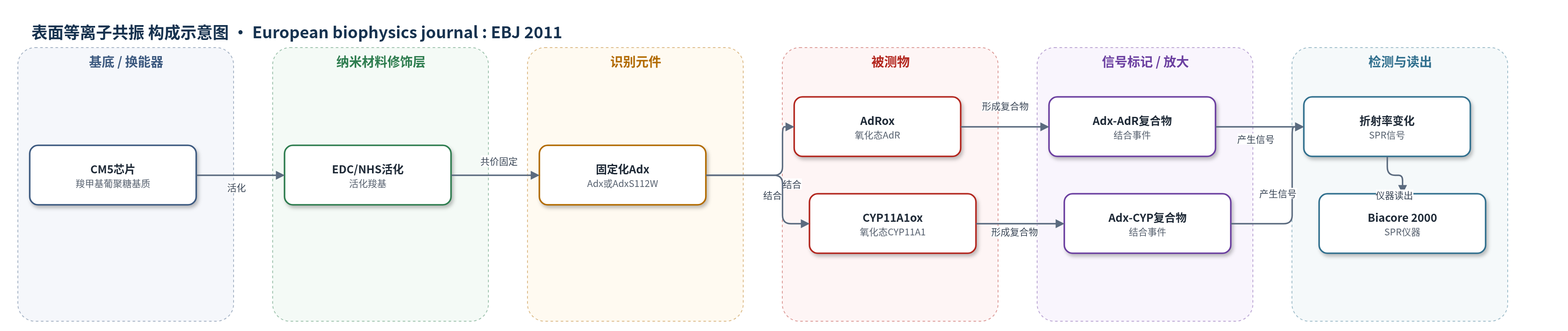
点击图片查看大图 · 依据论文自动绘制
传感器类型
表面等离子共振(SPR)生物传感器
检测对象
氧化态AdR(adrenodoxin reductase, AdRox)、氧化态CYP11A1(cholesterol side chain cleavage enzyme, CYP11A1ox);样品基质:HBS-EP缓冲液中的重组/纯化蛋白溶液
检测原理
CM5芯片表面羧基经EDC/NHS活化后,与Adx或AdxS112W的游离氨基共价结合,形成固定化识别层;乙醇胺封闭残余活性位点。将氧化态AdR或CYP11A1注入HBS-EP流动相时,其与固定化Adx发生特异性蛋白-蛋白结合,使芯片界面质量与折射率改变,SPR共振角发生偏移,Biacore 2000记录共振单位(RU)随时间的结合/解离曲线。结合速率常数kon、解离速率常数koff和Kd由曲线拟合获得。盐离子强度改变静电相互作用,突变体Trp112引入疏水/芳香堆积作用,降低koff并增强Adx/CYP11A1复合物稳定性,从而改变信号响应。
检测灵敏度
原文未报告LOD、线性范围、灵敏度斜率或相关系数。
效应效果
SPR结合参数标准误差为±5%。野生型Adx与CYP11A1的kon为691,000 M^-1 s^-1、koff为0.00926 s^-1、Kd为1.34E-08 M;突变体AdxS112W的kon为798,000 M^-1 s^-1、koff为0.00271 s^-1、Kd为3.39E-09 M,复合物稳定性提高约4倍,且比AdxS112W/AdR复合物稳定177倍。停流实验显示AdR还原表观速率约30–50 s^-1;预还原AdxS112W还原CYP11A1的相对速率随KCl升高从6.8增至89。底物转化中,200 mM KCl时突变体kcat/Km最高比野生型高14倍。作者认为该突变可增强类固醇合成电子传递效率。
传感器的构成
- 基底/换能器:CM5传感器芯片(羧甲基葡聚糖基质,Biacore 2000 SPR换能器)
- 活化层:EDC/NHS(0.2 M EDC、0.05 M NHS)活化芯片羧基
- 识别元件:固定化Adx或AdxS112W(氧化态蛋白,共价结合约200 RU)
- 封闭剂:1 M乙醇胺盐酸盐封闭残余酯基
- 运行缓冲液:HBS-EP(10 mM HEPES pH 7.4、150 mM NaCl、0.005% Surfactant P20)
中文摘要
在哺乳动物中,类固醇激素由胆固醇经线粒体CYP11A1系统代谢生成孕烯醇酮,所需还原当量由NADPH经AdR(adrenodoxin reductase)和Adx(adrenodoxin)组成的电子传递链提供。反应伙伴通过一系列瞬时相互作用实现电子从NADPH向CYP11A1的转移。本研究比较了野生型Adx与突变体AdxS112W在AdR/Adx及Adx/CYP11A1相互作用中的离子强度效应。利用表面等离子共振(SPR)、停流动力学和产物形成分析,获得了这些相互作用机制的新见解。将第112位丝氨酸替换为色氨酸使Adx/CYP11A1复合物的解离速率显著降低,Kd降低约4倍,表明突变体复合物更稳定。停流分析显示,还原态Adx与CYP11A1的结合可能是电子转移的限速步骤,预还原AdxS112W比野生型更高效。高离子强度下突变体显著增加孕烯醇酮生成,说明CYP11A1与Adx的相互作用是底物转化的限速步骤,疏水相互作用可改善结合与产物形成效率。
英文摘要
In mammals, steroid hormones are synthesized from cholesterol that is metabolized by the mitochondrial CYP11A1 system leading to pregnenolone. The reduction equivalents for this reaction are provided by NADPH, via a small electron transfer chain, consisting of adrenodoxin reductase (AdR) and adrenodoxin (Adx). The reaction partners are involved in a series of transient interactions to realize the electron transfer from NADPH to CYP11A1. Here, we compared the ionic strength effect on the AdR/Adx and Adx/CYP11A1 interactions for wild-type Adx and mutant AdxS112W. Using surface plasmon resonance measurements, stopped flow kinetic investigations and analyses of the product formation, we were able to obtain new insights into the mechanism of these interactions. The replacement of serine 112 by tryptophan was demonstrated to lead to a dramatically decreased k (off) rate of the Adx/CYP11A1 complex, resulting in a four-fold decreased K (d) value and indicating a much higher stability of the complex involving the mutant. Stopped flow analysis at various ionic strengths and in different mixing modes revealed that the binding of reduced Adx to CYP11A1 seems to display the limiting step for electron transfer to CYP11A1 with pre-reduced AdxS112W being much more efficient than wild-type Adx. Finally, the dramatic increase in pregnenolone formation at higher ionic strength using the mutant demonstrates that the interaction of CYP11A1 with Adx is the rate-limiting step in substrate conversion and that hydrophobic interactions may considerably improve this interaction and the efficiency of product formation. The data are discussed using published structural data of the complexes.