组成图示
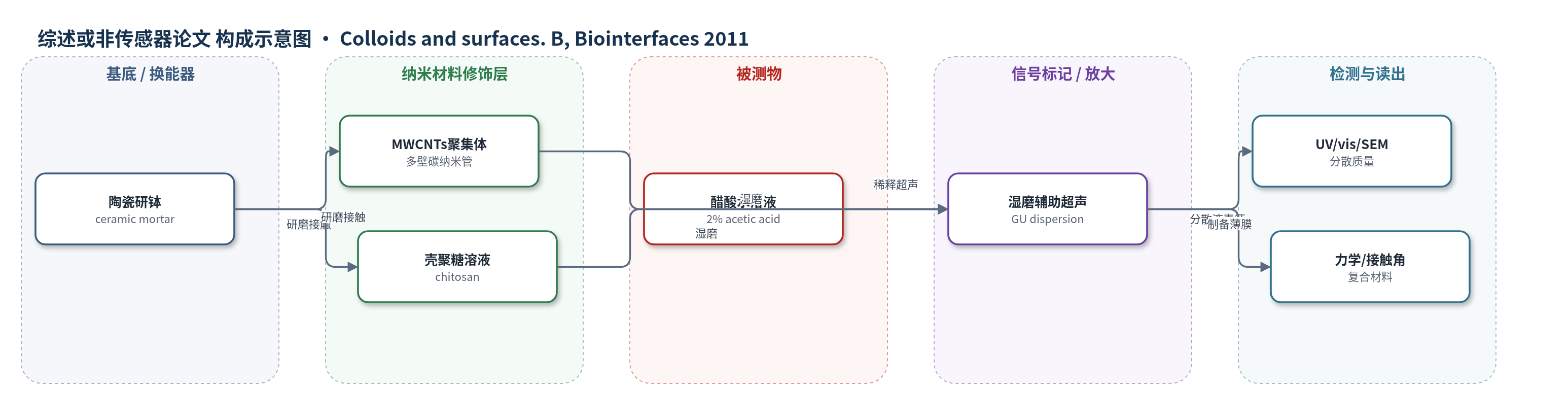
点击图片查看大图 · 依据论文自动绘制
传感器类型
综述或非传感器论文
检测对象
未报道(论文为材料分散研究,无被测物与样品基质)
检测原理
本文未报道生物传感识别事件与换能信号。其核心机制是湿磨辅助超声分散:原始MWCNTs表面疏水,聚集体表面和间隙常覆盖空气层,使超声波在气/液界面反射和衰减,难以到达管壁。湿磨使壳聚糖通过疏水作用和π-π作用吸附并包覆MWCNTs,同时破碎大聚集体;壳聚糖的氨基和羟基提高表面亲水性,接触角由139.6°降至66.3°,消除空气屏障。随后超声在湿润界面中有效传输,进一步将MWCNTs解聚为单根纳米管。分散质量通过UV/vis吸光度、SEM形貌、流变粘度和复合材料力学性能读出,而非传感信号。
检测灵敏度
未报道(无传感检测灵敏度)
效应效果
GU法制备的壳聚糖/MWCNTs悬浮液分散质量优于单独超声或湿磨。稀释至0.067 mg/mL时,GU样品260 nm吸光度最高约2.85,且吸光度随MWCNTs浓度线性增加,符合Lambert–Beer定律;SEM显示GU样品聚集体更少、单根MWCNTs更多。湿磨使MWCNTs接触角从139.6±3.3°降至66.3±0.4°,TGA显示壳聚糖包覆量由超声的约7%提高到湿磨/湿磨辅助超声的约17%和19%。2 wt% MWCNTs复合材料拉伸强度由纯壳聚糖53.0±2.2 MPa提高到77±4.5 MPa,增幅约45%。作者认为该方法可用于生物传感器等潜在应用,但未给出实际传感性能。
传感器的构成
- 基底/换能器电极:未报道;制备与表征中使用陶瓷研钵(ceramic mortar)和玻璃片(glass slide)
- 纳米材料修饰层:多壁碳纳米管(MWCNTs):作为纳米填料,经分散后用于复合材料
- 聚合物包覆/分散层:壳聚糖(chitosan):通过疏水作用与π-π作用包覆MWCNTs,提高水溶性
- 分散介质:醋酸(acetic acid)水溶液:2% (v/v) 酸性介质,使壳聚糖溶解并辅助分散
中文摘要
超声分散常用于将纳米颗粒分散于水溶液中,但超声波在气/液界面易发生反射和衰减,导致分散效果不稳定。本文报道一种湿磨辅助超声(GU)方法,先在壳聚糖(chitosan)溶液中对原始多壁碳纳米管(MWCNTs)进行湿磨,再进行超声处理。通过目视观察、紫外-可见吸收光谱和扫描电子显微镜(SEM)对分散质量进行表征。结果表明,GU法制备的壳聚糖/MWCNTs悬浮液分散质量明显优于单独超声或单独湿磨。湿磨可增强MWCNTs的水润湿性,消除其表面及聚集体间隙中的空气层对超声波传输的屏障,同时使壳聚糖更紧密包覆MWCNTs。由GU法悬浮液制备的壳聚糖/MWCNTs复合材料力学性能较纯壳聚糖显著提高。该方法简单,有望用于医用复合材料、生物纤维、生物传感器、抗菌涂层和细胞培养等生物技术领域。
英文摘要
Ultrasonication is often used to disperse nano-particles in aqueous solution. However, a good dispersion of nano-particles in aqueous solution is not always achieved, due to the fact that incoming ultrasonicwaves in liquid are usually reflected and damped at the gas/liquid interface. In this work, we report a so-called wet-grinding assisted ultrasonication (GU) method, in which wet-grinding of multi-walled carbon nanotubes (MWCNTs) in chitosan solution is carried out before ultrasonication. The dispersions of MWCNTs were characterized by visual comparison, UV/vis spectroscopy, and scanning electron microscopy (SEM). The results demonstrate that the dispersion quality of chitosan/MWCNT suspension prepared by wet-grinding assisted ultrasonication is much better than that by ultrasonication or wet-grinding alone. It was found that wet-grinding could improve the water wettability of MWCNTs and eliminate the barrier of air layer around MWCNTs to ultrasonicwaves. Meanwhile, the composite from the chitosan/MWCNTs suspension prepared by GU method has an obvious improvement in mechanical property compared to pure chitosan. This simple method for integrating MWCNTs and biocompatible chitosan into a homogeneous dispersion may have great potential application in biotechnology, such as preparing composite materials for medicine, bio-fiber, biosensor, antibacterial coating, and cell cultivation.