组成图示
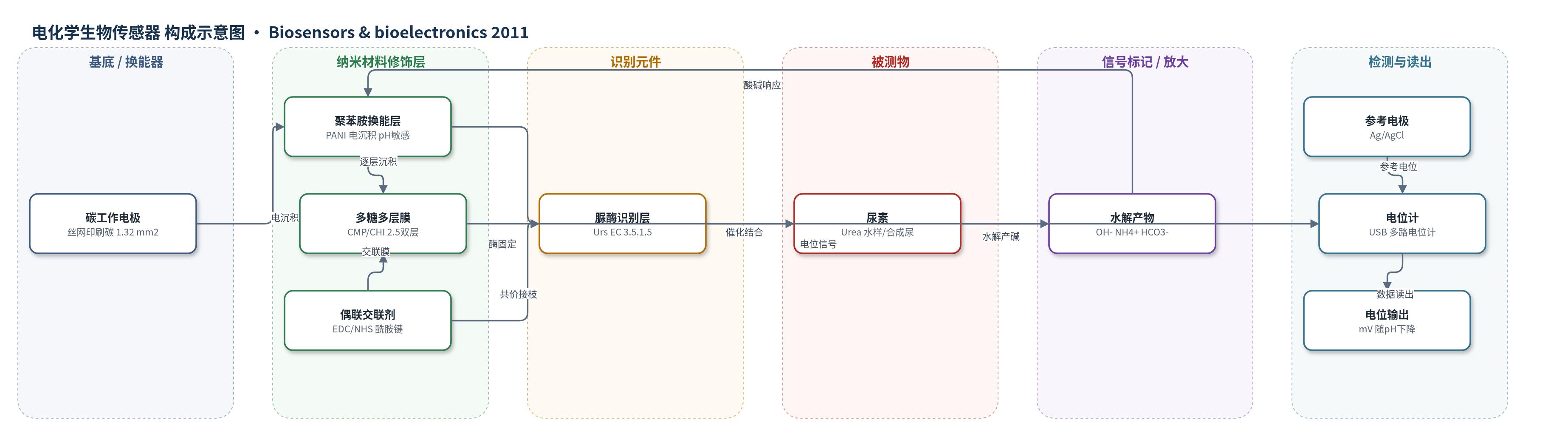
点击图片查看大图 · 依据论文自动绘制
传感器类型
电化学生物传感器
检测对象
尿素(urea);样品基质:水溶液、合成尿液(synthetic urine solution)
检测原理
脲酶(Urs)作为识别/催化元件,特异性催化尿素水解:H2N-CO-NH2 + 3H2O → 2NH4+ + HCO3- + OH-。反应在酶层内产生碱性产物,使聚苯胺(PANI)换能层附近局部pH升高。PANI是质子敏感的导电聚合物,其氧化还原/质子化状态随pH改变,导致工作电极与Ag/AgCl参考电极之间的电位按Nernst关系下降。尿素浓度越高,单位时间生成OH-越多,电位变化越大;高浓度时酶反应趋于饱和,电位进入平台,因此校准曲线呈S形。
检测灵敏度
灵敏度: 55–125 mV/decade(10^-5–10^-3 M);Table 1: 56–133 mV/decade;范围: 0.01–1 mmol L^-1(Table 1);S = 240.3 mV(PANI-Urs)、275.5 mV(PANI-EN-Urs)、219.7 mV(PANI-LbL-Urs)、111.8 mV(PANI-LbL-EN-Urs);相关系数: r > 0.999,Boltzmann 拟合 > 0.998;测量范围: 10^-6–10^-1 mol L^-1。
效应效果
响应时间小于2 min,6电极同时测试重现性好:PANI-LbL-EN-Urs 灵敏度111.8±3.8 mV,PANI-Urs、PANI-EN-Urs、PANI-LbL-Urs 为240.3±7.1、275.5±7.4、219.7±10.8 mV。稳定性上,吸附型5天后保留68%/54%、9天后42%/35%;LbL共价接枝型5天后88%、21天后78%,3周后约80%。合成尿液中PANI-Urs测得-135 mV,预期-134 mV,差<1%;其他传感器因离子干扰低估9.6%–11.3%。作者认为其灵敏度处于已发表电位型尿素传感器前列,适合生物医学应用。
传感器的构成
- 基底/换能器电极:丝网印刷碳工作电极(screen printed carbon,面积1.32 mm^2)与Ag/AgCl参考电极;碳电极用于电沉积PANI并提供电位测量界面。
- 导电聚合物换能层:电沉积聚苯胺(PANI)薄膜,由0.2 mol/L苯胺/2 mol/L HCl恒电流15 μA沉积至15 mC/cm^2,形成多孔纳米线结构,对pH/质子敏感。
- 聚电解质多层膜:羧甲基普鲁兰(CMP,阴离子多糖)与壳聚糖(CHI,阳离子多糖)逐层组装2.5双层,形成PANI-(CMP-CHI)2-CMP,保护酶并改善固定。
- 识别/催化元件:脲酶(urease,Urs,EC 3.5.1.5,jack bean),催化尿素水解产生OH-、NH4+和HCO3-,改变局部pH。
- 共价偶联/交联剂:EDC和NHS,活化CMP羧基与酶氨基形成酰胺键,同时交联LbL多糖膜,提高稳定性。
- 信号读出:自制USB电位计与多路复用器,测量工作电极与Ag/AgCl参考电极间电位变化,输出mV信号。
中文摘要
本文报道了一种基于脲酶的电位型酶生物传感器,用于水溶液中尿素浓度的定量检测,面向生物医学应用。脲酶可直接物理吸附于电沉积聚苯胺(PANI)薄膜,或先通过带电荷多糖羧甲基普鲁兰(CMP)与壳聚糖(CHI)交替沉积构建逐层组装(LbL)薄膜,再将脲酶物理吸附或经碳二亚胺偶联共价接枝于LbL膜上。传感器电位响应随水溶液中尿素浓度(10^-6–10^-1 mol/L)变化而改变,表现出高灵敏度和短响应时间。稳定性研究表明,酶共价接枝于LbL膜的传感器随时间保持更高电位响应,说明多糖包覆具有保护作用,共价接枝有利于提高传感器寿命。
英文摘要
A potentiometric biosensor based on urease was developed for the quantitative determination of urea concentration in aqueous solutions for biomedical applications. The urease was either physisorbed onto an electrodeposited polyaniline film (PANI), or immobilized on a layer-by-layer film (LbL) assembled over the PANI film, that was obtained by the alternate deposition of charged polysaccharides (carboxymethylpullulan (CMP) and chitosan (CHI)). In the latter case, the urease (Urs) enzyme was either physically adsorbed or covalently grafted to the LbL film using carbodiimide coupling reaction. Potentiometric responses of the enzymatic biosensors were measured as a function of the urea concentration in aqueous solutions (from 10(-6) to 10(-1) mol L(-1) urea). Very high sensitivity and short response time were observed for the present biosensor. Moreover, a stability study showed a higher stability over time for the potentiometric response of the sensor with the enzyme-grafted LbL film, testifying for the protective nature of the polysaccharide coating and the interest of covalent grafting.