组成图示
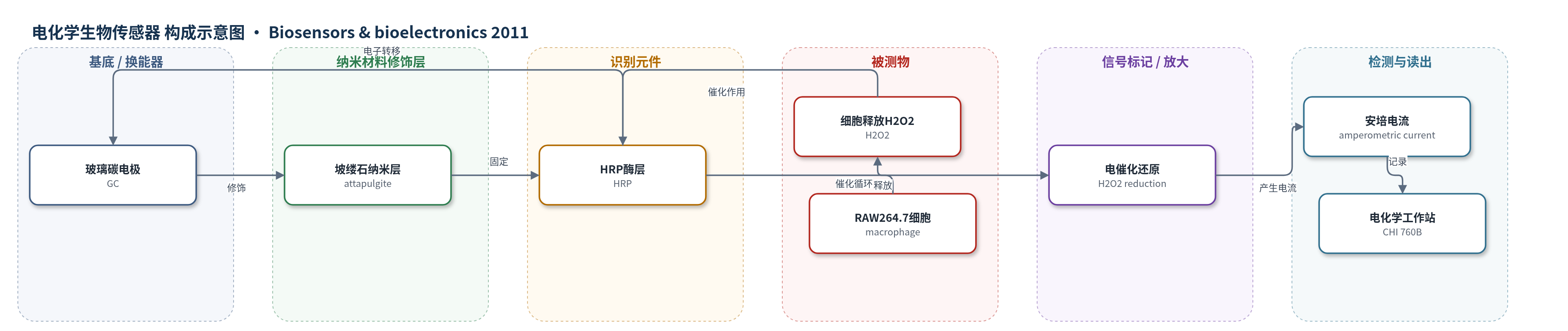
点击图片查看大图 · 依据论文自动绘制
传感器类型
电化学生物传感器
检测对象
过氧化氢(H2O2),样品基质为 RAW 264.7 巨噬细胞在 PBS 缓冲液中的释放液/细胞悬液
检测原理
传感器以玻璃碳电极为基底,坡缕石纳米层固定 HRP 并促进直接电子转移。当 RAW 264.7 细胞受 PMA 等刺激发生呼吸爆发时,细胞内生成的 H2O2 扩散至电极表面。HRP 血红素铁中心(FeIII)与 H2O2 反应生成 Compound I,Compound I 在电极上获得电子生成 Compound II,Compound II 再结合质子和电子再生 HRP-FeIII,形成催化循环。该过程将 H2O2 浓度转化为法拉第还原电流,在 -400 mV(vs. SCE)恒电位安培检测下,电流随 H2O2 浓度增加而增大,并在 0.2–150 μM 范围内线性响应。坡缕石提供高比表面积和生物相容微环境,提高酶负载与电子传递效率,酶催化循环本身实现信号放大。
检测灵敏度
LOD: ca. (0.05 ± 0.01) μM (S/N = 3);线性范围: 0.2–150 μM;斜率: (3.8 ± 0.2) μA mM−1;灵敏度: (55.8 ± 2.9) μA mM−1 cm−2;R^2 = 0.997;表观米氏常数: (0.09 ± 0.02) mM
效应效果
传感器对 H2O2 响应约 2 s 达稳态 95%,线性范围 0.2–150 μM,R^2=0.997,灵敏度 (55.8±2.9) μA mM−1 cm−2,LOD 约 (0.05±0.01) μM。-400 mV 低电位下 OCl−、NO•、ONOO−、AA 干扰可忽略。100 ng/mL PMA 刺激 RAW 264.7 细胞后最大电流 (47.3±1.6) nA,对应 H2O2 (8.2±0.5) nmol,平均通量 (48.2±2.9) amol cell−1 s−1;加入 300 U/mL 过氧化氢酶 50 μL 后信号消失,证明响应来自 H2O2。PMA 50–400 ng/mL 增加时通量升高;ADP、AA、fMLP、PMA 刺激下 H2O2 生成量依次增大,PMA 最大、ADP 最低。作者认为该平台适用于细胞 H2O2 释放动力学与氧化应激研究。
传感器的构成
- 基底电极:玻璃碳电极(GC),作为导电基底和电子转导界面
- 纳米修饰层:坡缕石(attapulgite)纳米结构,针状天然矿物,高比表面积和负电荷,固定 HRP 并促进直接电子转移
- 识别/催化元件:辣根过氧化物酶(HRP),通过静电作用负载于坡缕石表面,催化 H2O2 还原
- 信号转换元件:HRP 血红素铁中心(FeIII/Compound I/II),介导 H2O2 电催化还原并产生法拉第电流
- 支持电解质:0.1 M PBS(pH 7.4),提供离子导电和生理缓冲环境
中文摘要
本文报道了一种用于测定 RAW 264.7 巨噬细胞释放过氧化氢(H2O2)通量的电化学方法。H2O2 是生物体内重要的活性氧(ROS),其浓度变化与细胞信号转导、氧化应激及多种病理过程密切相关。作者将辣根过氧化物酶(HRP)负载于天然矿物坡缕石(attapulgite)纳米结构表面,形成 HRP-attapulgite 纳米杂化材料,并沉积在玻璃碳(GC)电极上,构建 HRP-attapulgite/GC 电化学生物传感器。该传感器通过 HRP 对释放 H2O2 的电催化还原产生安培电流,具有响应快、线性范围宽、灵敏度高、检出限低、稳定性和重复性好等优点。由于采用 -400 mV(vs. SCE)低工作电位,次氯酸盐(OCl−)、一氧化氮(NO•)、过氧亚硝酸盐(ONOO−)和抗坏血酸(AA)等常见共存 ROS 及化合物不产生干扰。该方法还可用于研究不同刺激物剂量和类型对细胞 H2O2 生成及释放通量的影响,为细胞生物学和病理生理学中的氧化应激研究提供了简单有效的传感平台。
英文摘要
Determination of cellular ROS (reactive oxygen species) could lead to a better understanding of the clinical consequences of the enhancement in ROS concentration, and assisting in studies of the biological effect of ROS in cells. This work developed an electrochemical approach for measuring the flux of H(2)O(2) (a major ROS in living organisms) releasing from RAW 264.7 macrophage cells. This approach is based on the electrocatalytic reduction of the releasing H(2)O(2) at the biosensor of HRP-attapulgite/GC, which was fabricated by depositing the horseradish peroxidase-attapulgite nanohybrids on the glassy carbon (GC) electrode. The biosensor exhibited a rapid response, a wide linear range, a high sensitivity, a low detection limit, as well as good stability and repeatability due to using the natural mineral (attapulgite) as the enzyme immobilization substrate. In addition, some common coexisting ROS and compounds in biological system such as hypochlorite (OCl(-)), nitric oxide (NO), peroxynitrite (ONOO(-)), and ascorbic acid (AA) etc., did not cause any interference due to the use of a low operating potential (-400mV, versus SCE). Moreover, the developed approach can also be used for studying the effects of the stimulator loading and a variety of stimuli on the generation of H(2)O(2) in cells and the release flux of H(2)O(2) from cells. Therefore, this work has demonstrated a simple and effective sensing platform for detection of cellular H(2)O(2) released from cells such as RAW 264.7 cells, which has potential utility to cellular biology and pathophysiology.