组成图示
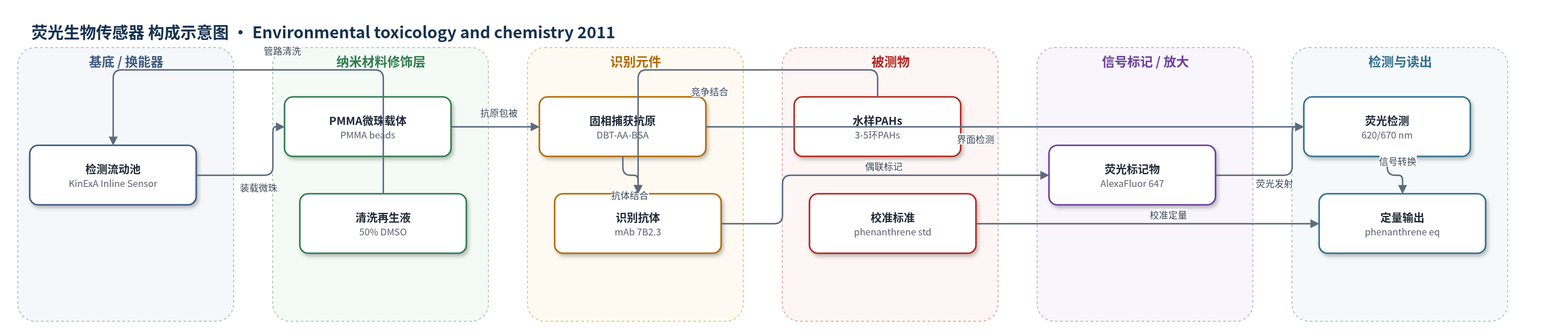
点击图片查看大图 · 依据论文自动绘制
传感器类型
荧光生物传感器
检测对象
多环芳烃(polycyclic aromatic hydrocarbons, PAHs;3-5环PAHs,以phenanthrene equivalents计);样品基质:河口疏浚区水样、雨水径流水样
检测原理
该传感器基于KinExA竞争免疫荧光原理。PMMA微珠表面包被DBT-AA-BSA抗原,作为固相捕获层。用AlexaFluor 647标记的单克隆抗体7B2.3与固相抗原结合;样品中3-5环PAHs与标记抗体竞争结合抗原。PAH浓度越高,结合到微珠上的荧光抗体越少,620 nm激发、670 nm发射的荧光信号越低。荧光信号与PAH浓度呈对数线性负相关。抗体-抗原平衡约10 s,无需额外孵育,定量约3 min。使用phenanthrene标准建立校准曲线,结果以phenanthrene equivalents报告。
检测灵敏度
LOD: 0.3 mg/L (phenanthrene equivalents, EPA method);线性范围: 0.3 to 30 mg/L;field LOD: 0.2 to 1 mg/L;R^2 ≈ 0.98
效应效果
该传感器现场快速、便携,定量响应约3 min,采样后10 min内出结果,3 d内完成80+样品。标准品重复误差通常≤10%。与GC-MS比较:河口疏浚区水样r=0.95(n=7),Deming斜率0.90±0.14;雨水径流水样r=0.86(n=7),斜率9.68±2.63。空间监测定义0.3–3.2 mg/L(phenanthrene equivalents)羽流,覆盖约90,000 m2,确认PAH未超10 mg/L;降雨峰值4.4和3.6 mg/L。抗体识别3–5环PAHs,交叉反应可累加低水平烷基化PAHs。作者认为其可指导采样与修复决策,节省时间和成本。
传感器的构成
- 检测平台:KinExA Inline Sensor flow cell,容纳微珠并实现荧光检测
- 固相载体:PMMA beads (Sapidyne),承载抗原包被层
- 固相捕获层:dibenzothiophene-acrylic acid-bovine serum albumin (DBT-AA-BSA),包被于PMMA微珠,用于结合荧光标记抗体
- 识别元件:monoclonal antibody (mAb) 7B2.3,特异性识别3-5环PAHs
- 信号标记物:AlexaFluor 647标记的mAb 7B2.3,提供荧光信号
- 清洗再生液:50% dimethylsulfoxide (DMSO)/去离子水,样品间清洗管路防止交叉污染
- 校准标准:phenanthrene/PAH标准溶液,用于建立定量校准曲线
中文摘要
本研究展示了利用抗体基生物传感器对水环境中溶解性多环芳烃(PAHs)进行快速、现场、定量评估的两个现场应用。该平台采用 Sapidyne Instruments 的 KinExA 在线传感器,使用对3至5环PAHs具有特异性的单克隆抗体7B2.3。研究在受污染沉积物疏浚作业附近开展空间监测,并在降雨事件期间开展时间监测。最重要的是,近实时数据生成为现场管理决策提供了依据,并确定了用于常规实验室分析的适当采样方案。该方法可在样品采集后10分钟内测定低至0.3 mg/L的PAH浓度,并在3天内完成80个以上样品(不含标准品和空白)的评估。结果与实验室气相色谱-质谱法进行了比较,后者检测了包括烷基化同系物在内的多种PAHs。该系统作为快速监测PAH污染的现场仪器展现出良好前景。
英文摘要
Rapid, on-site, quantitative assessments of dissolved polycyclic aromatic hydrocarbons (PAHs) were demonstrated for two field applications. The platform, a KinExA Inline Sensor (Sapidyne Instruments), employed the monoclonal anti-PAH antibody, 7B2.3, which has specificity for 3- to 5-ring PAHs. A spatial study was conducted near a dredging site where contaminated sediments were being removed, and a temporal study was performed during a rainfall event. Most importantly, the generation of near real-time data guided management decisions in the field and determined proper sampling protocols for conventional analyses. The method was able to determine PAH concentrations as low as 0.3 µg/L, within 10 min of sample acquisition, and to assess 80+ samples (not including standards and blanks) in less than 3 d. These results were compared with a laboratory-based gas chromatography-mass spectrometry method in which a wide array of PAHs, including alkylated homologs, were examined. This system shows great promise as a field instrument for the rapid monitoring of PAH pollution.