组成图示
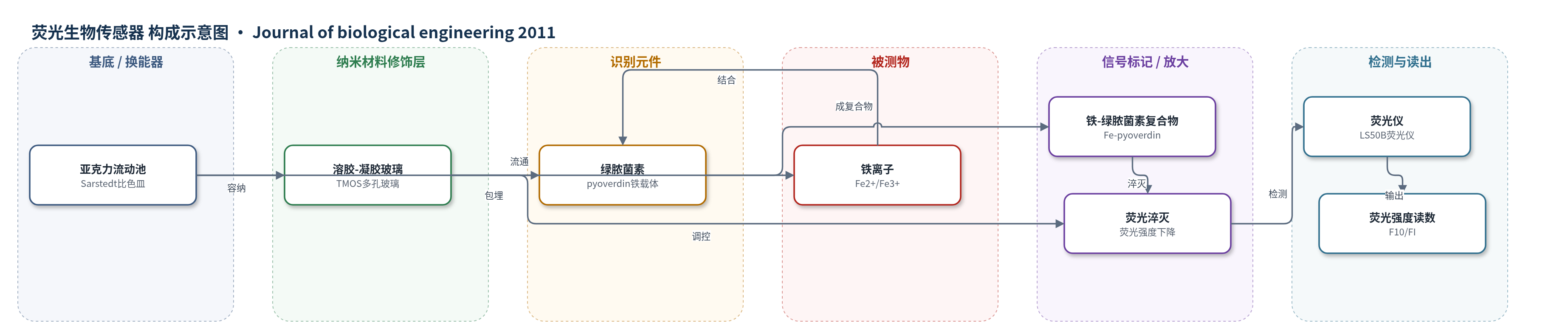
点击图片查看大图 · 依据论文自动绘制
传感器类型
荧光生物传感器
检测对象
铁(II)(ferrous iron, Fe2+)、铁(III)(ferric iron, Fe3+);样品基质为 0.1 M 醋酸缓冲液(pH 5.0),文中关联井水/水样
检测原理
绿脓菌素是含二羟基喹啉荧光团的荧光铁载体,游离态在激发下发射荧光。当 Fe3+ 进入溶胶-凝胶孔隙并与绿脓菌素配位形成铁-绿脓菌素复合物时,荧光团发生能量/电子转移或内滤效应,导致荧光淬灭;Fe2+ 结合较弱,淬灭较小,溶液低浓度 Fe2+ 甚至引起荧光增强。溶胶-凝胶玻璃通过物理包埋和微孔环境限制绿脓菌素构象与扩散,改变其对铁价态的响应,提高 Fe3+ 特异性与线性。样品在流动池中循环,荧光仪在固定激发/发射波长(固定后 382/480 nm,溶液 390/452 nm)连续测量荧光强度,以 10 min 后荧光强度百分比 F10/FI 表示;Fe3+ 浓度越高,荧光保留率越低,信号下降。
检测灵敏度
原文未报告正式 LOD、线性范围、灵敏度斜率或 R^2;测试浓度范围:溶胶-凝胶 0.28–0.56 mM Fe(II/III),溶液 0.45–3.03 μM Fe(II/III);0.3 μM 及更小的铁浓度变化可被检测。
效应效果
该传感器对 Fe3+ 的选择性明显优于 Fe2+:溶胶-凝胶颗粒暴露 0.28–0.56 mM 铁 10 min 后,Fe2+ 仅使荧光保留 89–97%,Fe3+ 降至 65–88%;溶胶-凝胶 C 对铁价态最特异且响应最线性。溶液态绿脓菌素在低 Fe2+(0.45–2.18 μM)下荧光反而升至 101–114%,而 Fe3+(0.45–3.03 μM)引起淬灭,说明固定化可改善低铁干扰。稳定性方面,A/B 经多次 1 M HCl 再生后荧光每次下降 4–20%,C 可完全恢复;淬灭反应重复性良好,但未报告 RSD。未做实际样品加标回收,仅指出井水铁均值 0.4 ppm(7.16 μM)、42% 井水≤0.005 ppm,认为可用于水样铁检测。
传感器的构成
- 检测基底/流通池:亚克力比色皿流动池(Sarstedt no. 67.755)与聚乙烯固定带(polyethylene ribbon),容纳溶胶-凝胶颗粒并允许样品流通
- 多孔固定基质:溶胶-凝胶玻璃(sol-gel xerogel),由四甲基硅烷(TMOS)、甲醇、2 N HNO3 和水制备,R=5.6/8.2/10.8,物理包埋识别分子并调控孔隙
- 识别元件:绿脓菌素(pyoverdin/pseudobactin),铜绿假单胞菌(Pseudomonas aeruginosa ATCC 15692)产生的荧光铁载体,结合 Fe3+/Fe2+
- 信号标记物:绿脓菌素自身荧光团(dihydroxyquinoline chromophore),固定后激发/发射约 382/480 nm,结合铁后荧光淬灭
- 样品介质:0.1 M 醋酸缓冲液(acetate buffer, pH 5.0),维持酸性条件,抑制 Fe3+ 沉淀和 Fe2+ 氧化
- 再生剂:1 M 盐酸(HCl),循环去除结合铁,恢复绿脓菌素荧光
中文摘要
生物传感器开发中两种技术很有前景:室温溶胶-凝胶法制备微孔玻璃,以及利用对特定分析物发生荧光淬灭的荧光化合物。本研究将二者结合构建铁生物传感器。为优化对铁(II/III)的特异性,将铜绿假单胞菌产生的荧光铁载体绿脓菌素固定在三种多孔溶胶-凝胶玻璃配方中,A、B、C 因加水量不同,水:硅摩尔比 R 分别为 5.6、8.2、10.8。将掺杂绿脓菌素的溶胶-凝胶颗粒置于荧光仪流动池中,在暴露于 0.28–0.56 mM 铁(II或III)时测量荧光淬灭。暴露 10 min 后,亚铁离子仅引起较小淬灭(保留初始荧光的 89–97%),而三价铁离子引起明显更强淬灭(65–88%)。固定在溶胶-凝胶 C 中的绿脓菌素表现出最特异且线性的响应。相比之下,3.0 μM 绿脓菌素溶液暴露于铁(II/III) 10 min 后,在低亚铁浓度(0.45–2.18 μM)下荧光增强(101–114%),而所有三价铁浓度(0.45–3.03 μM)均引起淬灭。总之,将绿脓菌素固定在溶胶-凝胶玻璃 C 中提高了其铁特异性。
英文摘要
Two current technologies used in biosensor development are very promising: 1. The sol-gel process of making microporous glass at room temperature, and 2. Using a fluorescent compound that undergoes fluorescence quenching in response to a specific analyte. These technologies have been combined to produce an iron biosensor. To optimize the iron (II or III) specificity of an iron biosensor, pyoverdin (a fluorescent siderophore produced by Pseudomonas spp.) was immobilized in 3 formulations of porous sol-gel glass. The formulations, A, B, and C, varied in the amount of water added, resulting in respective R values (molar ratio of water:silicon) of 5.6, 8.2, and 10.8. Pyoverdin-doped sol-gel pellets were placed in a flow cell in a fluorometer and the fluorescence quenching was measured as pellets were exposed to 0.28 - 0.56 mM iron (II or III). After 10 minutes of exposure to iron, ferrous ion caused a small fluorescence quenching (89 - 97% of the initial fluorescence, over the range of iron tested) while ferric ion caused much greater quenching (65 - 88%). The most specific and linear response was observed for pyoverdin immobilized in sol-gel C. In contrast, a solution of pyoverdin (3.0 μM) exposed to iron (II or III) for 10 minutes showed an increase in fluorescence (101 - 114%) at low ferrous concentrations (0.45 - 2.18 μM) while exposure to all ferric ion concentrations (0.45 - 3.03 μM) caused quenching. In summary, the iron specificity of pyoverdin was improved by immobilizing it in sol-gel glass C.