组成图示
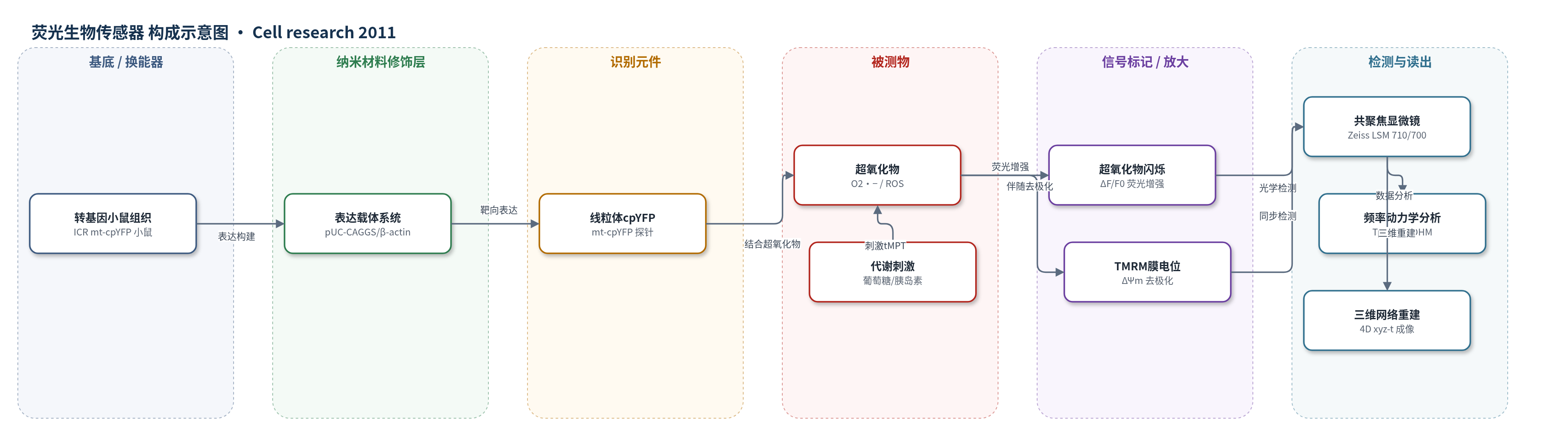
点击图片查看大图 · 依据论文自动绘制
传感器类型
荧光生物传感器
检测对象
线粒体超氧化物(superoxide, O2•−)、瞬时线粒体通透性转换(tMPT)活性;样品基质:活体麻醉转基因小鼠骨骼肌(gastrocnemius)与坐骨神经(sciatic nerve),等渗平衡盐溶液环境。
检测原理
mt-cpYFP 经线粒体靶向序列进入线粒体基质,作为超氧化物选择性荧光指示剂。线粒体瞬时通透性转换(tMPT)使内膜通透性短暂增加,电子传递链电子泄漏产生量子化超氧化物爆发。超氧化物与 mt-cpYFP 反应导致其荧光瞬时增强,形成 ΔF/F0 闪烁信号。共聚焦显微镜以 405/488 nm 交替激发并在 >505 nm 检测发射,记录单线粒体时间序列;TMRM 荧光下降同步指示膜电位去极化和 MPT 开放。葡萄糖或胰岛素刺激通过增强 tMPT 频率和门控模式增加闪烁频率,而单事件幅度基本不变,因此信号以频率调制方式反映代谢状态。
检测灵敏度
未报告 LOD、线性范围、灵敏度斜率或相关系数。
效应效果
mt-cpYFP 具有超氧化物选择性,克服 DCF 和 MitoSOX 的靶向/动力学限制;转基因小鼠组织学未见异常,野生型自荧光可忽略。活体成像在骨骼肌和坐骨神经中稳定记录自发超氧化物闪烁,单事件幅度 0.51±0.06,FDHM 9.15±0.63 s,FAHM 0.54±0.03 µm²;神经元与骨骼肌事件平均幅度约 0.5,Tp 约 5 s,T50 约 6 s。约 65% 为点状事件,35% 为同步线性/层状事件。葡萄糖或胰岛素刺激后 30–90 min 闪烁活性约增加 3.0 倍,FDHM 均值分别增加 40% 或 33%,并伴随 TMRM 指示的 ΔΨm 去极化。作者认为该技术可用于代谢病、氧化应激疾病及治疗评估。
传感器的构成
- 样品基质/组织基底:麻醉转基因小鼠骨骼肌(gastrocnemius)与坐骨神经(sciatic nerve),浸于等渗平衡盐溶液(NaCl、KCl、CaCl2、MgCl2、HEPES)
- 遗传表达系统:pUC-CAGGS 载体与鸡 β-actin 启动子,驱动 mt-cpYFP 在 ICR 小鼠泛组织表达
- 线粒体靶向层:mt-targeting 序列,将 cpYFP 定位至线粒体基质
- 识别/传感元件:mt-cpYFP(mitochondrially targeted circularly permuted yellow fluorescent protein),超氧化物选择性荧光指示剂
- 辅助信号元件:TMRM(tetramethylrhodamine methyl ester),线粒体膜电位指示剂,用于同步检测 ΔΨm 和 MPT 开放
- 换能/读出系统:激光扫描共聚焦显微镜(Zeiss LSM 710/700/510 Live),405/488/543 nm 激发,>505 nm 发射检测
中文摘要
线粒体是能量代谢和活性氧(ROS)产生的关键细胞器。在完整细胞中,呼吸线粒体可发生自发性“超氧化物闪烁”,即由瞬时线粒体通透性转换(tMPT)引发的量子化 ROS 产生事件。本研究首次在表达超氧化物生物传感器 mt-cpYFP 的活体小鼠中成像线粒体超氧化物闪烁和 tMPT 活性,并证明其与全身葡萄糖代谢耦联。在麻醉转基因小鼠的骨骼肌和坐骨神经中观察到强烈的 tMPT/超氧化物闪烁活性。骨骼肌成像揭示迷宫样三维线粒体网络可同步运作。全身葡萄糖负荷或胰岛素刺激使 tMPT/超氧化物闪烁活性显著增加,呈频率调制方式,并伴随 tMPT 门控模式转变。该活体成像技术为研究健康与疾病中线粒体功能、ROS 信号及代谢调控提供了重要工具和概念进展。
英文摘要
The mitochondrion is essential for energy metabolism and production of reactive oxygen species (ROS). In intact cells, respiratory mitochondria exhibit spontaneous "superoxide flashes", the quantal ROS-producing events consequential to transient mitochondrial permeability transition (tMPT). Here we perform the first in vivo imaging of mitochondrial superoxide flashes and tMPT activity in living mice expressing the superoxide biosensor mt-cpYFP, and demonstrate their coupling to whole-body glucose metabolism. Robust tMPT/superoxide flash activity occurred in skeletal muscle and sciatic nerve of anesthetized transgenic mice. In skeletal muscle, imaging tMPT/superoxide flashes revealed labyrinthine three-dimensional networks of mitochondria that operate synchronously. The tMPT/superoxide flash activity surged in response to systemic glucose challenge or insulin stimulation, in an apparently frequency-modulated manner and involving also a shift in the gating mode of tMPT. Thus, in vivo imaging of tMPT-dependent mitochondrial ROS signals and the discovery of the metabolism-tMPT-superoxide flash coupling mark important technological and conceptual advances for the study of mitochondrial function and ROS signaling in health and disease.