组成图示
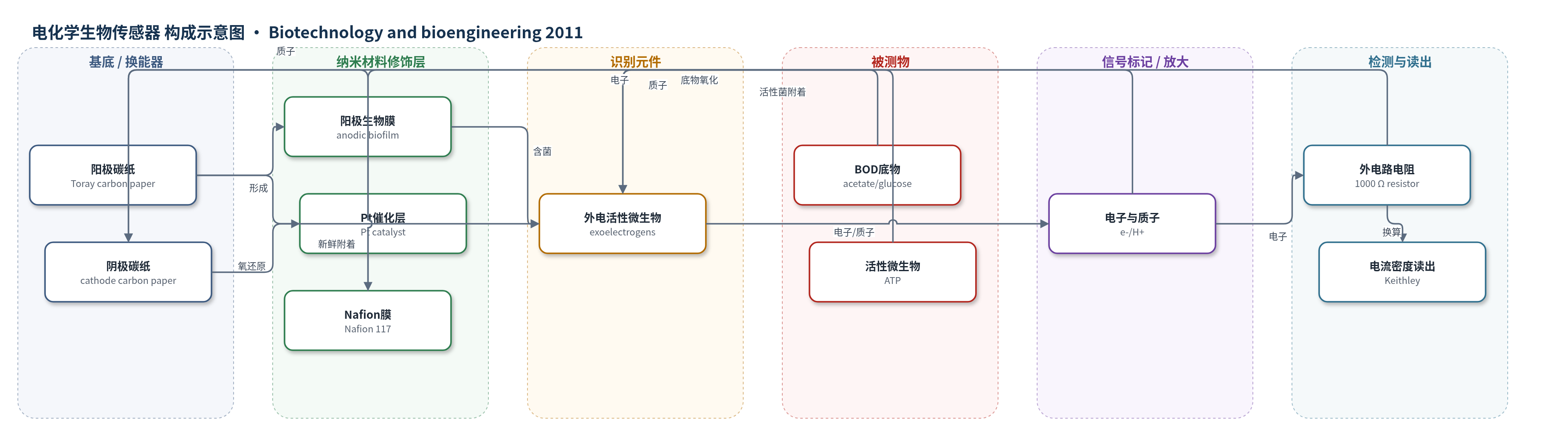
点击图片查看大图 · 依据论文自动绘制
传感器类型
电化学生物传感器
检测对象
微生物活性(microbial activity,以微生物ATP浓度表示)、生化需氧量(BOD);样品基质:人工地下水、真实受污染地下水(含乙酸/葡萄糖或废水稀释液)
检测原理
该传感器以微生物燃料电池为换能器。BOD模式下,阳极生物膜中的外电活性微生物氧化乙酸/葡萄糖等可生物降解有机物,电子经阳极进入外电路,质子经Nafion 117迁移至阴极,在Pt催化层上还原氧气,形成电流;电流密度随BOD浓度升高而增大,在10–250 mg-BOD/L内近似线性。微生物活性模式下,新鲜阳极允许地下水中活性外电菌附着并传递电子,在恒定BOD下电流密度随活性微生物(ATP)浓度升高而增大,0–6.52 nmol-ATP/L内线性。信号为直接生物电化学电流,无酶或核酸放大;温度、pH、电导率和无机固体通过影响电子传递、质子迁移和菌附着而改变灵敏度。
检测灵敏度
BOD:线性范围: 10–250 mg-BOD/L(乙酸电流密度至~233 ± 1 mA/m²,葡萄糖至~221 ± 1 mA/m²)。微生物活性:线性范围: 0–0.13 nmol-ATP/L(0.6±0.1–1.86±0.1 mA/m²,R²=0.984);0.13–6.52 nmol-ATP/L(1.86±0.1–12.4±0.1 mA/m²,R²=0.97)。
效应效果
生物膜阳极BOD模式在5个月内重复性良好;真实地下水BOD与APHA法偏差6%–16%,重复测量标准偏差±2%–±6%,低于传统BOD 5天法允许±15%。新鲜阳极活性模式对100 mg/L DNP抑制剂无电流,且在10、300、500 mg-BOD/L下无显著差异,表明受BOD干扰较小;真实地下水ATP与标准发光法偏差15%–22%。温度、pH、电导率升高有利,搅拌>250 rpm、硝酸盐>10 mg/L及无机固体升高降低电流(生物膜阳极0→0.75 kg/L时242±5降至142±2 mA/m²;新鲜阳极0→0.5 kg/L时12.4±0.1降至2.3±0.2 mA/m²)。作者认为可用于厌氧含水层原位快速定量监测。
传感器的构成
- 阳极换能电极:Toray碳纸(E-TEK,3 cm×3 cm,9 cm²,未防水);新鲜态用于微生物活性检测,培养2个月形成生物膜后用于BOD检测。
- 识别元件:阳极表面生物膜(初沉池废水培养)或地下水中可附着的外电活性微生物;催化底物氧化并向阳极传递电子。
- 阴极换能电极:5%防水Toray碳纸(E-TEK,3 cm×3 cm,9 cm²);作为氧还原阴极。
- 阴极催化层:Pt催化剂(0.5 mg/cm²,20% Pt,E-TEK);促进氧还原反应。
- 质子交换膜:Nafion 117(DuPont)热压于Pt面;分隔阴阳极并传导质子。
- 阴极腔:非导电聚碳酸酯板矩形腔(3 cm×3 cm×1 cm,9 cm³);容纳阴极并允许空气进入。
- 外部读出电路:铜导线连接1000 Ω电阻,Keithley 2700万用表与7701差分多路器监测电压;将电流密度作为信号。
中文摘要
本研究开发了一种基于可浸没微生物燃料电池(SUMFC)的生物传感器,用于原位监测地下水中微生物活性与生化需氧量(BOD)。阳极是否形成生物膜是传感器适用的关键:新鲜阳极用于微生物活性测定,而生物膜阳极用于BOD测定。配备生物膜阳极的SUMFC电流密度与BOD呈线性关系,最高可达250 mg/L(约233±1 mA/m²),响应时间<0.67 h;但该模式不能区分不同活性微生物浓度。相反,新鲜阳极的电流密度(0.6±0.1至12.4±0.1 mA/m²)与活性微生物浓度(以ATP表示)在0–6.52 nmol-ATP/L范围内线性相关,且与BOD无相关。温度、pH、电导率和无机固体含量显著影响灵敏度。在真实受污染地下水中,传感器可在<3.1 h内检测微生物活性和BOD,与标准方法偏差分别为15%–22%和6%–16%。该传感器为厌氧含水层生物修复过程中的原位定量监测提供了新途径。
英文摘要
A sensor, based on a submersible microbial fuel cell (SUMFC), was developed for in situ monitoring of microbial activity and biochemical oxygen demand (BOD) in groundwater. Presence or absence of a biofilm on the anode was a decisive factor for the applicability of the sensor. Fresh anode was required for application of the sensor for microbial activity measurement, while biofilm-colonized anode was needed for utilizing the sensor for BOD content measurement. The current density of SUMFC sensor equipped with a biofilm-colonized anode showed linear relationship with BOD content, to up to 250 mg/L (∼233 ± 1 mA/m(2)), with a response time of <0.67 h. This sensor could, however, not measure microbial activity, as indicated by the indifferent current produced at varying active microorganisms concentration, which was expressed as microbial adenosine-triphosphate (ATP) concentration. On the contrary, the current density (0.6 ± 0.1 to 12.4 ± 0.1 mA/m(2)) of the SUMFC sensor equipped with a fresh anode showed linear relationship, with active microorganism concentrations from 0 to 6.52 nmol-ATP/L, while no correlation between the current and BOD was observed. It was found that temperature, pH, conductivity, and inorganic solid content were significantly affecting the sensitivity of the sensor. Lastly, the sensor was tested with real contaminated groundwater, where the microbial activity and BOD content could be detected in <3.1 h. The microbial activity and BOD concentration measured by SUMFC sensor fitted well with the one measured by the standard methods, with deviations ranging from 15% to 22% and 6% to 16%, respectively. The SUMFC sensor provides a new way for in situ and quantitative monitoring contaminants content and biological activity during bioremediation process in variety of anoxic aquifers.