组成图示
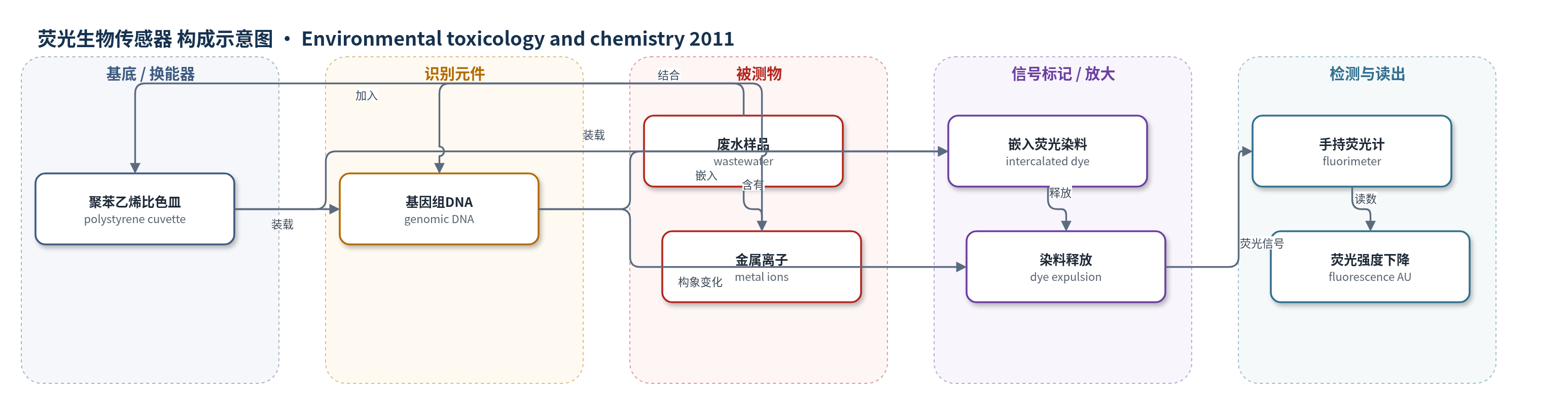
点击图片查看大图 · 依据论文自动绘制
传感器类型
荧光生物传感器
检测对象
毒性金属离子(toxic metal ions,Hg(II)、Ag(I)、Cu(II)、Cr(III)、Cr(VI)、Cd(II)、Pb(II) 等)、总化学毒性(chemical toxicity);样品基质:废水(wastewater)
检测原理
该检测以DNA为识别元件,以嵌入DNA的荧光染料为信号报告物。将废水样品加入DNA-染料测试液后,样品中的毒性金属离子与DNA碱基结合,尤其Hg(II)优先结合T和G,改变DNA双螺旋构象并降低溶液粘度。构象变化使原本嵌入在DNA碱基对之间的荧光染料被排出,染料释放后荧光强度下降。被测物毒性越强或加入样品量越大,荧光强度从校准值1000 AU下降越多;作者以1 mg/L Hg(II)使荧光降至约200 AU作为强毒标准,将800–200 AU划分为轻微毒、毒、很毒等级。该过程无需酶促或核酸扩增放大,直接通过DNA-染料界面荧光变化实现毒性读出。
检测灵敏度
相关系数: DNA-dye 与 C. dubia log(EC50) r = 0.87;DNA-dye 与 Microtox r = 0.75;C. dubia 与 Microtox r = 0.70;主成分回归 r^2: DNA-dye = 0.92, C. dubia = 0.96, Microtox = 0.66
效应效果
在48个废水样品中,DNA-染料检测与C. dubia和Microtox结果总体一致:与C. dubia在40个可比较样品中22个一致(55%),与Microtox 25个一致(63%);18个样品被三种方法均判为毒性。DNA-染料检测未出现假阴性,而C. dubia和Microtox分别有7个和5个假阴性。检测在pH 4.8–9.2范围内稳定,荧光强度从1000 AU降至不低于800 AU;浓缩DNA-染料试剂保质期12个月,稀释液室温稳定至少24 h、4°C稳定5–7 d;重复测量典型误差约±2%。30个自荧光样品经H2O2淬灭后仍可评估。作者认为其快速、便携、无需活体生物,适合作为现场化学毒性筛查的替代生物测定。
传感器的构成
- 检测容器/光学基底:一次性聚苯乙烯荧光比色皿(polystyrene fluorescence cuvette),承载DNA-染料反应液并用于荧光测量
- 预混试剂:HazardScreen DNA-染料测试液(HAZ-1/HAZ-2),提供DNA与荧光染料预混体系
- 识别元件:基因组DNA(genomic DNA,HAZ-1/HAZ-2 不同来源;机制验证采用牛胸腺DNA calf thymus DNA),结合金属离子并发生构象变化
- 信号标记物:嵌入荧光报告染料(intercalated fluorescent reporter dye),嵌入DNA双链,金属诱导结构变化后释放导致荧光下降
- 反应介质:MilliQ水(Millipore),稀释DNA-染料测试液并作为空白/滴定介质
- 样品基质:废水(wastewater),含金属离子等毒性化学物质,加入后与DNA-染料作用
- 读出设备:手持荧光计(Turner Designs PicoFluor 或 HazardScreen fluorimeter),测量荧光强度(AU)
中文摘要
化学毒物,尤其是金属离子,是全球水体的主要污染物。传统活体生物测定通常监测淡水枝角类Ceriodaphnia dubia的活动或存活,或海洋细菌Vibrio fischeri的发光变化,如商业Microtox检测。本文报道一种新型分子检测系统,以DNA作为化学生物传感器。金属离子与DNA结合后引起DNA结构变化,使嵌入的荧光报告染料被排出,导致荧光强度下降。对48个可能受金属离子污染的废水样品分析表明,DNA-染料检测结果与C. dubia和Microtox生物测定结果相关。三种检测均表现出加性、拮抗性和协同性反应,这些反应不能仅凭单个金属浓度预测。样品金属分析提示还存在金属离子以外的化学毒物。DNA-染料检测稳健,保质期12个月,在pH 4至9范围内仅受轻微影响,几分钟内即可完成,便携性使其适合作为现场筛查方法。作者认为该DNA-染料检测是适合筛查化学毒性的替代生物测定。
英文摘要
Chemical toxicants, particularly metal ions, are a major contaminant in global waterways. Live-organism bioassays used to monitor chemical toxicants commonly involve measurements of activity or survival of a freshwater cladoceran (Ceriodaphnia dubia) or light emitted by the marine bacterium Vibrio fischeri, used in the commercial Microtox® bioassay. Here we describe a novel molecule-based assay system employing DNA as the chemical biosensor. Metals bind to DNA, causing structural changes that expel a bound (intercalated) fluorescent reporter dye. Analyses of test data using 48 wastewater samples potentially contaminated by metal ions show that the DNA-dye assay results correlate with those from C. dubia and Microtox bioassays. All three assays exhibit additive, antagonistic, and synergistic responses that cannot be predicted by knowing individual metal concentrations. Analyses of metals in these samples imply the presence of chemical toxicants other than metal ions. The DNA-dye assay is robust, has a 12-month shelf life, and is only slightly affected by sample pH in the range 4 to 9. The assay is completed in a matter of minutes, and its portability makes it well suited as a screening assay for use in the field. We conclude that the DNA-dye test is a surrogate bioassay suitable for screening chemical toxicity.