组成图示
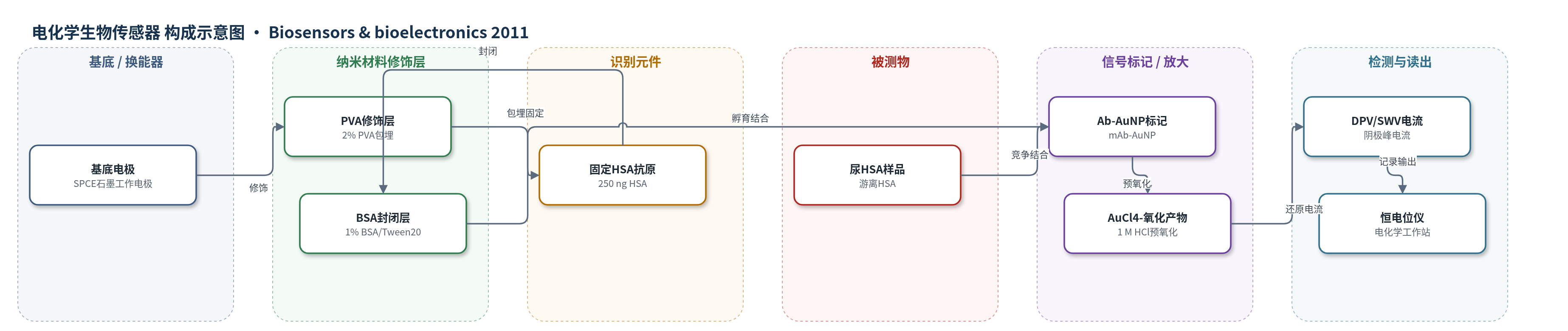
点击图片查看大图 · 依据论文自动绘制
传感器类型
电化学生物传感器
检测对象
人血清白蛋白(HSA,urinary albumin);样品基质:尿液(含正常与糖尿病人尿样、24 h 尿液)
检测原理
该传感器采用竞争性免疫识别。PVA 修饰的 SPCE 表面通过物理包埋固定 HSA 抗原,BSA/Tween 20 封闭非特异位点。检测时,尿样中的游离 HSA 与电极固定 HSA 竞争结合 Ab-AuNP;游离 HSA 浓度越高,结合到电极表面的 Ab-AuNP 越少。随后在 1 M HCl 中于 +1.25 V 预氧化 40 s,使结合 AuNP 氧化为 AuCl4-;高氯酸性环境使带负电的 Au 络合物被正电位吸引并减少扩散损失。DPV/SWV 在 0.1-0.4 V 扫描还原 AuCl4-,产生阴极电流。AuNP 的高导电性增强电子转移,电流随 HSA 浓度升高而降低,从而实现定量检测。
检测灵敏度
LOD: 25 ng/mL;线性范围: 2.5-200 μg/mL;LOD: 0.025 μg/mL
效应效果
该传感器对 HSA 具有良好选择性,在尿素、肌酐、血红蛋白、免疫球蛋白、葡萄糖、四环素、抗坏血酸、半胱氨酸和对乙酰氨基酚存在时无明显干扰。批内重现性 CV 为低浓度 3.0%、中浓度 3.5%,批间为 4.0% 和 5.0%。17 例糖尿病及对照尿样检测结果与免疫比浊法(IT)和化学发光免疫分析(CLIA)一致,三次重复 RSD 为 1.9%-9%。PVA-HSA 电极在 37°C 保存 3 个月后仍保持检测能力,抗原固定效率较裸电极提高约 18%。完整检测约 80 min,作者认为其比 HPLC、免疫分析、IT 和压电免疫传感器具有更低检出限和更高灵敏度,适用于尿微量白蛋白筛查。
传感器的构成
- 基底/换能器电极:丝网印刷碳电极(SPCE),含石墨工作电极、Ag/AgCl 参比电极和石墨辅助电极,提供电化学界面
- 聚合物修饰层:聚乙烯醇(PVA,2% wt),由乙烯醇(VA)在醋酸缓冲液中滴涂后紫外光聚合,物理包埋 HSA 并提高稳定性
- 固定抗原层:人血清白蛋白(HSA,250 ng),包埋于 PVA 孔中,作为竞争法固定抗原
- 封闭层:1% 牛血清白蛋白(BSA)和 0.05% Tween 20 的磷酸缓冲液(PBS),封闭非特异结合位点
- 识别/信号标记物:抗 HSA 小鼠单克隆抗体(mAb)标记 20 nm 金纳米颗粒(Ab-AuNP),识别 HSA 并提供电化学信号
- 信号电解质:1 M 盐酸(HCl),用于预氧化 AuNP 生成 AuCl4- 并支持 DPV/SWV 还原
- 信号读出:恒电位仪配合差分脉冲伏安法(DPV)和方波伏安法(SWV),记录阴极电流
中文摘要
免疫传感器通过生物识别元件与物理化学换能器结合,为疾病早期诊断和治疗提供快速、灵敏的检测手段。本研究开发了一种新型竞争性电化学生物传感器,用于检测尿液中的人血清白蛋白(HSA)。该传感器以丝网印刷碳电极(SPCE)为基底,采用聚乙烯醇(PVA)修饰电极表面,并将 HSA 抗原包埋固定于 PVA 中;随后用抗 HSA 单克隆抗体标记的金纳米颗粒(Ab-AuNP)作为识别和信号标记物。场发射扫描电镜(FE-SEM)显示 HSA 抗原、单克隆抗体与 AuNP 之间结合稳定;循环伏安法(CV)表明修饰过程成功。差分脉冲伏安法(DPV)和方波伏安法(SWV)用于定量检测,其他蛋白混合实验显示该传感器对 HSA 具有高特异性和选择性。最佳条件下,传感器在 2.5-200 μg/mL 范围内呈良好线性,检出限为 25 ng/mL。该策略可进一步改进并用于其他抗原检测。
英文摘要
The development of immunosensors with high sensitivity and specificity in detecting the pathogenic or physiologically relevant molecules in the body, offers a powerful opportunity in early diagnosis and treatment of diseases. In this study, we developed a new competitive immunosensor with employing antibody (Ab) labeled AuNP (Ab-AuNP) and PVA modified screen-printed carbon electrode (SPCE) surface to detect the urine albumin. Field emission scanning electron microscopy (FE-SEM) of modified electrode showed a suitable and stable attachment between HSA antigen- mAb and AuNP. Cyclic voltammetric (CV) method demonstrated that modification process was well performed. Electrochemical measurements including differential pulse voltammetry (DPV) and square wave voltammetry (SWV) were employed for quantitative antigen detection. The electrochemical measurements performed with other proteins mixed with samples demonstrated a high specificity and selectivity for this biosensor in detecting the HSA. In optimal conditions, the immunosensor could detect HSA in a high linear range (from 2.5 to 200 μg/mL) with a low detection limit of 25 ng/mL. This new strategy could be improved and applied to detect the other antigen.