组成图示
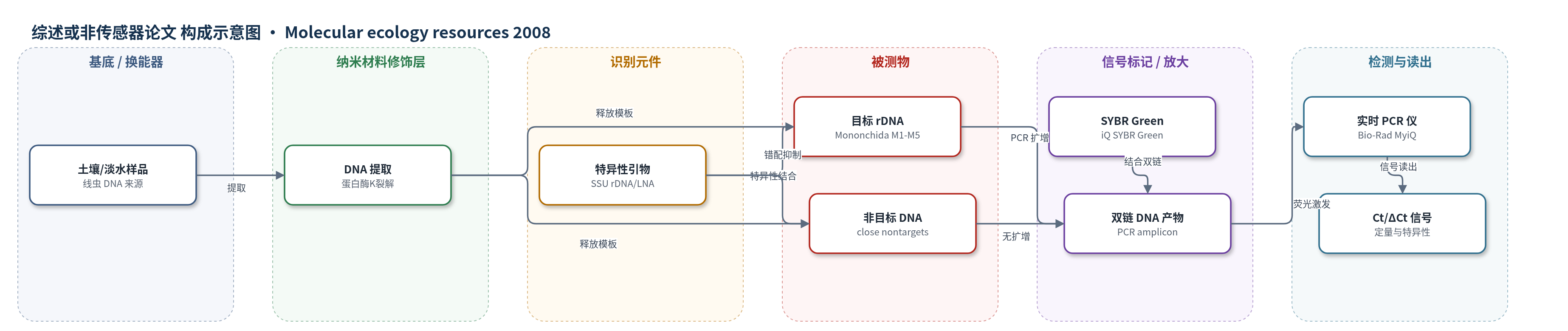
点击图片查看大图 · 依据论文自动绘制
传感器类型
综述或非传感器论文
检测对象
线虫(Nematoda;Mononchida 亚类群 M1–M5,亦涉及 Dorylaimida 亚类群 D1–D9/PP1–PP3);样品基质:土壤/淡水环境样品
检测原理
该方法以线虫 SSU/LSU rDNA 序列签名作为识别基础。首先从土壤或淡水样品中提取线虫 DNA,针对 Mononchida 各亚类群(M1–M5)设计特异性引物,部分引物引入 LNA 以提高错配耐受性。目标 rDNA 与引物特异性退火后,经 PCR 指数扩增产生大量双链 DNA;SYBR Green I 染料结合双链 DNA 后发出荧光,荧光强度随循环数增加而上升。实时 PCR 仪记录扩增曲线,Ct 值与初始模板量呈负相关,从而实现定量。非目标 DNA 因引物错配而不扩增或 Ct 显著延迟,ΔCt 可评估特异性。
检测灵敏度
原文未报告 LOD、线性范围、灵敏度斜率或 R^2。
效应效果
作者以克隆 SSU rDNA 片段验证引物特异性:M1、M2、M4、M5 引物组合高度特异,60 个 PCR 循环后几乎检测不到信号;M3 引物特异性略低,但 ΔCt 仍约 20,表明目标与非目标信号可区分。该方法无需依赖专家形态分类,可检测所有发育阶段,适用于较大数量土壤/淡水样品,并显著减少样品处理时间。论文未报告 RSD、稳定性、实际样品加标回收率或与 ELISA/HPLC/qPCR 标准方法的定量对比,主要作为基于 DNA 序列签名监测胁迫敏感线虫科的概念验证。
传感器的构成
- 非传感器体系:无传统基底/换能器电极,检测基于溶液相实时 PCR
- 识别元件:亚类群特异性 SSU rDNA 引物(部分含 LNA),识别目标线虫 rDNA
- 信号标记:iQ SYBR Green Supermix 中 SYBR Green I 染料,结合双链 DNA 产生荧光
- 读出体系:Bio-Rad MyiQ 实时 PCR 仪,输出 Ct/ΔCt 荧光信号
- 样品基质:土壤/淡水样品提取的线虫 DNA,复杂 DNA 背景
中文摘要
土壤线虫多样、丰富、营养类型异质且易提取,具有评估土壤健康的潜力,但形态保守限制了其应用,宜基于非形态特征构建生物传感器系统。超过80%对环境胁迫敏感的线虫科属于 Mononchida 和 Dorylaimida 目。全长 SSU rDNA 在这两目中的系统发育分辨率差异较大:Mononchida 亚类群(M1–M5)支持较好,可定义科特异性 DNA 序列签名;除 Nygolaimidae 和 Longidoridae 外,Dorylaimida 分辨率较差,因此对 72 个物种测序了约 1000 bp 的 LSU rDNA 5′端片段。序列分析将 Dorylaimida 划分为 D1–D9 和 PP1–PP3 亚类群,多数营养类型均一并有形态支持。作者据此设计引物,在复杂 DNA 背景中用实时 PCR 检测 Mononchida 单个亚类群,证明基于 DNA 序列签名监测环境样品中胁迫敏感线虫科的概念可行。
英文摘要
Indigenous communities of soil-resident nematodes have a high potential for soil health assessment as nematodes are diverse, abundant, trophically heterogeneous and easily extractable from soil. The conserved morphology of nematodes is the main operational reason for their under-exploitation as soil health indicators, and a user-friendly biosensor system should preferably be based on nonmorphological traits. More than 80% of the most environmental stress-sensitive nematode families belong to the orders Mononchida and Dorylaimida. The phylogenetic resolution offered by full-length small subunit ribosomal DNA (SSU rDNA) sequences within these two orders is highly different. Notwithstanding several discrepancies between morphology and SSU rDNA-based systematics, Mononchida families (indicated here as M1-M5) are relatively well-supported and, consequently, family-specific DNA sequences signatures could be defined. Apart from Nygolaimidae and Longidoridae, the resolution among Dorylaimida families was poor. Therefore, a part of the more variable large subunit rDNA (≈ 1000 bp from the 5'-end) was sequenced for 72 Dorylaimida species. Sequence analysis revealed a subclade division among Dorylaimida (here defined as D1-D9, PP1-PP3) that shows only distant similarity with 'classical' Dorylaimid systematics. Most subclades were trophically homogeneous, and - in most cases - specific morphological characteristics could be pinpointed that support the proposed division. To illustrate the practicability of the proposed molecular framework, we designed primers for the detection of individual subclades within the order Mononchida in a complex DNA background (viz. in terrestrial or freshwater nematode communities) and tested them in quantitative assays (real-time polymerase chain reaction). Our results constitute proof-of-principle for the concept of DNA sequence signatures-based monitoring of stress sensitive nematode families in environmental samples.