组成图示
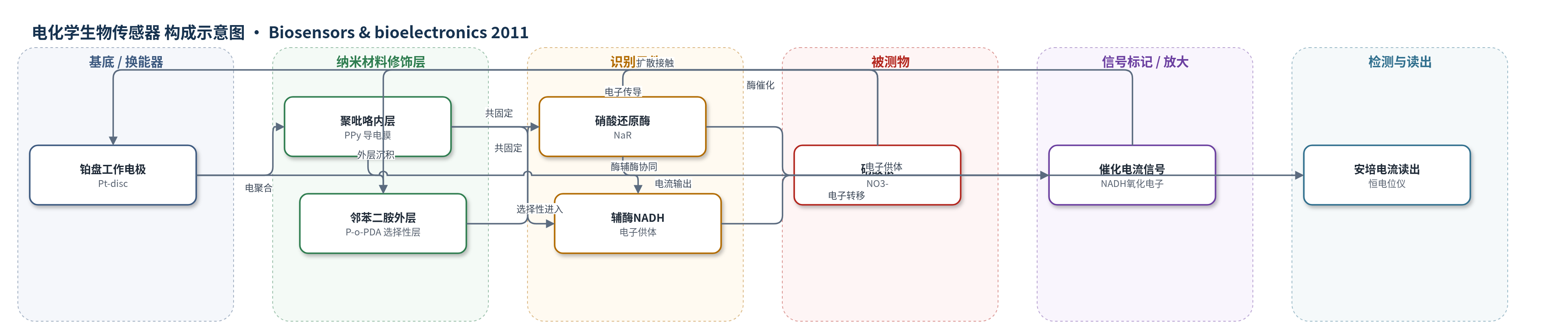
点击图片查看大图 · 依据论文自动绘制
传感器类型
电化学生物传感器
检测对象
硝酸根(nitrate, NO3-);样品基质:0.1 M 磷酸盐缓冲液(pH 7.3),文中讨论天然水样
检测原理
硝酸盐(NO3-)从测量液扩散穿过外层 P-o-PDA 选择性膜,进入内层 PPy–NaR–NADH 催化区。NaR 以 NADH 为电子供体,催化 NO3- 还原为亚硝酸盐(NO2-),同时 NADH 被氧化为 NAD+。该催化反应产生的电子经导电 PPy 膜传递至铂工作电极,在 -200 mV 或 -225 mV 恒电位下被恒电位仪记录为安培电流。随着 NO3- 浓度升高,催化电子转移速率增加,电流响应增大。P-o-PDA 外层通过离子选择性排斥无机阴/阳离子干扰,并限制 NaR 和 NADH 流失;加入 EDTA 可络合金属阳离子,进一步提高抗干扰能力。
检测灵敏度
LOD: 0.20 μM;线性范围: 10–500 μM;灵敏度: 34.2 nA μM−1 cm−2;R^2 = 0.978
效应效果
双层传感器抗干扰能力显著:P-o-PDA 外层对阴离子干扰排除效率 73%–88%,阳离子 47%–84%;加 1 mM EDTA 后阳离子排除效率达 89%–94%,EDTA 贡献 10%–40%。重现性 2.7% RSD(n=10;摘要 3.4%)。稳定性:24 h 响应降 20%(6.1% RSD),48 h 降 25%(6.3% RSD),可重复使用 30 d 以上且灵敏度损失≤30%。与单层相比,LOD 由 0.55 μM 降至 0.20 μM,线性范围由 25–500 μM 扩至 10–500 μM,灵敏度 34.2 nA μM−1 cm−2,响应时间 19–22 s。作者认为适用于天然水样硝酸盐检测,但灵敏度仍需提高。
传感器的构成
- 工作电极基底:铂盘电极(Pt-disc,0.024 cm2),经氧化铝抛光和 H2SO4 电化学清洗,作为导电换能器。
- 内层导电聚合物:聚吡咯(PPy)膜,由吡咯(Py)恒电流聚合形成,提供电子传导通道并固定生物分子。
- 识别/催化元件:硝酸还原酶(NaR)与辅酶 NADH,共固定于 PPy 内层,催化 NO3- 还原为 NO2- 并传递电子。
- 内层支持电解质:氯化钾(KCl,0.2 M),作为 PPy 成膜掺杂剂和支持离子。
- 外层选择性阻隔层:聚邻苯二胺(P-o-PDA)膜,由邻苯二胺(o-PDA)循环伏安聚合形成,排斥无机干扰并保留 NaR/NADH。
- 外层成膜电解质:氯化钾(KCl,0.5 M)与巴比妥酸缓冲液(barbitone buffer,0.05 M),辅助 o-PDA 聚合并控制 pH。
- 测量介质:0.1 M 磷酸盐缓冲液(pH 7.3),提供酶活性环境;可选 1 mM EDTA 络合金属阳离子。
- 电化学读出组件:Ag/AgCl(3 M KCl)参比电极、Pt 丝辅助电极和恒电位仪,用于三电极安培测量。
中文摘要
本文报道了一种集成离子选择性外层的聚吡咯双层安培硝酸盐生物传感器,用于排除无机阴离子和阳离子干扰。内层 PPy–NaR–NADH 膜通过恒电流聚合吡咯(Py)制备,并在聚合过程中共固定硝酸还原酶(NaR)和还原型烟酰胺腺嘌呤二核苷酸(NADH);外层聚邻苯二胺(P-o-PDA)膜通过循环伏安聚合邻苯二胺(o-PDA)形成,具有自限性、绝缘性和离子选择性。作者提出新的排除效率关系式,用于评价外层对无机干扰的排斥能力。结果表明,P-o-PDA 外层可高效排除 73%–87% 的阴离子干扰和 47%–84% 的阳离子干扰;在测量液中加入 1 mM EDTA 后,阳离子排除效率进一步提高 10%–40%,净排除效率达 89%–94%。外层还有助于保留 NaR 和 NADH,从而改善硝酸盐安培检测性能,检出限为 0.20 μM,线性范围为 10–500 μM,相对标准偏差为 3.4%(n=10)。
英文摘要
A bilayer amperometric nitrate biosensor with an integrated permselective layer has been developed for exclusion of inorganic anion and cation interferences. The inner PPy(polypyrrole)-NaR-NADH layer of the biosensor is formed by galvanostatic polymerization of pyrrole (Py) in presence of nitrate reductase (NaR) and nicotinamide adenine dinucleotide (NADH), followed by formation of the outer permselective poly-ortho-phenylenediamine (P-o-PDA) layer by potentiodynamic polymerization of ortho-phenylenediamine (o-PDA). The exclusion efficiency (E(eff)) of the outer layer in rejecting inorganic cation and anion interferences is evaluated by a new proposed relationship. 73-87% and 47-84% of anion and cation interferences, respectively, were efficiently rejected with the permselective layer. Further improvement in the exclusion efficiency for cations was accomplished by combining the use of the outer layer with the addition of 1mM EDTA into the measurement solution. The addition of EDTA improved the E(eff) achieved for cation rejection by 10-40% to give net E(eff) of 89-94%. The inclusion of the outer layer also aided the retention of NaR and NADH in the inner PPy-NaR-NADH layer and, hence, enabled improved amperometric detection of nitrate, achieving a detection limit of 0.20 μM and a linear concentration range of 10-500 μM with a 3.4%rsd (n=10).