组成图示
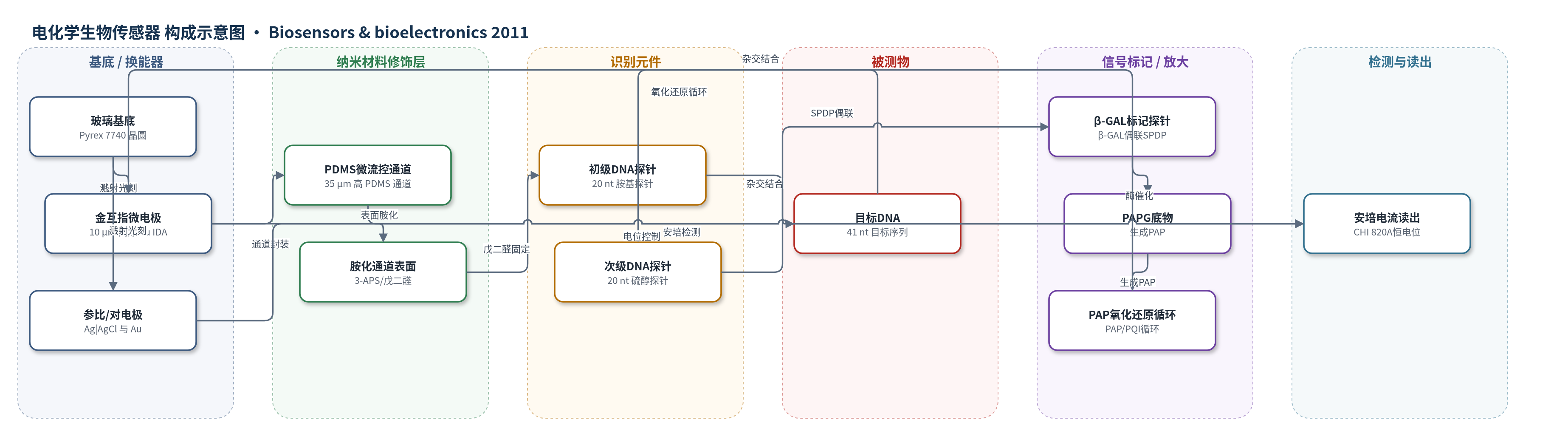
点击图片查看大图 · 依据论文自动绘制
传感器类型
电化学生物传感器
检测对象
4-氨基苯酚 (4-aminophenol, PAP)、目标 DNA 序列 (target DNA, 41 nt);样品基质为磷酸盐缓冲液/微流控通道内缓冲液
检测原理
固定于 PDMS 通道表面的初级 DNA 探针与目标 DNA 杂交后,标记 β-GAL 的次级探针再杂交,形成三明治结构并将 β-GAL 固定于通道表面。加入 PAPG 后,β-GAL 催化水解生成 PAP。PAP 在金 IDA 阳极被氧化为 PQI,PQI 在阴极还原回 PAP,形成氧化还原循环;微流控通道限制扩散,使 PAP 在相邻微带间反复循环,循环效率达 97%,从而放大电流。恒电位安培法在阳极 0.15 V、阴极 -0.1 V 下记录稳态电流。目标 DNA 浓度越高,固定 β-GAL 越多,生成 PAP 越多,电流越大。测量间用乙醇冲洗去除 PAP 聚合物,降低电极污染和信号波动。
检测灵敏度
PAP: LOD: 1.0 × 10⁻¹⁰ M;线性范围: 1.0 × 10⁻⁹ M–1.0 × 10⁻⁵ M;相关系数 = 0.994。目标 DNA: LOD: 1.0 × 10⁻¹⁰ M;线性范围: 1.0 × 10⁻¹⁰ M–1.0 × 10⁻⁸ M;相关系数 = 0.999。
效应效果
系统对 PAP 的背景电流为 54.6±0.482 pA,1.0×10−10 M PAP 产生 600 pA,IUPAC 检出限信号为 56.046 pA。微流控限制扩散使 PAP 循环效率达 97%,70 nL 样品即可检测。电流与流速立方根在 0.3–1.8 mL/h 内线性相关(R=0.984),停泵 20 s 后信号稳定,作者采用 30 s 静态测量。乙醇再生可去除 PAP 聚合物,提高信号并降低标准偏差。DNA 杂交检测中,0 与 1.0×10⁻¹⁰ M 目标 DNA 差异显著(P=0.05),检测时间小于 30 min;此前微流控微电极酶放大 DNA 杂交最低检出限为 1.0×10⁻⁹ M 且耗时超过 170 min。作者认为该低成本 IDA 微流控平台适合高灵敏 DNA 序列检测。
传感器的构成
- 基底/换能器电极:Pyrex 7740 玻璃晶圆溅射 100 Å Cr 和 1000 Å Au,光刻形成 25 对 Au IDA 微带电极(10 μm 宽、540 μm 长、10 μm 间隙),并制作 Ag|AgCl 参比电极与 Au 对电极;1100 Å SiO2 绝缘层。
- 微流控通道:PDMS(Sylgard 184)软光刻矩形通道,高 35 μm、宽 200 μm、长 1 cm,两端设样品口与废液口,连接注射泵,用于限制扩散和静态测量。
- 通道表面功能化:3-氨基丙基三甲氧基硅烷(3-APS)胺化 PDMS 通道表面,再用 2% 戊二醛活化,用于固定 DNA 探针或酶。
- 识别元件:20 nt 5′-胺基初级 DNA 探针通过戊二醛交联固定于通道表面;20 nt 3′-硫醇次级 DNA 探针经 SPDP 交联偶联 β-半乳糖苷酶(β-GAL)。
- 信号标记物:β-GAL 标记的次级 DNA 探针,杂交后固定于通道表面,催化底物生成可电化学检测的 PAP。
- 底物/信号分子:4-氨基苯基-β-D-半乳糖吡喃糖苷(PAPG)作为 β-GAL 底物,水解生成 4-氨基苯酚(PAP)。
- 电极再生层:每次测量后用 7.5 μL 乙醇和 7.5 μL 缓冲液冲洗微通道,去除 PAP 聚合物并再生 Au 表面。
- 信号读出:CHI 820A 电化学工作站进行恒电位安培法,阳极 0.15 V、阴极 -0.1 V,记录稳态电流。
中文摘要
本文报道了一种集成于微流控通道的互指阵列(IDA)微电极酶联 DNA 杂交检测方法,可实现亚纳摩尔级检出限。为突破传统电化学生物传感器的灵敏度限制,作者采用可循环氧化还原产物 4-氨基苯酚(PAP)作为信号分子,并与金 IDA 微电极耦合。该 IDA 指间距为 10 μm,易于制备;微流控通道限制扩散,使 PAP 循环效率达到 97%。在 70 nL 样品体积下,PAP 检出限为 1.0×10⁻¹⁰ M,线性范围为 1.0×10⁻⁹–1.0×10⁻⁵ M,为已报道最低 PAP 检出限。DNA 检测采用杂交三明治:固定互补探针、目标 DNA 和标记 β-半乳糖苷酶(β-GAL)的第二探针;β-GAL 将底物 4-氨基苯基-β-D-半乳糖吡喃糖苷(PAPG)转化为 PAP。该方法以低成本、易制备的电化学生物传感器实现目标 DNA 序列的高灵敏检测。
英文摘要
A novel enzyme-linked DNA hybridization assay on an interdigitated array (IDA) microelectrode integrated into a microfluidic channel is demonstrated with sub-nM detection limit. To improve the detection limit as compared to conventional electrochemical biosensors, a recyclable redox product, 4-aminophenol (PAP) is used with an IDA microelectrode. The IDA has a modest and easily fabricated inter-digit spacing of 10 μm, yet we were able to demonstrate 97% recycling efficiency of PAP due to the integration in a microfluidic channel. With a 70 nL sample volume, the characterized detection limit for PAP of 1.0 × 10⁻¹⁰ M is achieved, with a linear dynamic range that extends from 1.0 × 10⁻⁹ to 1.0 × 10⁻⁵ M. This detection limit, which is the lowest reported detection limit for PAP, is due to the increased sensitivity provided by the sample confinement in the microfluidic channel, as well as the increased repeatability due to perfectly static flow in the microchannel and an additional anti-fouling step in the protocol. DNA sequence detection is achieved through a hybridization sandwich of an immobilized complementary probe, the target DNA sequence, and a second complementary probe labeled with β-galactosidase (β-GAL); the β-GAL converts its substrate, 4-aminophenyl-d-galactopyranoside (PAPG), into PAP. In this report we present the lowest reported observed detection limit (1.0 × 10⁻¹⁰ M) for an enzyme-linked DNA hybridization assay using an IDA microelectrode and a redox signaling paradigm. Thus, we have demonstrated highly sensitive detection of a targeted DNA sequence using a low-cost easily fabricated electrochemical biosensor integrated into a microfluidic channel.