组成图示
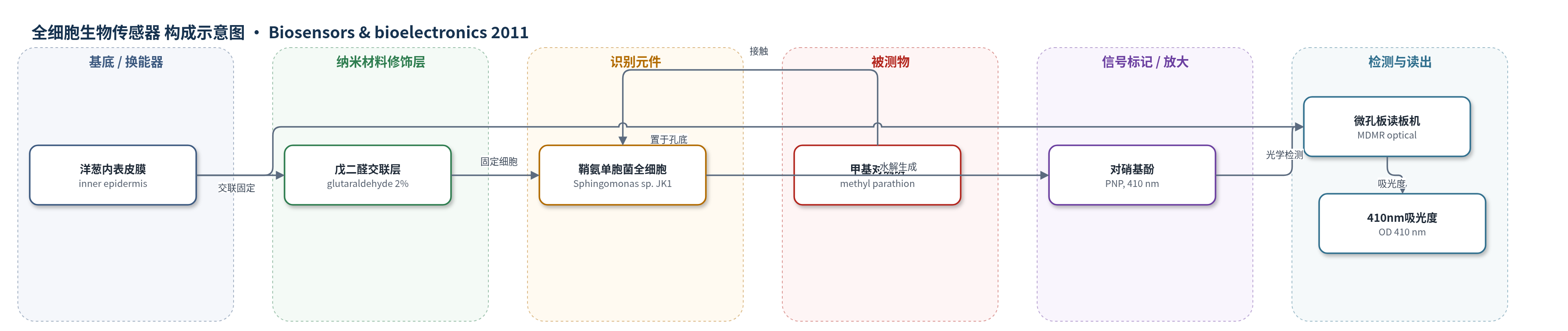
点击图片查看大图 · 依据论文自动绘制
传感器类型
全细胞生物传感器
检测对象
甲基对硫磷(methyl parathion, MP);样品基质为自来水加标样品(tap water spiked samples,与磷酸盐缓冲液 3:1 混合)
检测原理
该传感器以固定于洋葱内表皮上的 Sphingomonas sp. JK1 全细胞为识别元件。样品中的甲基对硫磷(MP)扩散至固定膜表面,被细胞内/周质表达的有机磷水解酶(OPH)催化水解,生成显色产物对硝基酚(PNP)。在 pH 8.0 磷酸盐缓冲液中,PNP 在 410 nm 处具有特征吸收,其吸光度增量与生成的 PNP 量成正比,进而与 MP 浓度成正比。固定膜置于 96 孔微孔板孔底,多检测微孔板读板机以光学换能器采集 410 nm 吸光度,通过初始与终末吸光度差值定量。戊二醛交联使细胞稳定附着,避免洗脱,使酶促反应可重复进行;在 4–80 μM 范围内信号随 MP 浓度线性增加。
检测灵敏度
线性范围: 4–80 μM;灵敏度斜率: 0.00212(校准曲线 y = 0.01296 + 0.00212x);R^2 = 0.9819
效应效果
该传感器在 4–80 μM 甲基对硫磷范围内线性响应,校准曲线 R^2 = 0.9819。单个固定洋葱膜可重复使用 52 次,仍保留 90% 初始水解活性;4 ℃ 保存 32 天后活性保留 90%,优于作者先前仅稳定 18 天的报告。不同微孔板孔间重现性良好,对 80 μM 甲基对硫磷的 RSD 为 0.156(mean = 8.48×10^-6 A,n = 6)。加标自来水样品(5–60 μM)与传感器实测值线性相关,斜率 0.961,R^2 = 0.9963,表明其适用于实际水样检测。作者认为洋葱内表皮作为天然支撑成本低、生物相容性好,结合微孔板可实现多样品并行检测,具有环境农药残留监测应用价值。
传感器的构成
- 基底支撑层:洋葱鳞茎内表皮(inner epidermis of onion bulb scale),天然聚合物膜,含纤维素、聚半乳糖醛酸(PGA)、半纤维素、蛋白和酚类/木质素,提供生物相容微环境与机械支撑
- 交联固定层:戊二醛(glutaraldehyde, GA, 2%),交联吸附的微生物细胞至膜表面及细胞间,防止洗脱并提高重复使用稳定性
- 识别元件层:鞘氨单胞菌全细胞(Sphingomonas sp. JK1 whole cells),含有机磷水解酶(organophosphorus hydrolase, OPH,opd 基因编码),催化水解甲基对硫磷
- 信号产物层:对硝基酚(p-nitrophenol, PNP),甲基对硫磷水解生成的显色产物,在 410 nm 处被光学检测
- 反应介质层:磷酸盐缓冲液(phosphate buffer, pH 8.0),维持微生物酶活性和反应条件
- 换能读出层:96 孔微孔板(microplate)与多检测微孔板读板机(multidetection microplate reader, MDMR, Biotek Synergy HT),以 410 nm 吸光度读出 PNP 信号
中文摘要
洋葱鳞茎内表皮被用作固定微生物细胞的天然支撑材料,以构建生物传感器。作者分离并鉴定出一种能水解甲基对硫磷(methyl parathion)生成显色产物对硝基酚(p-nitrophenol, PNP)的鞘氨单胞菌 Sphingomonas sp. JK1。PNP 可通过电化学或比色方法检测。将 Sphingomonas sp. 全细胞先吸附于洋葱鳞茎内表皮,再用戊二醛交联固定。固定后的洋葱膜直接置于微孔板孔中,并与多检测微孔板读板机的光学换能器联用。甲基对硫磷是一种广泛使用的有机磷杀虫剂,其残留会造成环境污染和生态问题。根据酶促反应校准曲线的线性范围,确定甲基对硫磷检测范围为 4–80 μM。单个固定膜可重复使用 52 次,并在 4 ℃ 保存 32 天后仍保留 90% 的初始水解活性。加标自来水样品验证了该固定细胞洋葱膜生物传感器的适用性。
英文摘要
Inner epidermis of onion bulb scales was used as a natural support for immobilization of microbial cells for biosensor application. A bacterium Sphingomonas sp. that hydrolyzes methyl parathion into a chromophoric product, p-nitrophenol (PNP), has been isolated and identified in our laboratory. PNP can be detected by electrochemical and colorimetric methods. Whole cells of Sphingomonas sp. were immobilized on inner epidermis of onion bulb scale by adsorption followed by cross-linking methods. Cells immobilized onion membrane was directly placed in the wells of microplate and associated with the optical transducer. Methyl parathion is an organophosphorus pesticide that has been widely used in the field of agriculture for insect pest control. This pesticide causes environmental pollution and ecological problem. A detection range 4-80 μM of methyl parathion was estimated from the linear range of calibration plot of enzymatic assay. A single membrane was reused for 52 reactions and was found to be stable for 32 days with 90% of its initial hydrolytic activity. The applicability of the cells immobilized onion membrane was also demonstrated with spiked samples.