组成图示
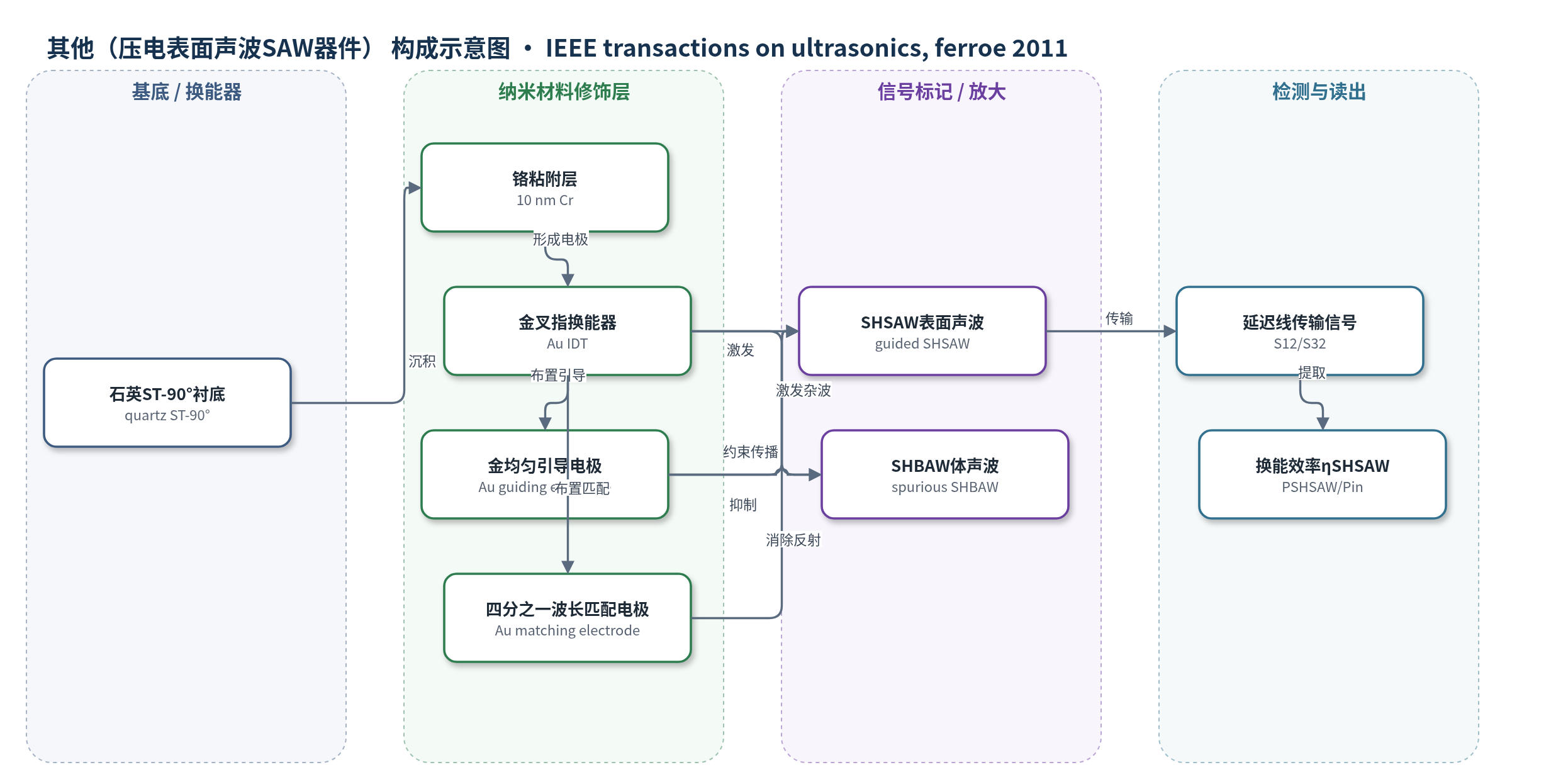
点击图片查看大图 · 依据论文自动绘制
传感器类型
其他(压电表面声波SAW器件)
检测对象
未指定具体分析物;面向液相/生物传感平台,可探测界面质量、刚度、粘度与电扰动(样品基质:液相负载)
检测原理
本文器件以石英ST-90°为压电基底,IDT施加射频电压后通过逆压电效应激发纯剪切水平表面声波(SHSAW)。若液相或生物分子在表面/界面发生吸附,会改变界面质量、刚度、粘度或电边界条件,从而改变SHSAW的相速度、衰减、相位和幅值;信号经延迟线传输至检测IDT,再经正压电效应转换为电信号,由S参数(|S12|、|S32|)读取。本文未引入特异性识别元件,信号增强主要来自金均匀电极或栅格电极对SHSAW的声学约束,以及对SHBAW杂波和边缘反射的抑制;四分之一波长匹配电极进一步消除有限长引导电极边缘反射,提高换能效率、信噪比、动态范围和分辨率。
检测灵敏度
未报告LOD、线性范围、灵敏度斜率或相关系数。
效应效果
本文未开展实际生物样品检测,因此未报告选择性、抗干扰、稳定性、RSD、回收率或ELISA/HPLC/qPCR对比。数值结果表明,均匀有限厚度金引导电极可显著提高SHSAW换能效率;示例中匹配后ηSHSAW约43%,栅格引导结构SHSAW功率比达90.8%。长均匀引导电极置于IDT两侧相比仅置于IDT之间可使SHSAW传输幅度最多提高45%;长厚IDT配栅格引导比均匀电极效率最多高8%,而短薄IDT配均匀电极比栅格最多高15%。实验器件中心频率150.8 MHz,预测方向性9.0 dB,实测9.8 dB,偏差0.8 dB,验证模型并支持其用于液相/生物传感平台。
传感器的构成
- 基底:石英ST-90°压电衬底,支持纯剪切水平表面声波传播
- 粘附层:10 nm铬Cr,增强金电极与石英结合
- 换能器电极:金Au叉指换能器IDT,将电信号转换为SHSAW并接收信号
- 金属化层:287.5 nm金Au,构成IDT与引导电极,提供质量/刚度加载与表面引导
- 均匀引导电极:有限长度金Au均匀电极,置于IDT两侧或之间,约束SHSAW并抑制SHBAW
- 匹配电极:四分之一波长金Au匹配电极,调节厚度/长度消除边缘反射,使有限长引导电极等效无限长
- 读出系统:S参数测量(|S12|、|S32|),提取SHSAW功率、方向性与换能效率
中文摘要
纯剪切水平表面声波(SHSAW)器件可在液相负载下工作,并对界面质量、刚度、粘度和电扰动敏感,因而被用于液相与生物传感。通常SHSAW在自由表面边界条件下弱引导,某些取向甚至不存在,如石英ST-90°。自由表面下叉指换能器(IDT)常激发较强剪切水平体声波(SHBAW),因此需引入周期或均匀厚电极作为引导结构,置于延迟线IDT之间,以提高SHSAW功率与IDT输入功率比ηSHSAW。作者此前用有限元/边界元(FEM/BEM)模型评估ηSHSAW,但限于自由表面或有限厚度栅格。本工作扩展到均匀有限厚度电极引导,该结构常用于液相和生物传感。通过有限长度均匀电极后附加四分之一波长匹配电极,调节其厚度和长度可消除边缘反射,使有限长引导电极等效为无限长,从而方便计算ηSHSAW,并考虑所有电极有限厚度。模拟带均匀引导电极的IDT并与实验比较,预测SHSAW激发方向性9 dB,实验在0.8 dB内确认。
英文摘要
Pure shear-horizontal surface acoustic wave (SHSAW) devices have been increasingly considered for liquidphase and biosensing applications because of their ability to operate under liquid-loaded conditions and intrinsic sensitivity to mass, stiffness, viscosity, and electrical perturbations occurring at the device/fluid interface. Typically, the SHSAW is weakly guided by a free surface boundary condition (BC) or may not even exist for some materials and orientations, such as the quartz ST-90° orientation considered in this work. For a surrounding free surface BC, the interdigital transducer (IDT) typically generates strong shear-horizontal bulk acoustic waves (SHBAWs) relative to SHSAW. For that reason, guiding structures, e.g., dense and/or thick electrodes in periodic or uniform configurations, are incorporated into the design and placed between IDTs in delay-line devices to increase the ratio of transduced SHSAW power to IDT input power, ηSHSAW. The degree of ηSHSAW improvement depends on the thickness, composition, and geometry of the guiding structure. In previous work, the authors evaluated ηSHSAW using hybrid finite and boundary element method (FEM/BEM) models, but were limited to cases of stress-free or finite-thickness-grating surrounding surfaces. This work extends the analysis to the important boundary condition case of uniform finite-thickness electrode guiding, which is typically employed in liquid-phase and biosensor applications. To integrate the uniform electrode guiding structure with the SHSAW device analysis, a combined finite-length uniform electrode structure followed by an additional quarter-wavelength electrode was considered. In this work, it is shown that adjusting the quarter-wavelength electrode's film thickness and length allows cancellation of the SHSAW reflection from the edge discontinuity. As a result, the finite-length uniform guiding electrode can be treated as if it extends to infinity, and ηSHSAW can be easily obtained. In addition, the finite thickness of all electrodes is considered in the calculations. To verify the model, an IDT with uniform guiding electrodes was simulated and compared with the experimental results of a fabricated and tested device. The simulations predict SHSAW excitation directivity of 9 dB by the IDT, which is experimentally confirmed to within 0.8 dB.