组成图示
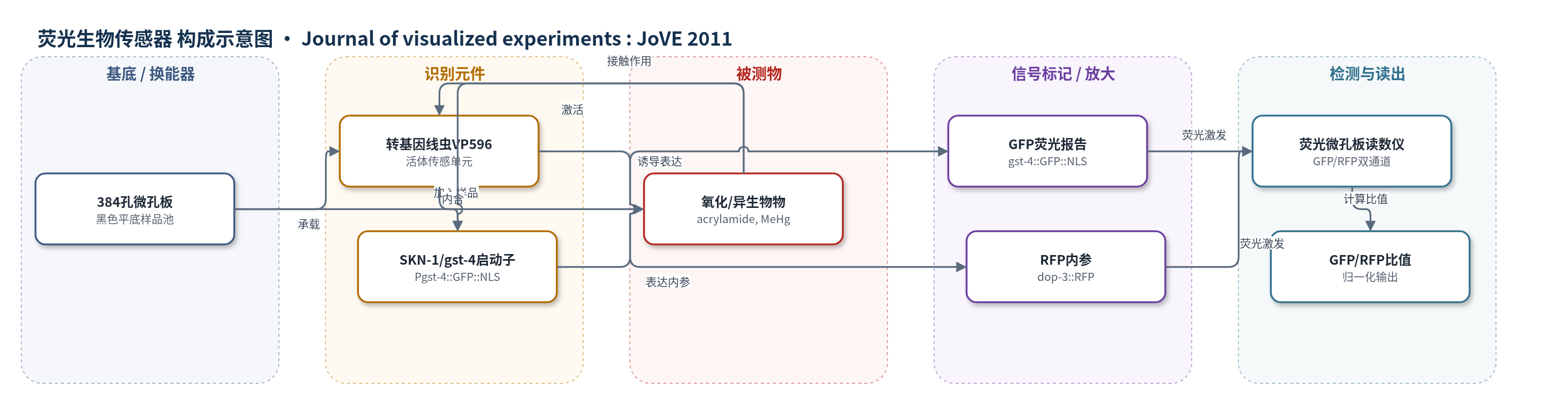
点击图片查看大图 · 依据论文自动绘制
传感器类型
荧光生物传感器
检测对象
SKN-1/Nrf2 激活型氧化/异生物化学物(oxidative/xenobiotic chemicals,如 acrylamide、methyl-mercury、juglone);样品基质:水、食品、土壤样品或化学库小分子溶液
检测原理
本方法以转基因线虫 VP596 为活体传感单元。当孔中加入氧化应激或异生物化学物(如 acrylamide、methyl-mercury、juglone)后,线虫细胞内 SKN-1/Nrf2 转录因子被激活并进入细胞核,结合 gst-4 启动子,诱导下游 gst-4::GFP::NLS 报告基因表达。GFP 荧光强度随 SKN-1 通路激活程度及被测物浓度升高而增强。同时,dop-3 启动子驱动的 RFP 作为内参,用于校正线虫数量与孔间差异。荧光微孔板读数仪分别采集 GFP(485/20ex, 528/20em)和 RFP(540/25ex, 590/35em)信号,计算 GFP/RFP 比值并与未诱导对照比较,从而定量反映污染物或通路调节剂的作用。
检测灵敏度
原文未报告 LOD、线性范围、灵敏度斜率或相关系数。
效应效果
该方法在 384 孔板中表现出良好的孔间重现性:分配体积与线虫数量呈良好相关;单孔总 GFP 和 RFP 荧光变异系数均低于 9%;GFP 与 RFP 荧光呈线性相关,计算 GFP/RFP 比值后变异系数降至 6% 以下,说明 dop-3::RFP 内参可有效降低线虫数量差异带来的波动。以 38 μM juglone 诱导时,GFP/RFP 相对荧光比值从对照均值 1.0 升至约 8.9,且 384 孔板内响应稳健、一致。作者认为该活体荧光生物传感器可用于高通量筛选 SKN-1/Nrf2 通路调节剂,并检测环境或食品样品中的氧化/异生物污染物。
传感器的构成
- 样品池/基底:黑色平底384孔微孔板(black flat-bottomed 384-well plate),承载线虫与样品并适配荧光微孔板读数
- 悬浮介质:NGM buffer 加 1% LB broth(NGM+LB),维持线虫悬浮、洗涤和生理状态
- 生物识别/响应单元:转基因线虫 VP596(dvIs19[pAF15(gst-4::GFP::NLS)];vsIs33[dop-3::RFP]),作为活体识别与信号产生单元
- 识别元件:线虫内 SKN-1/Nrf2 转录因子及 gst-4 启动子(Pgst-4),响应氧化/异生物化学物
- 信号标记物:GFP(绿色荧光蛋白)融合 NLS,由 gst-4 启动子驱动,作为 SKN-1 活性荧光报告
- 内参标记物:RFP(红色荧光蛋白)由 dop-3 启动子驱动,用于线虫数量归一化
- 被测物/样品:小分子化学库或环境样品(水、食品、土壤),加入孔中与线虫共孵育
- 读出装置:荧光微孔板读数仪(fluorescence microplate reader),采集 GFP 485/20ex 528/20em 与 RFP 540/25ex 590/35em 信号
中文摘要
高通量筛选(HTS)可鉴定生物过程的化学调节剂,但细胞培养模型中筛选出的化合物在体内常有毒性或药理学不活跃。整动物模型筛选有助于避免这些问题并加速药物开发。秀丽隐杆线虫(C. elegans)体积小(<1 mm),可经济地液体培养和分配,且实验可操作性强,适合 HTS。本文描述了培养并分配荧光线虫品系,用于高通量筛选化学库或检测改变特定基因表达的环境污染物的方案。大量发育同步线虫在液体中培养、收获、洗涤并按定义密度悬浮,用蠕动液体分配器加入黑色平底384孔板;化学库小分子或水、食品、土壤等测试样品加入含线虫孔中,用荧光微孔板读数仪实时测量体内荧光强度。该方法可适用于线虫中任何具有合适报告基因的可诱导基因。作者以监测 cap ‘n’ collar 转录因子 SKN-1 的 HTS 检测为例:SKN-1 及其哺乳动物同源物 Nrf2 在氧化和异生物应激时激活细胞保护基因。检测基于 SKN-1 靶基因 gst-4 的 GFP 转基因报告基因,gst-4 编码谷胱甘肽-S-转移酶;该报告基因可作为异生物和氧化化学物生物传感器,用于检测丙烯酰胺和甲基汞等低水平污染物。
英文摘要
High-throughput screening (HTS) is a powerful approach for identifying chemical modulators of biological processes. However, many compounds identified in screens using cell culture models are often found to be toxic or pharmacologically inactive in vivo(1-2). Screening in whole animal models can help avoid these pitfalls and streamline the path to drug development. C. elegans is a multicellular model organism well suited for HTS. It is small (<1 mm) and can be economically cultured and dispensed in liquids. C. elegans is also one of the most experimentally tractable animal models permitting rapid and detailed identification of drug mode-of-action(3). We describe a protocol for culturing and dispensing fluorescent strains of C. elegans for high-throughput screening of chemical libraries or detection of environmental contaminants that alter the expression of a specific gene. Large numbers of developmentally synchronized worms are grown in liquid culture, harvested, washed, and suspended at a defined density. Worms are then added to black, flat-bottomed 384-well plates using a peristaltic liquid dispenser. Small molecules from a chemical library or test samples (e.g., water, food, or soil) can be added to wells with worms. In vivo, real-time fluorescence intensity is measured with a fluorescence microplate reader. This method can be adapted to any inducible gene in C. elegans for which a suitable reporter is available. Many inducible stress and developmental transcriptional pathways are well defined in C. elegans and GFP transgenic reporter strains already exist for many of them(4). When combined with the appropriate transgenic reporters, our method can be used to screen for pathway modulators or to develop robust biosensor assays for environmental contaminants. We demonstrate our C. elegans culture and dispensing protocol with an HTS assay we developed to monitor the C. elegans cap 'n' collar transcription factor SKN-1. SKN-1 and its mammalian homologue Nrf2 activate cytoprotective genes during oxidative and xenobiotic stress(5-10). Nrf2 protects mammals from numerous age-related disorders such as cancer, neurodegeneration, and chronic inflammation and has become a major chemotherapeutic target(11-13).Our assay is based on a GFP transgenic reporter for the SKN-1 target gene gst-4(14), which encodes a glutathione-s transferase(6). The gst-4 reporter is also a biosensor for xenobiotic and oxidative chemicals that activate SKN-1 and can be used to detect low levels of contaminants such as acrylamide and methyl-mercury(15-16).