组成图示
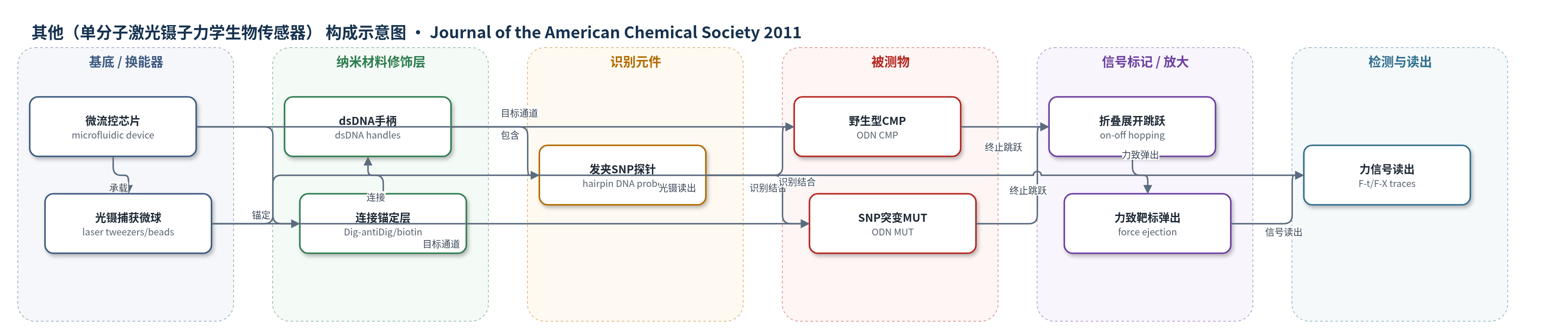
点击图片查看大图 · 依据论文自动绘制
传感器类型
其他(单分子激光镊子力学生物传感器)
检测对象
单核苷酸多态性 DNA 靶标(SNP DNA target,ODN CMP/MUT),样品基质为微流控缓冲液中的寡核苷酸溶液(含冠心病相关 SNP Rs1333049 序列)
检测原理
发夹 SNP 探针被夹在两个光镊捕获微球之间,在张力下于折叠(on)与展开(off)状态随机跳跃。当探针进入含互补 ODN 靶标的微流控通道时,靶标与发夹识别区结合,使发夹稳定展开,跳跃停止;非互补序列不结合,跳跃持续。结合事件通过力-时间曲线中跳跃消失和力-伸长曲线中折叠/展开特征消失来读出。靶标浓度越低,捕获时间越长,符合扩散控制过程。为区分 SNP,对结合态施加拉力,力致熔解使靶标弹出;野生型与突变型弹出力不同,如 CMP4 为 43±1 pN、MUT4 为 30±2 pN,弹出概率随张力变化,从而区分单碱基突变并再生探针。
检测灵敏度
LOD: 100 pM
效应效果
该方法无需 PCR 扩增,30 min 内检测 100 pM 冠心病相关 SNP 靶标。1 μM 非互补 ODN 不终止发夹跳跃,显示抗干扰;CMP1/MUT1 选择性为 80:1,弹出力分别为 44±1 与 36±1 pN。优化 15-nt 探针后,CMP4/MUT4 弹出力为 43±1 与 30±2 pN;1 μM 混合靶标呈 46±2 与 30±1 pN 双峰,选择性达 1600:1。系统可检测 A/T 单突变,5 通道微流控验证多重检测,并可通过力致弹出原位再生探针。作者认为优化流道与流速后可达 fM 级,适合作通用 on-off 数字生物传感器。
传感器的构成
- 微流控基底:互连通道微流控芯片(microfluidic device),提供缓冲通道、靶标通道与导流管,实现多重检测与探针原位再生
- 换能器/光镊系统:激光镊子(laser tweezers)与两个光学捕获微球,施加张力并记录力-时间/力-伸长信号
- 锚定连接层:双链 DNA 手柄(dsDNA handles)经地高辛-抗地高辛抗体(Dig-antiDig)和生物素-链霉亲和素(biotin-streptavidin)分别连接至两微球
- 识别元件:含 SNP 识别序列的发夹 DNA 探针(hairpin DNA probe),通过折叠/展开状态识别互补或突变寡核苷酸
- 被测物:微流控目标通道中的寡脱氧核苷酸(ODN)靶标,包括野生型 CMP 与 SNP 突变型 MUT
- 信号读出层:单分子机械 on-off 信号(hairpin 折叠/展开跳跃及力致靶标弹出事件),无需荧光/电化学标记
中文摘要
单核苷酸多态性(SNP)是个体间最常见的遗传变异,其与病原体应答、表型差异和基因功能相关,因此敏感可靠的 SNP 检测对生物医学诊断和治疗具有重要意义。多数方法依赖 PCR 等扩增步骤产生可检测信号,但扩增会增加系统复杂性,且集合平均信号常受背景干扰。本文利用单分子探针的随机行为,在微流控平台中结合激光镊子识别 SNP 序列。检测依赖 on-off 机械信号,背景干扰小,并能高特异性地区分野生型与 SNP 序列。微流控结构允许多重传感和 SNP 探针原位回收。作为概念验证,该方法无需扩增即可在半小时内检测低至 100 pM 的冠心病相关 SNP 靶标。机械信号还可检测涉及 G/C 或 A/T 碱基对的单突变。作者预期,引入适配体等特异性识别元件后,该系统可成为高灵敏通用生物传感器。
英文摘要
Single nucleotide polymorphism (SNP) is the most common genetic variation among individuals. The association of SNP with individual's response to pathogens, phenotypic variations, and gene functions emphasizes the importance of sensitive and reliable SNP detection for biomedical diagnosis and therapy. To increase sensitivity, most approaches employ amplification steps, such as PCR, to generate detectable signals that are usually ensemble-averaged. Introduction of amplification steps increases the complexity of a system, whereas ensemble averaging of signals often suffers from background interference. Here, we have exploited the stochastic behavior of a single-molecule probe to recognize SNP sequence in a microfluidic platform using a laser-tweezers instrument. The detection relies on on-off mechanical signals that provide little background interference and high specificity between wild type and SNP sequences. The microfluidic setting allows multiplex sensing and in situ recycling of the SNP probe. As a proof-of-concept, we have detected as low as 100 pM of an SNP target associated with coronary heart diseases within half an hour without any amplification steps. The mechanical signal permits the detection of single mutations involving either G/C or A/T pairs. We anticipate this system has the capacity to function as a highly sensitive generic biosensor after incorporation of a specific recognition element, such as an aptamer for example.