组成图示
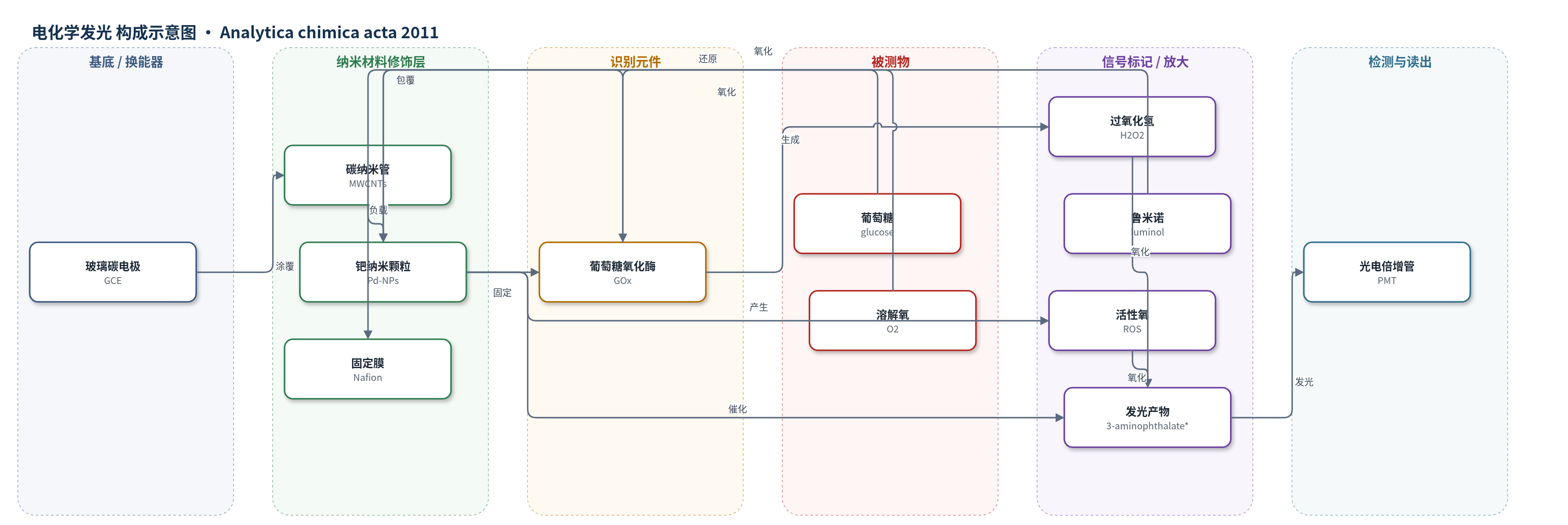
点击图片查看大图 · 依据论文自动绘制
传感器类型
电化学发光(ECL)生物传感器
检测对象
溶解氧(dissolved oxygen, O2,PBS 缓冲液)、葡萄糖(glucose,PBS 及正常人血清)、过氧化氢(H2O2,PBS)、鲁米诺(luminol,PBS)
检测原理
在 GCE/nanoPd-MWCNTs 电极上,Pd-NPs 提供电催化位点。检测溶解氧时,先施加 -0.3 V 还原电位 60 s,Pd-NPs 催化 O2 还原生成 HO2•、O2•− 和 OH• 等 ROS;随后正扫至 0.8 V,luminol 在约 0.45 V 被氧化为 luminol 自由基阴离子,ROS 进一步氧化该自由基生成激发态 3-aminophthalate,发射约 425 nm ECL 光。O2 浓度越高,ROS 越多,ECL 越强。检测葡萄糖时,GOx 催化葡萄糖氧化生成 H2O2;H2O2 在 Pd-NPs 表面氧化产生 ROS,并直接参与氧化 luminol 自由基,同时 Pd-NPs 催化 luminol 氧化,使 ECL 随葡萄糖浓度增加。Nafion 固定 GOx,PMT 读取光信号。
检测灵敏度
溶解氧:LOD: 0.02 mM;线性范围: 0.08–0.94 mM;R^2 = 0.9996;校准方程: y = 33692x - 2399.1。葡萄糖:LOD: 54 nM;线性范围: 0.1–1000 μM;R^2 = 0.9998;校准方程: y = 29.424x + 0.7646。H2O2:LOD: 0.5 nM;线性范围: 1 nM–0.45 mM;r = 0.9997。鲁米诺:LOD: 8 nM;线性范围: 50 nM–100 μM;r = 0.9997。
效应效果
该传感器重现性良好:0.50 mM O2、10 μM葡萄糖、10 μM H2O2和100 μM鲁米诺的RSD分别为3.5%、0.3%、0.8%和0.7%;5个电极制备重现性为8.6%。葡萄糖传感器一周内响应保持初始值的约76%。抗干扰方面,甘氨酸、丙氨酸、果糖、麦芽糖、蔗糖和半乳糖在约0.01 M(100倍)无干扰;抗坏血酸和尿酸最大允许浓度50 μM,多巴胺5 μM。正常人血清葡萄糖测得4.82 mM,医院值4.67 mM,回收率约103%;加标回收率97%–103%。作者认为其LOD和线性范围优于多种鲁米诺ECL葡萄糖传感器,可用于临床诊断、免疫分析和环境监测。
传感器的构成
- 基底/换能器电极:GCE(玻璃碳电极,导电基底与 ECL 信号产生界面)
- 纳米杂化修饰层:nanoPd-MWCNTs(Pd-NPs 负载 MWCNTs,催化鲁米诺氧化、O2 还原和 H2O2 氧化,增强 ECL)
- 识别元件:GOx(葡萄糖氧化酶,催化葡萄糖氧化生成 H2O2,仅用于葡萄糖传感器)
- 固定/封闭层:Nafion(全氟离子交换膜,固定 GOx 并阻隔干扰物)
- 发光剂/信号标记物:luminol(鲁米诺,工作液中加入,氧化后与 ROS/H2O2 反应产生激发态 3-aminophthalate 发光)
中文摘要
将钯纳米颗粒(Pd-NPs)负载到多壁碳纳米管(MWCNTs)表面,制备纳米杂化材料 nanoPd-MWCNTs,并将其修饰玻璃碳电极(GCE),得到新型 ECL 电极。该修饰电极在中性介质中对鲁米诺–O2 和鲁米诺–H2O2 电致发光(ECL)反应表现出显著的电催化活性和敏化作用。基于鲁米诺–O2 体系,ECL 信号强度与溶解氧浓度在 0.08–0.94 mM 范围内线性相关(r = 0.9996);基于鲁米诺–H2O2 体系,ECL 信号强度与葡萄糖浓度在 0.1–1000 μM 范围内线性相关(r = 0.9998)。溶解氧和葡萄糖的检出限(S/N = 3)分别为 0.02 mM 和 54 nM。重复测定 0.50 mM 溶解氧(n = 10)和 10 μM 葡萄糖(n = 30)的相对标准偏差分别为 3.5% 和 0.3%。此外,鲁米诺–H2O2 体系对 H2O2 在 1 nM–0.45 mM 范围内线性(r = 0.9997),H2O2 检出限为 0.5 nM,10 μM H2O2 的 RSD 为 0.8%。
英文摘要
Incorporation of palladium nanoparticles on the surface of multi-walled carbon nanotubes and modification of glassy carbon electrode with the prepared nano-hybrid material led to the fabrication of a novel electrode. The modified electrode showed attractive electrocatalytic activity and sensitizing effect on luminol-O(2) and luminol-H(2)O(2) electrochemiluminescence (ECL) reactions at neutral media. The sensitized luminol-O(2) and luminol-H(2)O(2) reactions were successfully applied for the ECL determination of dissolved O(2) and glucose, respectively. Under the optimal conditions for luminol-O(2) system, the ECL signal intensity of luminol was linear with the concentration of dissolved oxygen in the range between 0.08 and 0.94 mM (r=0.9996) and for luminol-H(2)O(2) system, the ECL signal intensity of luminol was linear with the concentration of glucose in the range between 0.1 and 1000 μM (r=0.9998). The limits of detection (S/N=3) for dissolved oxygen and glucose were 0.02 mM and 54 nM, respectively. The relative standard deviations (RSD) for repetitive measurements of 0.50 mM oxygen (n=10) and 10 μM glucose (n=30) were 3.5% and 0.3%, respectively. Also, under the optimal conditions for luminol-H(2)O(2) system, the ECL signal intensity of luminol was linear with the concentration of H(2)O(2) in the range between 1 nM and 0.45 mM (r=0.9997). The limit of detection (S/N=3) for H(2)O(2) detection was 0.5 nM and the relative standard deviation for repetitive measurements of 10 μM H(2)O(2) (n=10) was 0.8%.