组成图示
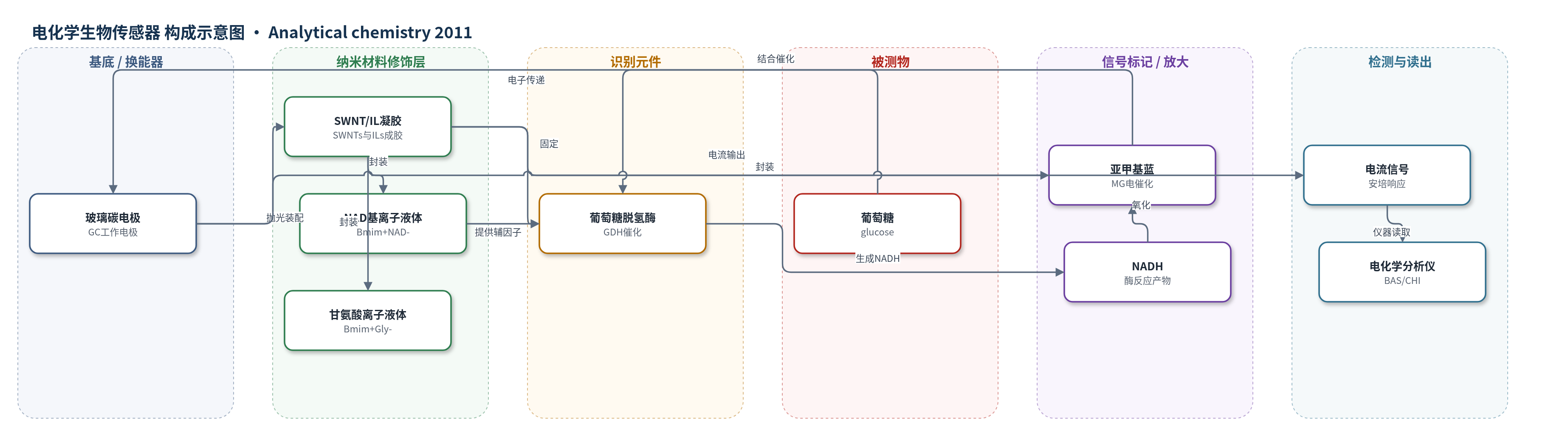
点击图片查看大图 · 依据论文自动绘制
传感器类型
电化学生物传感器
检测对象
葡萄糖(glucose);样品基质:0.10 M磷酸缓冲液(PBS, pH 7.0)
检测原理
GDH以NAD+为辅因子催化葡萄糖氧化,生成葡萄糖酸和NADH;NADH被MG电催化氧化再生NAD+,电子经MG和SWNT/IL凝胶传递至GC电极,在+0.20 V产生安培电流。NAD+以Bmim+NAD-形式稳定封装于SWNT/IL bucky gel,Bmim+Gly-协助成胶,MG与SWNT相互作用稳定封装,形成电子/离子导电网络。葡萄糖浓度越高,酶促反应生成NADH越多,氧化电流越大。信号放大来自酶催化循环和MG对NADH的电催化氧化。
检测灵敏度
线性范围: 20 μM–3.8 mM;线性系数: 0.999
效应效果
该传感器在0.10 M PBS(pH 7.0)中对葡萄糖响应良好,连续运行60 min以上电流基本不变,稳定性优于以天然NAD溶解于Bmim+Gly-/SWNT凝胶为换能层的对照传感器,且灵敏度更高。同一电极重复测量葡萄糖的RSD为3.30%(n=7),不同电极同法制备后平行测量同浓度葡萄糖的RSD为4.70%(n=6),表明凝胶换能器可显著降低传感器间偏差。论文未报告选择性、抗干扰、实际样品回收率或与ELISA/HPLC/qPCR的定量对比。作者认为该策略简化了脱氢酶型电化学生物传感器制备,适用于环境监测、食品分析和临床诊断等快速检测。
传感器的构成
- 基底/工作电极:玻璃碳电极(GC),提供电子传导与信号读出
- 多功能凝胶换能层:单壁碳纳米管(SWNTs)与离子液体(ILs)一步研磨形成的bucky gel,提供电子/离子导电并稳定封装组分
- 辅因子离子液体:NAD基离子液体Bmim+NAD-,以NAD+为阴离子,作为GDH辅因子载体并保持生物活性
- 辅助离子液体:Bmim+Gly-,液态离子液体,协助SWNTs形成凝胶并改善生物相容性
- 电催化电子介体:亚甲基蓝(MG),封装于SWNT/IL凝胶中,催化氧化NADH并传递电子
- 识别元件:葡萄糖脱氢酶(GDH),固定于凝胶修饰电极表面,特异性催化葡萄糖氧化
- 电化学测量体系:Ag/AgCl参比电极、Pt对电极及0.10 M磷酸缓冲液(PBS, pH 7.0),用于三电极电流检测
中文摘要
本研究提出一种通过理性设计并一步形成多功能凝胶电子换能器来简化生物传感器制备、降低传感器间偏差的新策略,并以葡萄糖脱氢酶(GDH)电化学生物传感器为例。为满足整合型传感器制备及电子/离子导电要求,作者合成了以酶辅因子氧化型烟酰胺腺嘌呤二核苷酸(NAD+)为阴离子的离子液体(ILs),并与单壁碳纳米管(SWNTs)形成bucky gel,其中稳定封装亚甲基蓝(MG)电催化剂用于氧化还原型烟酰胺腺嘌呤二核苷酸(NADH)。以该多功能凝胶为电子换能器,GDH电化学生物传感器只需将电极在凝胶上抛光后再固定酶即可制备。该策略显著简化传感器制备、延长稳定性,并明显降低传感器间偏差。同一电极重复测量葡萄糖的相对标准偏差为3.30%(n=7),不同电极同法制备后平行测量同浓度葡萄糖的相对标准偏差为4.70%(n=6)。这些优异性能使其可满足环境监测、食品分析和临床诊断等快速检测需求。
英文摘要
This study demonstrates a new strategy to simplify the biosensor fabrication and thus minimize the biosensor-to-biosensor deviation through rational design and one-step formation of a multifunctional gel electronic transducer integrating all elements necessitated for efficiently transducing the biorecognition events to signal readout, by using glucose dehydrogenase (GDH) based electrochemical biosensor as an example. To meet the requirements for preparing integrated biosensors and retaining electronic and ionic conductivities for electronically transducing process, ionic liquids (ILs) with enzyme cofactor (i.e., oxidized form of nicotinamide adenine dinucleotide) as the anion were synthesized and used to form a bucky gel with single-walled carbon nanotubes, in which methylene green electrocatalyst was stably encapsulated for the oxidation of nicotinamide adenine dinucleotide. With such kind of rationally designed and one-step-formed multifunctional gel as the electronic transducer, the GDH-based electrochemical biosensors were simply fabricated by polishing the electrodes onto the gel followed by enzyme immobilization. This capability greatly simplifies the biosensor fabrication, prolongs the stability of the biosensors, and, more remarkably, minimizes the biosensor-to-biosensor deviation. The relative standard deviations obtained both with one electrode for the repeated measurements of glucose and with the different electrodes prepared with the same method for the concurrent measurements of glucose with the same concentration were 3.30% (n = 7) and 4.70% (n = 6), respectively. These excellent properties of the multifunctional gel-based biosensors substantially enable them to well-satisfy the pressing need of rapid measurements, for example, environmental monitoring, food analysis, and clinical diagnoses.