组成图示
点击图片查看大图 · 依据论文自动绘制
传感器类型
电化学生物传感器
检测对象
总胆固醇(total cholesterol,含游离胆固醇 free cholesterol 与胆固醇酯 cholesterol esters);样品基质:pH 7.4 磷酸盐缓冲液、人造黄油(margarine)、黄油(butter)、鱼油(fish oil)
检测原理
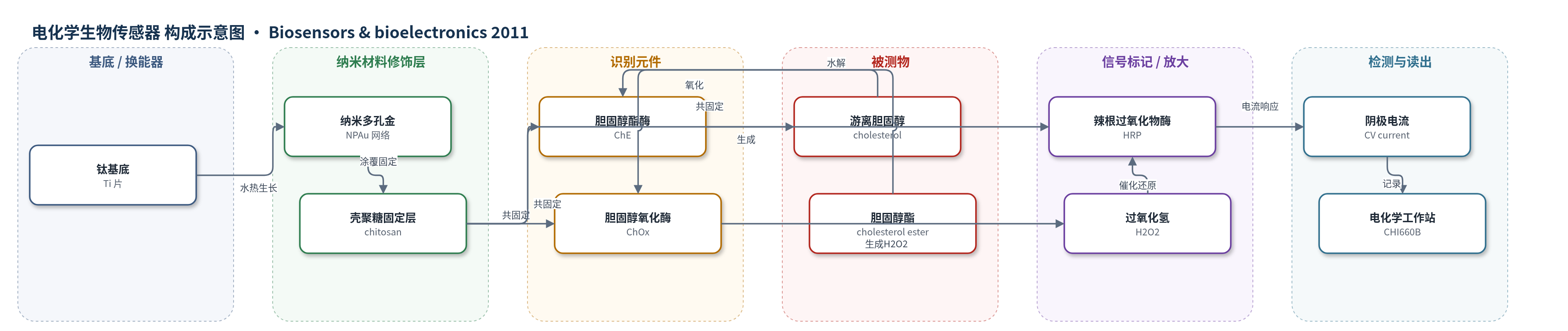
胆固醇酯先被固定于纳米多孔金表面的胆固醇酯酶(ChE)水解为游离胆固醇和脂肪酸;游离胆固醇再被胆固醇氧化酶(ChOx)催化氧化,与 O2 反应生成 4-胆甾烯-3-酮和 H2O2。生成的 H2O2 在电极表面被辣根过氧化物酶(HRP)催化还原,HRP 血红素 Fe(III) 与 H2O2 结合形成 Compound I/II,经单电子转移再生,使 H2O2 在较低过电位发生电化学还原,产生与 H2O2 浓度成正比的阴极电流。由于 H2O2 生成量与总胆固醇浓度成正比,阴极峰电流随胆固醇浓度增加而增大。纳米多孔金网络提供高比表面积、良好导电性和酶固定微环境,壳聚糖增强酶保留,从而提高灵敏度并降低表观 Michaelis 常数。
检测灵敏度
LOD: 0.5 mg dL−1;线性范围: 0.97–7.8 mM(最高 300 mg dL−1);灵敏度: 29.33 μA mM−1 cm−2
效应效果
该传感器对常见干扰物抗干扰性好:0.1 mM 抗坏血酸、5 mM 乳酸、5 mM 葡萄糖和 0.1 mM 尿酸仅产生可忽略或较小电流,而 5.2 mM 胆固醇产生强响应。五个独立制备传感器的相对标准偏差为 5.0%。在 4°C 磷酸盐缓冲液中保存 60 天后仍保持初始电流响应的 95%。与文献金基胆固醇传感器相比,其表观 Michaelis 常数 0.64 mM、灵敏度 29.33 μA mM−1 cm−2 和线性范围 0.97–7.8 mM 更优。实际食品样品中,黄油测得 2.35±0.03 mg(标签 2.4 mg),人造黄油 0.69±0.05 mg(标签 0 mg),鱼油 45.82±0.06 mg(标签 46 mg),与标签值一致,表明可用于临床诊断和食品质量控制。
传感器的构成
- 基底/换能器电极:钛片(Ti)经盐酸刻蚀,作为导电基底并粗糙化表面
- 纳米材料修饰层:纳米多孔金网络(NPAu)由 HAuCl4 与甲酸铵水热生长,提供高比表面积和电子传导通道
- 固定/稳定层:壳聚糖(chitosan)作为胶黏剂,增强酶在 NPAu 上的保留和稳定性
- 识别/催化元件:胆固醇酯酶(ChE)水解胆固醇酯为游离胆固醇
- 识别/催化元件:胆固醇氧化酶(ChOx)催化胆固醇氧化生成 4-胆甾烯-3-酮和 H2O2
- 信号转换元件:辣根过氧化物酶(HRP)催化 H2O2 电化学还原,产生与胆固醇浓度相关的阴极电流
中文摘要
本文报道一种用于总胆固醇检测的高灵敏电化学生物传感器。该传感器通过在直接生长于钛基底上的纳米多孔金网络上共固定胆固醇氧化酶(ChOx)、胆固醇酯酶(ChE)和辣根过氧化物酶(HRP)制备,记为 Ti/NPAu/ChOx–HRP–ChE。采用扫描电镜、能谱和 X 射线衍射对纳米多孔金形貌与组成进行表征。循环伏安法研究表明,所构建传感器具有高选择性和高灵敏度(29.33 μA mM−1 cm−2)。其表观 Michaelis–Menten 常数很低(0.64 mM),源于有效固定过程和纳米多孔基底结构。在生理条件(pH 7.4)下,传感器具有宽线性范围,最高可达 300 mg dL−1,适合临床胆固醇检测。进一步用真实食品样品(人造黄油、黄油和鱼油)测试,表明该传感器可便捷用于食品和补充剂质量控制。
英文摘要
We report on a highly sensitive electrochemical biosensor for the determination of total cholesterol. The novel biosensor was fabricated by co-immobilizing three enzymes, cholesterol oxidase (ChO(x)), cholesterol esterase (ChE) and horseradish peroxidase (HRP), on nanoporous gold networks directly grown on a titanium substrate (Ti/NPAu/ChO(x)-HRP-ChE). The morphology and composition of the fabricated nanoporous gold were characterized by scanning electron microscopy (SEM), energy-dispersive X-ray spectroscopy (EDS) and X-ray diffraction spectroscopy (XRD). The electrochemical behaviour of the Ti/NPAu/ChO(x)-HRP-ChE biosensor was studied using cyclic voltammetry (CV), showing that the developed biosensor possessed high selectivity and high sensitivity (29.33 μA mM⁻¹ cm⁻²). The apparent Michaelis-Menten constant, K(M)(app) of this biosensor was very low (0.64 mM), originating from the effective immobilization process and the nanoporous structure of the substrate. The biosensor exhibited a wide linear range up to 300 mg dL⁻¹ in a physiological condition (pH 7.4), which makes it very promising for the clinical determination of cholesterol. The fabricated biosensor was further tested using real food samples margarine, butter and fish oil, showing that the biosensor has the potential to be used as a facile cholesterol detection tool in food and supplement quality control.