组成图示
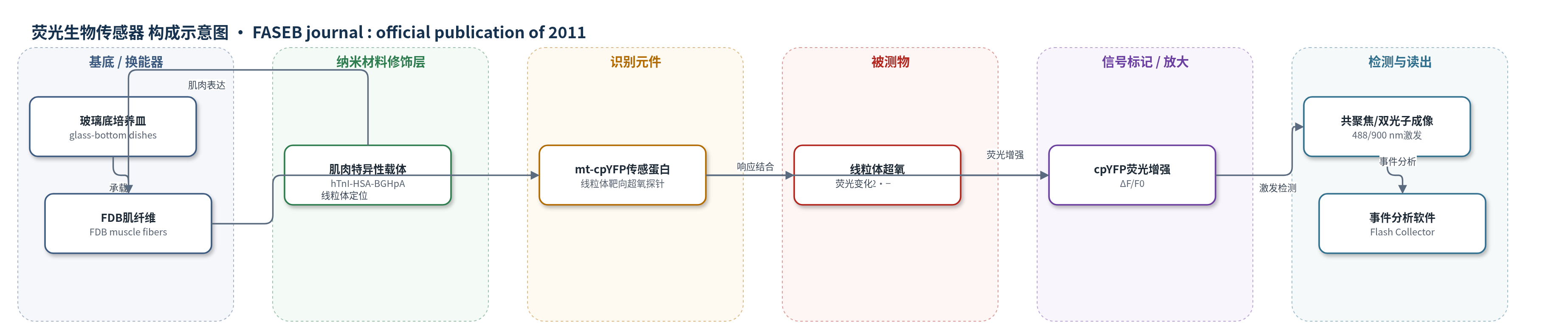
点击图片查看大图 · 依据论文自动绘制
传感器类型
荧光生物传感器
检测对象
线粒体超氧(mitochondrial superoxide, O2•−);样品基质:小鼠骨骼肌趾短屈肌 FDB 肌纤维(flexor digitorum brevis muscle fibers)/线粒体基质
检测原理
mt-cpYFP 经线粒体靶向序列进入线粒体基质,作为超氧识别元件。当 ETC 电子漏产生超氧 O2•− 时,超氧与 mt-cpYFP 发生选择性反应,引起探针荧光增强,形成持续数秒的 mSOF 事件;随后超氧被清除或探针恢复,荧光回落。共聚焦或双光子显微镜以 488 nm 或 900 nm 激发,检测 515/30 nm 或 520–550 nm 发射的 ΔF/F0 时间序列。Flash Collector 自动识别事件并计算频率、幅度、FDHM 和面积。mSOF 频率和幅度随线粒体呼吸/超氧生成速率增加而升高,受 ETC 和 ANT 活性调节,不依赖 mPTP;无外源放大,空间传播反映线粒体网络内再生性超氧生成。
检测灵敏度
原文未报告 LOD、线性范围、灵敏度斜率或相关系数。
效应效果
mt-cpYFP 选择性响应超氧,不受 H2O2、NO、Ca2+、ATP/ADP 干扰;MnTMPyP 和 tiron 抑制闪烁。rotenone 5 μM 使频率(次/1000 μm²·100 s)由 9.3±1.8 降至 1.8±0.3,oligomycin 5 μM 由 10.8±2.3 降至 2.2±0.3;BA、CATR 降低频率。CsA 与 CypD−/− 不改变 mSOF。5 次强直刺激使频率由 18.1±1.6 升至 22.3±2.0,40 次后降至 7.7±1.6 并恢复;RYR1Y522S/WT 37°C 升至 19.8±2.6。作者认为 mSOF 是线粒体呼吸与肌肉代谢状态的高敏感标志物。
传感器的构成
- 成像基底:玻璃底培养皿(glass-bottom dishes),承载分离的 FDB 肌纤维并用于共聚焦/双光子成像
- 表达载体:pcDNA3.1(−)-hTnI-HSA-BGHpA,含 hTnI USE、HSA 启动子、BGH polyA 和 C 端 3X HA-tag,实现骨骼肌特异性表达 mt-cpYFP
- 靶向元件:线粒体靶向序列(mitochondrial targeting sequence),将 cpYFP 导向线粒体基质
- 识别元件:mt-cpYFP(线粒体靶向循环置换黄色荧光蛋白),选择性响应超氧 O2•− 并产生荧光增强
- 辅助标记:TMRE(tetramethylrhodamine ethyl ester),共定位线粒体并同步监测线粒体膜电位
- 信号读出:共聚焦/双光子显微镜,488 nm 激发、515/30 nm 发射或 900 nm 双光子激发、520–550 nm 发射检测 mt-cpYFP 荧光
中文摘要
线粒体超氧闪烁(mSOFs)是线粒体超氧量子化生成的随机事件。本研究利用肌肉特异性表达新型线粒体靶向超氧生物传感器 mt-cpYFP 的转基因小鼠,检测趾短屈肌(FDB)肌纤维在静息、强烈活动和病理状态下的 mSOF 活性。结果显示,骨骼肌中的 mSOF 活性依赖于电子传递链(ETC)和腺嘌呤核苷酸转位酶(ANT)功能,但不依赖于亲环蛋白 D(CypD)介导的线粒体通透性转换孔(mPTP)活性。单个 mSOF 事件呈现多样的空间尺度,电子显微镜观察表明其反映了复杂的线粒体网络形态。肌肉活动以双相方式调节 mSOF:短暂强直刺激后频率显著升高(5 次强直刺激前后分别为 18.1±1.6 和 22.3±2.0 次/1000 μm²·100 s),而长时间强直刺激(40 次)后明显下降至 7.7±1.6 次/1000 μm²·100 s。在恶性高热和热诱导高代谢小鼠模型 RYR1Y522S/WT 中,mSOF 频率呈显著温度依赖性升高(23°C 为 11.9±0.8,37°C 为 19.8±2.6 次/1000 μm²·100 s)。这些结果表明,mSOF 活性是线粒体呼吸和肌肉细胞代谢状态在生理活动及病理氧化应激下的高度敏感生物标志物。
英文摘要
Mitochondrial superoxide flashes (mSOFs) are stochastic events of quantal mitochondrial superoxide generation. Here, we used flexor digitorum brevis muscle fibers from transgenic mice with muscle-specific expression of a novel mitochondrial-targeted superoxide biosensor (mt-cpYFP) to characterize mSOF activity in skeletal muscle at rest, following intense activity, and under pathological conditions. Results demonstrate that mSOF activity in muscle depended on electron transport chain and adenine nucleotide translocase functionality, but it was independent of cyclophilin-D-mediated mitochondrial permeability transition pore activity. The diverse spatial dimensions of individual mSOF events were found to reflect a complex underlying morphology of the mitochondrial network, as examined by electron microscopy. Muscle activity regulated mSOF activity in a biphasic manner. Specifically, mSOF frequency was significantly increased following brief tetanic stimulation (18.1 ± 1.6 to 22.3 ± 2.0 flashes/1000 μm²·100 s before and after 5 tetani) and markedly decreased (to 7.7 ± 1.6 flashes/1000 μm²·100 s) following prolonged tetanic stimulation (40 tetani). A significant temperature-dependent increase in mSOF frequency (11.9 ± 0.8 and 19.8 ± 2.6 flashes/1000 μm²·100 s at 23°C and 37°C) was observed in fibers from RYR1(Y522S/WT) mice, a mouse model of malignant hyperthermia and heat-induced hypermetabolism. Together, these results demonstrate that mSOF activity is a highly sensitive biomarker of mitochondrial respiration and the cellular metabolic state of muscle during physiological activity and pathological oxidative stress