组成图示
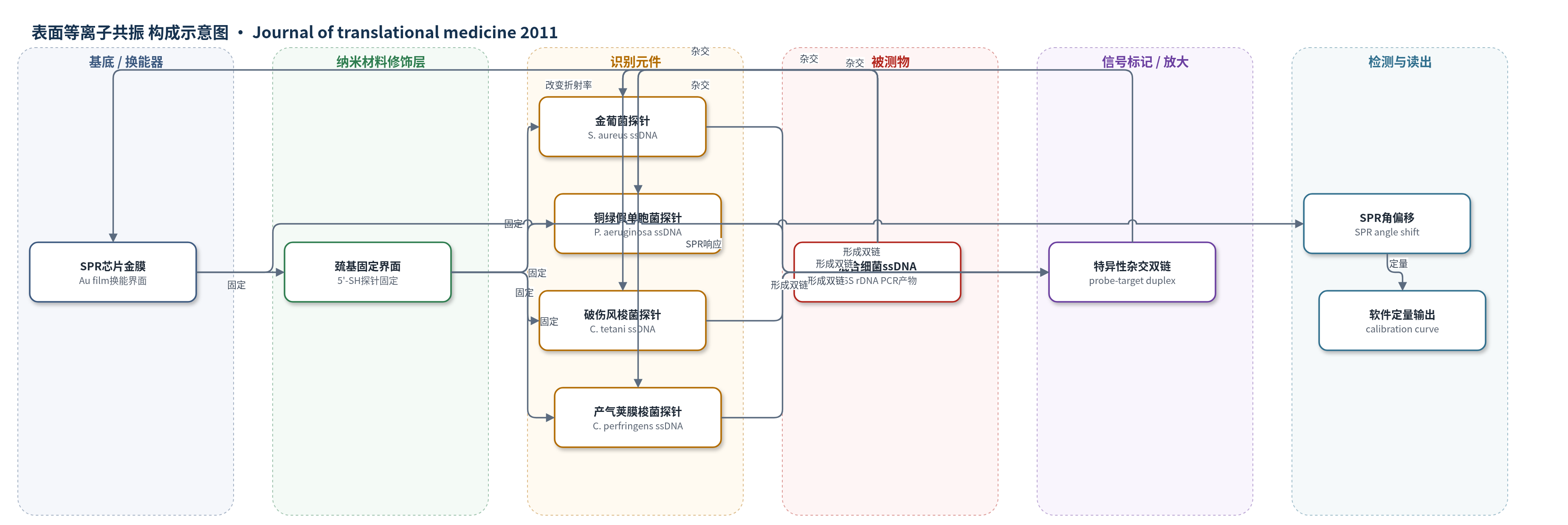
点击图片查看大图 · 依据论文自动绘制
传感器类型
表面等离子共振(SPR)生物传感器
检测对象
铜绿假单胞菌(Pseudomonas aeruginosa)、金黄色葡萄球菌(Staphylococcus aureus)、破伤风梭菌(Clostridium tetani)、产气荚膜梭菌(Clostridium perfringens)的16S rDNA单链扩增产物;样品基质为临床感染组织样品及标准菌株DNA/PCR产物。
检测原理
以16S rDNA通用引物通过LATE-PCR同时扩增四种细菌特异性单链DNA片段,避免双链产物高温解链步骤。芯片表面固定四种5'-巯基标记的细菌特异性ssDNA探针,形成串联阵列。样品中目标ssDNA与互补探针杂交形成双链,使金膜界面厚度或折射率改变,激发SPR共振角发生偏移。样品在循环检测井中反复流过探针区,提高低浓度目标捕获效率;串联排列降低探针间干扰。光检测器实时记录SPR角偏移,经软件转换为电信号,并与标准曲线比较定量。目标浓度越高,杂交量越多,SPR角偏移越大。
检测灵敏度
LOD: 铜绿假单胞菌 0.03 nM;金黄色葡萄球菌 0.02 nM;破伤风梭菌 0.01 nM;产气荚膜梭菌 0.02 nM(摘要)/0.03 nM(结果);线性范围: 0.1 nM–100 nM;R^2 > 0.99;校准曲线: y=0.153×ln(x)+0.197(铜绿假单胞菌,R^2=0.9991)、y=0.121×ln(x)+0.103(金黄色葡萄球菌,R^2=0.9974)、y=0.139×ln(x)+0.157(产气荚膜梭菌,R^2=0.9974)、y=0.160×ln(x)+0.222(破伤风梭菌,R^2=0.9994)
效应效果
该SPR方法对单碱基错配和非特异探针杂交均无显著信号(P<0.05),四种细菌间交叉反应低。365例临床感染组织样品中,与培养法比较:铜绿假单胞菌灵敏度92.86%、特异性95.65%;金黄色葡萄球菌98.33%、100%;产气荚膜梭菌96.67%、97.14%;破伤风梭菌91.67%、96.23%,检测率差异无统计学意义(P>0.05)。芯片前100次再生后SPR角下降<20%,200次后效率<50%,可再生>100次。PCR产物定量15 min内完成,全流程约3–4 h,较培养法1周缩短至2–3 h,适合混合感染快速诊断。
传感器的构成
- 基底/换能器:SPR传感芯片(5 mm × 10 mm)表面金膜(Au film),作为SPR换能界面,感应杂交引起的折射率变化
- 识别元件固定层:5'-巯基(SH)标记的细菌特异性ssDNA探针,固定于金膜表面,形成探针单分子层
- 识别元件:四种细菌特异性ssDNA探针,分别对应铜绿假单胞菌、金黄色葡萄球菌、破伤风梭菌和产气荚膜梭菌,用于捕获16S rDNA扩增产物
- 阵列结构:串联探针阵列(tandem probe arrays)与循环检测井(circulation detection well),使样品反复通过探针区,提高低浓度检测灵敏度
- 样品流路:样品加载腔(sample-loading chamber)与微流泵(micro-flow pump),将PCR产物引入检测井
- 光学读出:偏振光源(polarized light source)与光检测器(light detector),实时记录SPR角偏移并转换为电信号
中文摘要
背景:混合需氧-厌氧感染因复杂环境中表型变化而难以早期检测。表面等离子共振(SPR)生物传感器可无标记、灵敏地检测DNA相互作用。方法:本研究开发单链DNA(ssDNA)扩增技术并改造SPR系统,快速同时检测铜绿假单胞菌、金黄色葡萄球菌、破伤风梭菌和产气荚膜梭菌的混合感染。结果:循环检测井提高灵敏度,串联探针阵列降低非特异杂交;16S rDNA通用引物同时扩增四种目标序列,电泳和测序证实高效。单碱基错配或非特异杂交无显著信号(P<0.05)。四种细菌扩增产物在0.1–100 nM线性良好,R2>0.99;检测限分别为0.03、0.02、0.01和0.02 nM。SPR法与培养法检测率相同(P<0.05),PCR产物定量15 min内完成,再生性能良好。结论:该方法可快速准确识别混合需氧-厌氧感染,是细菌培养的可靠替代。
英文摘要
BACKGROUND: Early detection of mixed aerobic-anaerobic infection has been a challenge in clinical practice due to the phenotypic changes in complex environments. Surface plasmon resonance (SPR) biosensor is widely used to detect DNA-DNA interaction and offers a sensitive and label-free approach in DNA research.
METHODS: In this study, we developed a single-stranded DNA (ssDNA) amplification technique and modified the traditional SPR detection system for rapid and simultaneous detection of mixed infections of four pathogenic microorganisms (Pseudomonas aeruginosa, Staphylococcus aureus, Clostridium tetani and Clostridium perfringens).
RESULTS: We constructed the circulation detection well to increase the sensitivity and the tandem probe arrays to reduce the non-specific hybridization. The use of 16S rDNA universal primers ensured the amplification of four target nucleic acid sequences simultaneously, and further electrophoresis and sequencing confirmed the high efficiency of this amplification method. No significant signals were detected during the single-base mismatch or non-specific probe hybridization (P < 0.05). The calibration curves of amplification products of four bacteria had good linearity from 0.1 nM to 100 nM, with all R(2) values of >0.99. The lowest detection limits were 0.03 nM for P. aeruginosa, 0.02 nM for S. aureus, 0.01 nM for C. tetani and 0.02 nM for C. perfringens. The SPR biosensor had the same detection rate as the traditional culture method (P < 0.05). In addition, the quantification of PCR products can be completed within 15 min, and excellent regeneration greatly reduces the cost for detection.
CONCLUSIONS: Our method can rapidly and accurately identify the mixed aerobic-anaerobic infection, providing a reliable alternative to bacterial culture for rapid bacteria detection.