组成图示
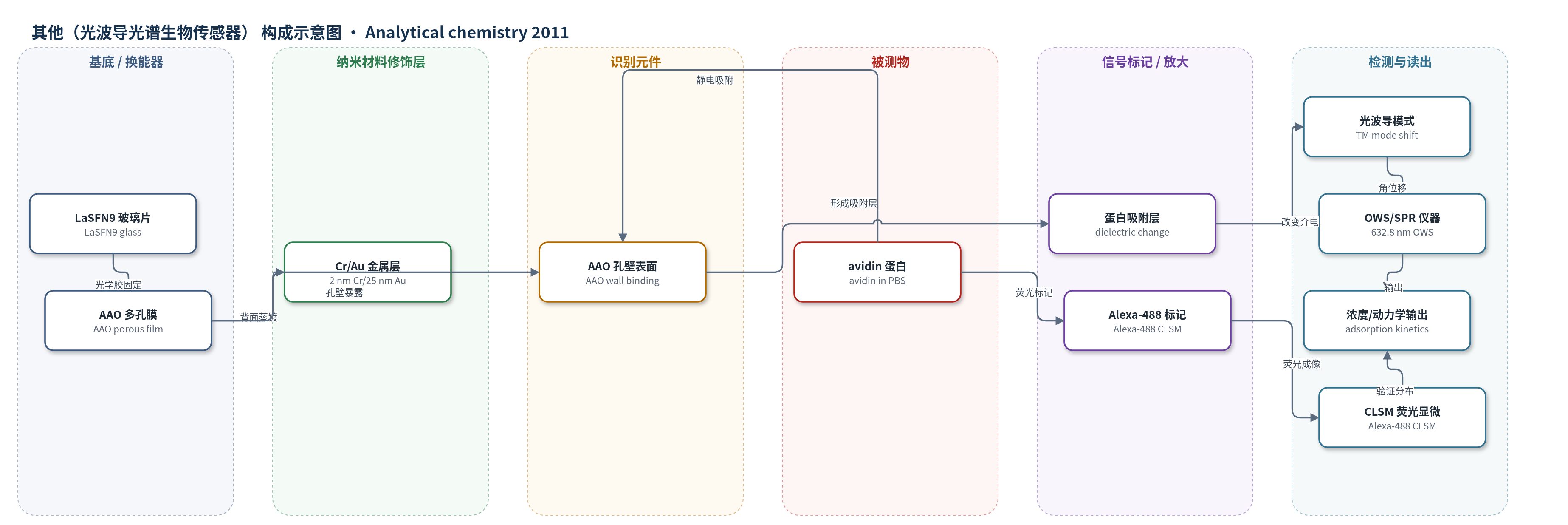
点击图片查看大图 · 依据论文自动绘制
传感器类型
其他(光波导光谱生物传感器)
检测对象
卵白蛋白(avidin);样品基质:PBS 缓冲液(20 mM 磷酸盐,100 mM NaCl,pH 7)
检测原理
在 pH>5 的 PBS 中,avidin 带正电,AAO 孔壁带负电,avidin 通过静电作用进入高纵横比圆柱孔并吸附于孔壁。由于孔内表面接触次数多,进入孔的蛋白几乎不可逆吸附,孔内表面形成近似完美汇,使表面附近产生稳态扩散边界层。吸附初期,表面浓度随时间近似线性增加,其斜率主要由进入孔的稳态通量决定,与体相 avidin 浓度成正比、与孔深成反比,而与吸附速率常数关系较弱。蛋白吸附改变 AAO 局部介电常数和折射率,使高阶 TM 光波导模式发生角位移,OWS 实时监测角位移即可得到吸附/解吸动力学。解吸时降低 pH 至 2.7 或用无蛋白缓冲液冲洗,释放过程受再结合影响,可反映蛋白-孔壁相互作用势。
检测灵敏度
—
效应效果
实验与有限元模拟一致,多孔 AAO 上 avidin 吸附初始斜率 Si 与蛋白浓度 cb 和孔深倒数 h^-1 线性相关。与平面金表面 SPR 相比,Rpore=35 nm、h=3.2 μm 的 AAO 吸附约慢 60 倍,1.5 μM avidin 加载约需 600 s。饱和蛋白层厚度为 2.8±0.5 nm(n=20),约对应 50% 表面覆盖。Rpore=10 nm 孔因位阻和静电排斥不能有效填充,需 Rpore>20 nm。Alexa-488 标记 avidin 的 CLSM 成像与 OWS 一致。pH 降至 2.7 时解吸在 20 s 内完成。作者认为多孔基底适合准确测定体相蛋白浓度,但不适合直接提取吸附速率常数。
传感器的构成
- 基底/换能器:LaSFN9 玻璃片,承载 AAO 薄膜并支持光波导模式
- 多孔传感膜:阳极氧化铝(AAO)薄膜,平行圆柱孔(Rpore 10–40 nm,h 0.8–9.6 μm),提供孔壁吸附界面
- 金属辅助层:2 nm Cr 和 25 nm Au 蒸镀于 AAO 背面,用于光波导/SPR 耦合与固定
- 识别/结合界面:AAO 孔壁表面,pH>5 时与正电 avidin 静电结合,无固定抗体或适配体
- 被测物/信号源:avidin(卵白蛋白)PBS 溶液,吸附后改变 AAO 介电响应;Alexa-488 标记 avidin 用于 CLSM 验证
- 样品介质:PBS(20 mM 磷酸盐缓冲液,100 mM NaCl,pH 7),维持蛋白稳定与离子强度
- 读出介质:632.8 nm OWS/SPR 装置,监测高阶 TM 波导模式角位移
中文摘要
多孔基底因分子识别型生物传感器应用而受到广泛关注,亟需系统研究限制分子向多孔基质内传输的参数及其随孔几何结构变化的规律。本文采用有限元模拟(FES)和时间分辨光波导光谱(OWS),系统研究分子在多孔材料内表面的传输与结合。OWS 用于测定蛋白在多孔阳极氧化铝(AAO)膜内的吸附动力学,该膜由平行排列的圆柱孔组成,孔半径为10–40 nm,孔深为0.8–9.6 μm。FES 表明,蛋白在多孔基质内表面的吸附几乎完全由进入孔内的通量控制,孔内表面几乎充当大分子的完美汇;除极低吸附速率常数外,孔内扩散和表面吸附均不是限速步骤。孔壁吸附主要由进入孔的稳态通量决定,而解吸则涉及解吸和吸附速率常数,本质上反映蛋白与孔壁的相互作用势。FES 再现了 OWS 实验的关键特征,如吸附动力学初始线性斜率与孔深成反比、与蛋白浓度成正比。结果表明,蛋白吸附动力学可用于准确测定蛋白浓度,而解吸动力学可用于表征大分子与孔壁的相互作用势。
英文摘要
Porous substrates have gained widespread interest for biosensor applications based on molecular recognition. Thus, there is a great demand to systematically investigate the parameters that limit the transport of molecules toward and within the porous matrix as a function of pore geometry. Finite element simulations (FES) and time-resolved optical waveguide spectroscopy (OWS) experiments were used to systematically study the transport of molecules and their binding on the inner surface of a porous material. OWS allowed us to measure the kinetics of protein adsorption within porous anodic aluminum oxide membranes composed of parallel-aligned, cylindrical pores with pore radii of 10-40 nm and pore depths of 0.8-9.6 μm. FES showed that protein adsorption on the inner surface of a porous matrix is almost exclusively governed by the flux into the pores. The pore-interior surface nearly acts as a perfect sink for the macromolecules. Neither diffusion within the pores nor adsorption on the surface are rate limiting steps, except for very low rate constants of adsorption. While adsorption on the pore walls is mainly governed by the stationary flux into the pores, desorption from the inner pore walls involves the rate constants of desorption and adsorption, essentially representing the protein-surface interaction potential. FES captured the essential features of the OWS experiments such as the initial linear slopes of the adsorption kinetics, which are inversely proportional to the pore depth and linearly proportional to protein concentration. We show that protein adsorption kinetics allows for an accurate determination of protein concentration, while desorption kinetics could be used to capture the interaction potential of the macromolecules with the pore walls.