组成图示
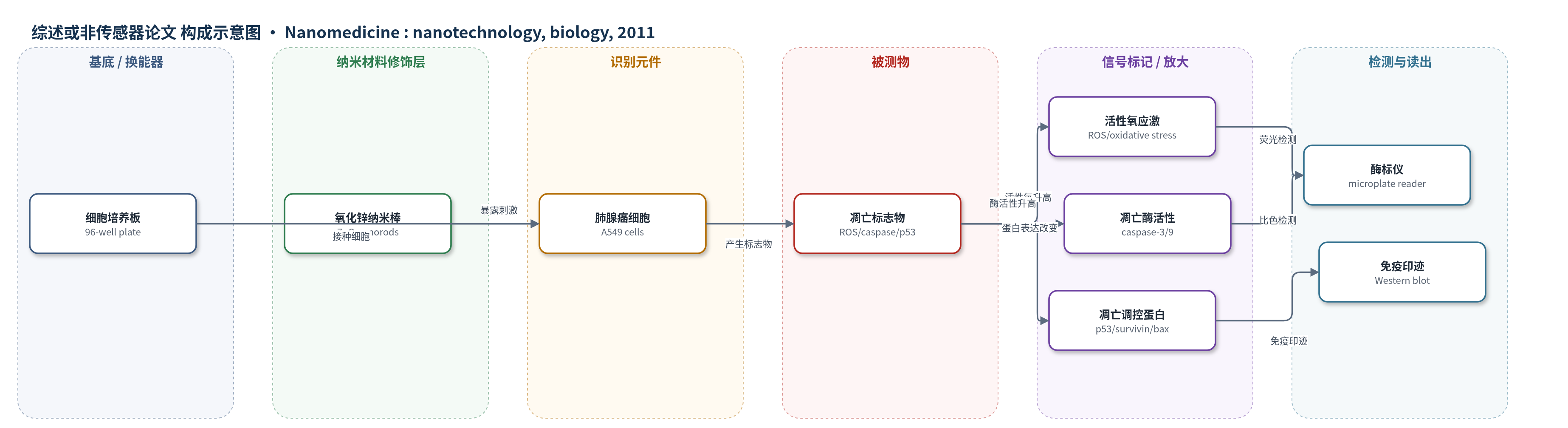
点击图片查看大图 · 依据论文自动绘制
传感器类型
综述或非传感器论文
检测对象
未报道传感检测对象;实验检测对象为A549细胞凋亡相关标志物(ROS、caspase-3、caspase-9、p53、survivin、bax、bcl-2、HSP70);样品基质:A549细胞裂解液/培养上清
检测原理
ZnO纳米棒接触A549细胞后,以剂量和时间依赖方式诱导细胞内ROS生成,造成氧化应激;ROS触发线粒体凋亡通路,使caspase-9和caspase-3活性升高,并调控p53、survivin、bax/bcl-2表达。检测上,MTT还原、LDH释放、DCFH-DA荧光、caspase底物pNA释放及Western blot分别反映细胞活力、膜损伤、ROS水平、凋亡酶活性和蛋白表达。信号强度随ZnO暴露浓度和时间增加而变化,用于判断凋亡机制。
检测灵敏度
未报道
效应效果
本文未报道传感器选择性、稳定性或回收率。ZnO纳米棒以剂量和时间依赖方式降低A549细胞活力:24 h暴露10、25、50、100 μg/ml时MTT还原率分别为73%、60%、49%、41%,48 h降至61%、48%、38%、27%;LDH释放、ROS、MDA、SOD、CAT及caspase-3/9活性显著升高(P<0.05)。100 μg/ml ZnO释放Zn2+最高10.23±0.41 μg/ml,10 μg/ml Zn2+无明显毒性,100 μg/ml Zn2+毒性弱于ZnO,提示毒性主要由纳米棒介导。
传感器的构成
- 基底/换能器电极:未报道(本文未构建生物传感器)
- 纳米材料修饰层:未报道(ZnO nanorods仅作为细胞毒性刺激物)
- 识别元件:未报道(A549细胞为受试细胞,非传感识别元件)
中文摘要
氧化锌(ZnO)纳米颗粒因在生物传感和医学中的应用而受到关注,但ZnO纳米棒对人细胞的毒性机制仍不清楚。本研究旨在探讨ZnO纳米棒诱导人肺泡腺癌A549细胞凋亡的可能机制。结果显示,ZnO纳米棒以剂量和时间依赖方式诱导细胞毒性、活性氧(ROS)生成、氧化应激以及caspase-3和caspase-9活性升高。Western blot检测表明,ZnO纳米棒上调细胞损伤早期标志物热休克蛋白70(HSP70)和细胞周期检查点蛋白p53的表达,同时上调促凋亡蛋白bax,下调抗凋亡蛋白survivin和bcl-2。研究结论表明,ZnO纳米棒通过ROS介导的氧化应激,经p53、survivin、bax/bcl-2及caspase通路诱导A549细胞凋亡。
英文摘要
UNLABELLED: Zinc oxide (ZnO) nanoparticles (NPs) are increasingly recognized for their utility in biological applications, including biosensor and medicine. However, little is known about the toxicity mechanisms of ZnO nanorods in human cells. This study was designed to investigate the possible mechanisms of apoptosis induced by ZnO nanorods in human alveolar adenocarcinoma (A549) cells. ZnO nanorod was found to induce cytotoxicity, reactive oxygen species (ROS) generation, oxidative stress and activities of caspase-3 & caspase-9 in a dose- and time-dependent manner. Western blot results showed that ZnO nanorods induced the expression of heat shock protein 70, a first-tier marker of cell damage and a cell-cycle checkpoint protein p53. Moreover, pro-apoptotic protein bax was upregulated and the antiapoptotic proteins, survivin and bcl-2, were downregulated in ZnO nanorod exposed cells. In conclusion, our data demonstrates that ZnO nanorod induced apoptosis in A549 cells through ROS and oxidative stress via p53, survivin, bax/bcl-2 and caspase pathways.
FROM THE CLINICAL EDITOR: This study describes the mechanisms of apoptosis induced by ZnO nanorods in human alveolar adenocarcinoma cells.