组成图示
点击图片查看大图 · 依据论文自动绘制
传感器类型
电化学生物传感器
检测对象
大肠杆菌(Escherichia coli, E. coli);样品基质:0.1 M 磷酸盐缓冲液(PBS, pH 6.8)纯培养液,面向水样/食品污染检测。
检测原理
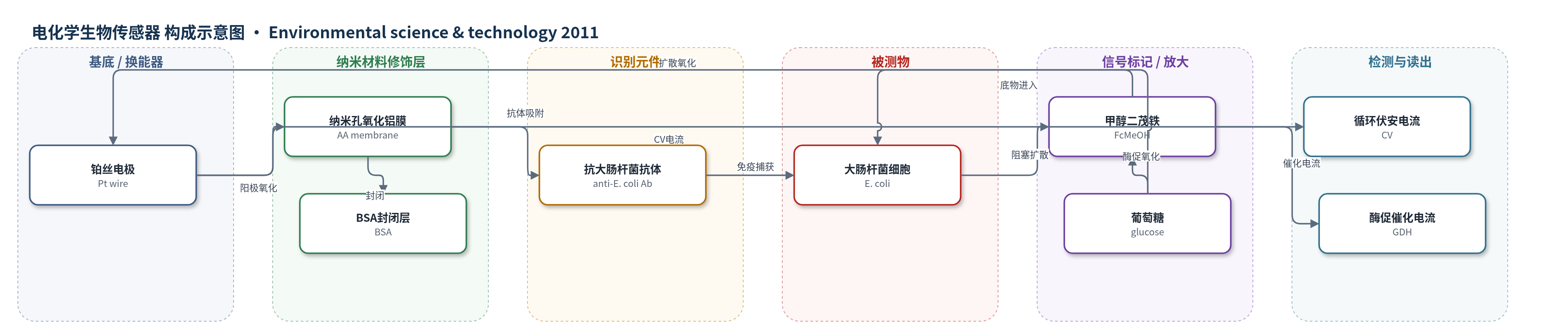
抗大肠杆菌抗体固定于纳米孔氧化铝膜表面及孔壁,BSA封闭剩余位点。样品中的大肠杆菌与抗体结合形成免疫复合物,阻塞纳米孔道,限制甲醇二茂铁(FcMeOH)向铂电极的扩散,使循环伏安法拉第峰电流下降;归一化电流与大肠杆菌浓度的对数呈线性关系。活力分析时,向捕获有细胞的传感器加入葡萄糖,活细胞和VBNC细胞外膜葡萄糖脱氢酶(GDH)催化葡萄糖氧化,FcMeOH作为人工电子受体在细胞膜与电极间穿梭,产生催化电流;死细胞无该酶促响应,从而区分活、VBNC和死细胞。
检测灵敏度
LOD: 22 cfu mL-1;线性范围: 10–10^6 cfu mL-1;R^2 = 0.999
效应效果
该传感器对大肠杆菌具有较高选择性,在 10^6 cfu/mL 时,对 S. marcescens 和 S. typhimurium 的信号变化仅为大肠杆菌的 22.6–28.4%;在 10^3 cfu/mL 时干扰为 8.2–12.4%。三次重复测量 RSD 为 2.5%,三个传感器在五个数量级范围内 RSD 为 0.6–2.5%。分析时间约 90 min,短于 ELISA 的 6–7 h;检出限优于 SPR、ELISA、光纤和 QCM 等常见方法(通常 10^2–10^4 cfu/mL)。作者认为其可用于现场水质检测,并区分活、VBNC 和死大肠杆菌。
传感器的构成
- 基底/换能器电极:铂丝电极(Pt wire,76 μm 直径),嵌入惰性环氧鞘(epoxy sheath),作为工作电极。
- 纳米材料修饰层:溅射铝膜(Al film,0.3–0.5 μm)经阳极氧化形成纳米孔氧化铝膜(AA),并用 3% H3PO4 刻蚀扩大纳米孔道。
- 识别元件:抗大肠杆菌抗体(anti-E. coli antibody)物理吸附于 AA 膜表面及孔壁,用于捕获 E. coli。
- 封闭剂:1% (w/v) 牛血清白蛋白(BSA)在 0.1 M PBS(pH 6.8)中封闭非特异性结合位点。
- 信号探针:甲醇二茂铁(ferrocenemethanol, FcMeOH)作为中性氧化还原探针,在 Pt 电极发生法拉第氧化还原。
- 活力分析底物:葡萄糖(glucose)作为底物,与 FcMeOH 共同用于监测捕获 E. coli 的葡萄糖脱氢酶(GDH)活性。
中文摘要
本文报道了一种基于纳米孔氧化铝膜的无标记电化学纳米生物传感器,用于大肠杆菌(Escherichia coli, E. coli)细胞的特异性定量检测,并可分析处于活但不可培养(VBNC)状态的 E. coli。传感机制依赖纳米孔道被免疫复合物阻塞:抗 E. coli 抗体固定于纳米孔氧化铝膜修饰电极上,E. coli 结合后阻碍分析液中氧化还原探针向底层铂电极的扩散,使循环伏安法拉第信号降低。通过优化抗体浓度和 pH,传感器在 10–10^6 cfu/mL 范围内呈对数线性响应,检出限为 22 cfu/mL(R^2=0.999),对两种常见水中病原菌交叉反应低,三次重复测量相对标准偏差为 2.5%。捕获定量后,加入葡萄糖并监测同一氧化还原探针的酶促电流,可区分活细胞、VBNC 细胞和死细胞。
英文摘要
A sensitive and selective membrane-based electrochemical nanobiosensor is developed for specific quantitative label-free detection of Escherichia coli (E. coli) cells and analysis of viable but nonculturable (VBNC) E. coli cells which remain mostly undetected using current methods. The sensing mechanism relies on the blocking of nanochannels of a nanoporous alumina-membrane modified electrode, upon the formation of immune complexes at the nanoporous membrane. The resulting obstacle to diffusive mass transfer of a redox probe in the analysis solution to the underlying platinum electrode reduces the Faradaic signal response of the biosensor, measured using cyclic voltammetry. Antibody loading under conditions of varying antibody concentrations and pHs are optimized. The biosensor gives a low detection limit of 22 cfu mL(-1) (R(2) = 0.999) over a wide linear working range of 10 to 10(6) cfu mL(-1). It is specific toward E. coli with minimal cross-reactivity to two other pathogenic bacteria (commonly found in waters). Relative standard deviation (RSD) for triplicate measurements of 2.5% indicates reasonably useful level of reproducibility. Differentiation of live, VBNC, and dead cells are carried out after the cell capture and quantitation step, by simple monitoring of the cells' enzyme activity using the same redox probe in the analysis solution, in the presence of glucose.