组成图示
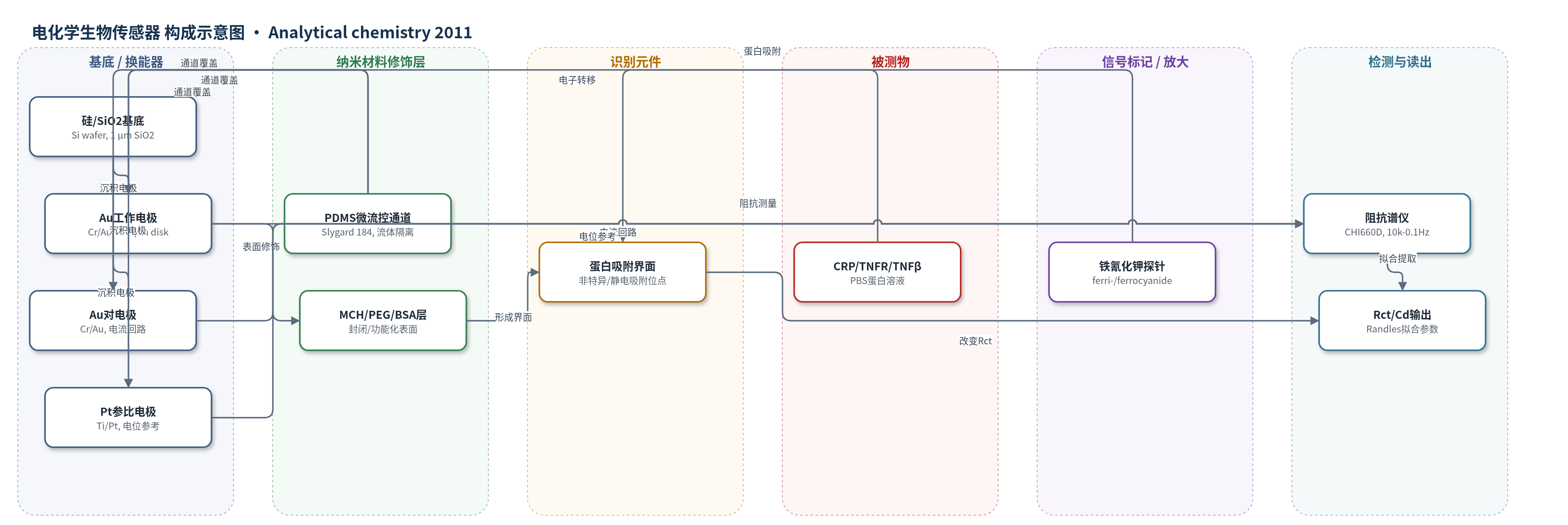
点击图片查看大图 · 依据论文自动绘制
传感器类型
电化学生物传感器
检测对象
cAMP受体蛋白(CRP)、肿瘤坏死因子R(TNFR)、肿瘤坏死因子β(TNFβ);样品基质:PBS缓冲液(10 mM PBS,TNFR/TNFβ含0.1% BSA)
检测原理
该传感器采用三电极微流控电化学阻抗检测。金工作电极表面分别修饰MCH、PEG或BSA,形成不同抗非特异吸附界面;PDMS通道使蛋白样品依次流过各列电极。蛋白与表面发生静电或空间位阻相互作用后,改变电极界面电荷和双电层结构,从而影响铁氰化钾/亚铁氰化钾氧化还原探针在电极表面的电子转移。阻抗谱在10 kHz–0.1 Hz采集,用Randles等效电路拟合提取电荷转移电阻Rct和双电层电容Cd。TNFR带负电,排斥铁氰化钾,使Rct增大;CRP带正电,吸引铁氰化钾,使Rct降低;TNFβ几乎不吸附,Rct变化很小。该方法无标记、无酶放大,直接以界面阻抗变化反映蛋白吸附。
检测灵敏度
原文未报告LOD、线性范围、灵敏度斜率及具体相关系数。
效应效果
CV显示9电极均匀:峰间隔0.087±0.004 V,氧化/还原峰-799/746±9.8 nA,电位0.037/-0.05±0.002 V。MCH表面TNFR使Rct由3.38×10^5 Ω增至6.97×10^5 Ω,CRP降至1.76×10^5 Ω,TNFβ不变;BSA变化小,PEG不稳定。n=3重复。改进电路使拟合误差MCH 8.1%→6.5%、BSA 14.6%→5.3%、PEG 16.4%→6.3%。-0.8至0.8 V vs Pt可再生。可高通量筛选表面化学。
传感器的构成
- 基底:4 in. 硅片,1 μm PECVD SiO2绝缘层,承载电极并增强PDMS键合
- 工作电极:20 nm Cr/200 nm Au圆盘(半径100 μm),发生蛋白吸附与电子转移
- 对电极:20 nm Cr/200 nm Au,面积大于工作电极,构成电流回路
- 参比电极:40 nm Ti/200 nm Pt,提供稳定电位参考
- 微流控通道:PDMS(Slygard 184)平行通道,控制蛋白/缓冲液流动并隔离各列表面
- 识别/功能化层:MCH(6-巯基-1-己醇)、PEG((1-巯基-11-十一烷基)四乙二醇)、BSA(牛血清白蛋白),通过硫醇自组装或吸附形成抗非特异表面
- 氧化还原探针:2.5 mM 铁氰化钾/亚铁氰化钾,在10 mM PBS+100 mM NaCl中作为电子转移指示剂
- 被测蛋白:CRP、TNFR、TNFβ,以PBS溶液流过表面发生吸附
中文摘要
本文报道了一种用于快速、灵敏探测蛋白质在不同功能化表面吸附行为的微流控平台。针对特定分析物定制传感器表面是便携式气体/液体传感器和药物筛选中的关键问题,而选择合适表面化学以抑制非特异性结合通常需要反复试验。该装置集成了一组电化学传感器阵列,可对这些结合相互作用进行快速、灵敏、无标记检测。电极布局允许在一个方向上分别装载不同表面化学,在另一方向上探测其与特定化合物的相互作用,且避免交叉污染。作者采集了三种常用封闭剂(巯基己醇、聚乙二醇和牛血清白蛋白)的阻抗数据,并展示了它们与三种遗传学和癌症研究中常用蛋白(cAMP受体蛋白、肿瘤坏死因子R和肿瘤坏死因子β)的相互作用。该平台能够快速表征多种表面相互作用,为选择任意生物传感器的最优功能化方案提供依据。
英文摘要
We present a unique microfluidic platform to allow for quick and sensitive probing of protein adsorption to various functionalized surfaces. The ability to tailor a sensor surface for a specific analyte is crucial for the successful application of portable gas and fluid sensors and is of great interest to the drug screening community. However, choosing the correct surface chemistry to successfully passivate against nonspecific binding typically requires repeated trial and error experiments. The presented device incorporates an array of integrated electrochemical sensors for fast, sensitive, label-free detection of these binding interactions. The layout of the electrodes allows for loading various surface chemistries in one direction while sensing their interactions with particular compounds in another without any cross-contamination. Impedance data is collected for three commonly used passivation compounds (mercaptohexanol, polyethylene glycol, and bovine serum albumin) and demonstrates their interaction with three commonly studied proteins in genetic and cancer research (cAMP receptor protein, tumor necrosis factor α, and tumor necrosis factor β). The ability to quickly characterize various surface interactions provides knowledge for selecting optimal functionalization for any biosensor.