组成图示
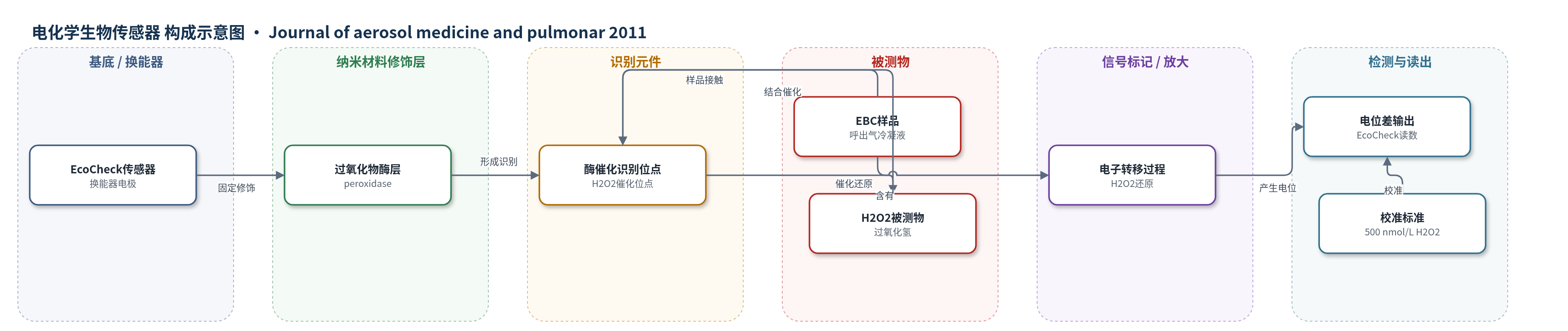
点击图片查看大图 · 依据论文自动绘制
传感器类型
电化学生物传感器
检测对象
过氧化氢(H2O2,hydrogen peroxide);样品基质:呼出气冷凝液(EBC)
检测原理
EBC 样品接触 EcoCheck 生物传感器表面固定的过氧化物酶(peroxidase)。H2O2 作为底物在过氧化物酶催化下发生还原反应,使传感器界面产生电子转移;该电子转移被换能器转换为可测量的电位差信号,并由 EcoCheck 系统在线读出。H2O2 浓度越高,酶促电子转移越强,电位差信号越大,因此信号随被测物浓度变化。测量前使用 500 nmol/L H2O2 标准样品校准,使电位差与 H2O2 浓度对应。该方法依赖酶催化电子转移的直接电化学响应,未使用额外信号放大策略。
检测灵敏度
重复测量相关系数: r^2 = 0.98 (p < 0.0001)
效应效果
EcoCheck 在线测量在正常潮式呼吸下个体内重复性良好,两次 EBC H2O2 为 888±176 与 874±156 nmol/L,差异无统计学意义,相关系数 r^2=0.98(p<0.0001)。但个体间变异较大,正常呼吸与增加潮气量呼吸的变异系数分别为 49% 和 54%。增加潮气量呼吸使 EBC 体积由 1413±59 mL 增至 1959±71 mL(p<0.001),同时 H2O2 浓度由 1400±171 nmol/L 降至 896±126 nmol/L(p<0.001);反向顺序亦为 1528±151 对 778±145 nmol/L(p<0.005)。H2O2 与分钟通气量、呼气流速等无显著相关。作者认为呼吸模式是 EBC H2O2 检测的重要混杂因素,限制其作为气道炎症标志物的临床实用性。
传感器的构成
- 换能器/电极:EcoCheck 生物传感器(具体电极材料未报道),承担电子转移并输出电位差
- 识别/催化元件:过氧化物酶(peroxidase)固定于传感器表面,催化 H2O2 还原
- 被测物/底物:呼出气冷凝液(EBC)中的过氧化氢(H2O2),作为酶促电子转移底物
- 信号读出:EcoCheck 系统读取电位差,反映 H2O2 浓度
中文摘要
过氧化氢(H2O2)可在呼出气冷凝液(EBC)中检出,并被提出作为气道氧化应激的替代标志物。本研究旨在检验 EBC 采集过程中的呼吸模式是否影响呼出 H2O2 浓度。16 名健康志愿者分别以潮式呼吸和增加潮气量呼吸采集 EBC 10 分钟,采用 EcoCheck 生物传感器系统进行在线 H2O2 测量,并进行重复测量以评估个体内重复性。结果显示,增加潮气量呼吸时分钟通气量、潮气量和呼气流速均显著增加;EBC 体积由 1413±59 mL 增至 1959±71 mL(p<0.001),而呼出 H2O2 水平由 1400±170 nmol/L 降至 840±130 nmol/L(p<0.001)。H2O2 水平与任何单个呼吸参数均无显著相关(p>0.05)。两种呼吸模式下 H2O2 测量的个体间变异系数分别为 49% 和 54%。正常呼吸下 EBC H2O2 测量高度可重复(888±176 对 874±156 nmol/L)。结论表明,EBC 中 H2O2 浓度取决于采集时的通气模式,所有 EBC H2O2 检测均应考虑该因素。
英文摘要
BACKGROUND: Hydrogen peroxide (H2O2) is detectable in exhaled breath condensate (EBC) and has been proposed to be a surrogate marker of oxidative stress in the airways. In this study we tested whether the breathing pattern during EBC collection influences the concentration of exhaled H2O2.
METHODS: EBC was collected during (1) tidal breathing and (2) breathing with increased tidal volume for 10 min from 16 healthy volunteers. On-line H2O2 measurement was performed by the EcoCheck™ biosensor system. Repeated measurements were also conducted to assess intrasubject reproducibility.
RESULTS: Minute ventilation, tidal volume, expiratory flow rate were all increased significantly when subjects were asked to perform breathing with increased tidal volume. In parallel, EBC volume increased (1413±59 vs. 1959±71 μL, p<0.001), whereas exhaled H2O2 levels decreased significantly (1400±170 vs. 840±130 nmol/L, p<0.001). H2O2 levels did not correlate with any individual breathing parameters (p>0.05). Assessment of intersubject variability of H2O2 measurements during the two types of breathing revealed a coefficient of variation of 49 and 54%, respectively. The EBC H2O2 measurement was highly reproducible (888±176 vs. 874±156 nmol/L) as tested during normal breathing.
CONCLUSIONS: These data demonstrate that the concentration of H2O2 in EBC depends on the ventilatory pattern during sample collection that has to be taken into consideration in all EBC H2O2 assays.