组成图示
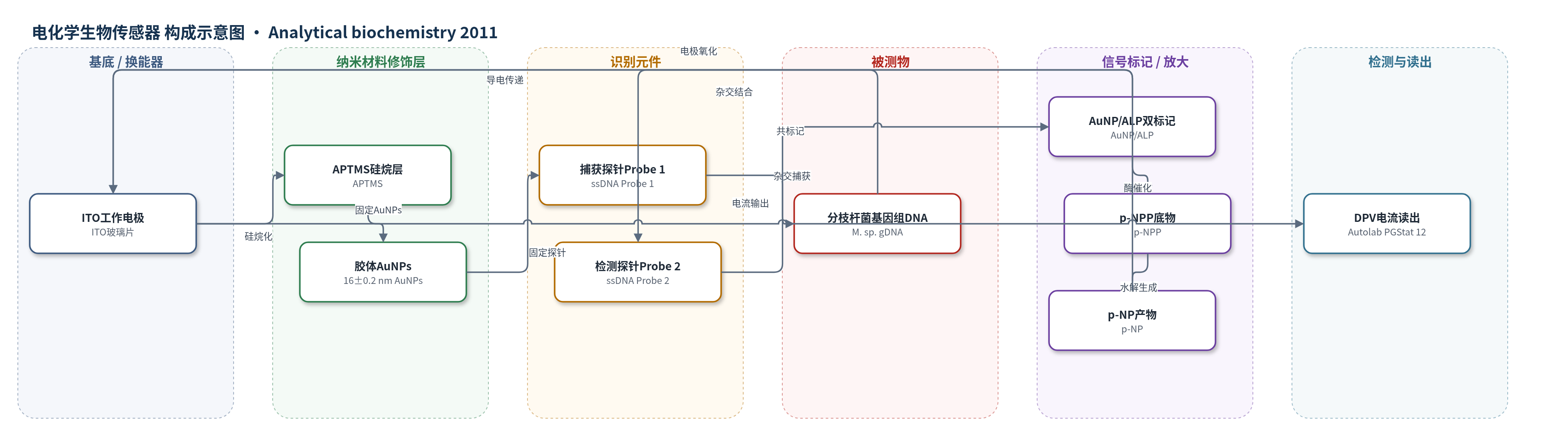
点击图片查看大图 · 依据论文自动绘制
传感器类型
电化学生物传感器
检测对象
分枝杆菌属基因组DNA(Mycobacterium sp. genomic DNA);样品基质:临床痰样(sputum)及MTB H37rv基因组DNA
检测原理
该传感器基于DNA三明治杂交与酶催化信号放大。ITO电极经APTMS和胶体AuNPs修饰后固定捕获探针Probe 1,分枝杆菌属基因组DNA与Probe 1杂交后被捕获。随后,同时标记有检测探针Probe 2和碱性磷酸酶(ALP)的AuNP探针与目标DNA结合,形成双探针夹心结构。由于单个AuNP可负载多个ALP分子,杂交事件被放大。加入底物p-NPP后,ALP将其水解为电活性产物p-NP;p-NP在电极表面发生氧化还原反应,差分脉冲伏安法(DPV)记录峰电流。目标DNA浓度越高,结合的双标记AuNP/ALP越多,生成的p-NP越多,DPV峰电流越大,从而实现定量检测。
检测灵敏度
LOD: 1.25 ng/ml;线性范围: 1.25–50 ng/ml
效应效果
该传感器对非特异性大肠杆菌基因组DNA无DPV信号,表明其具有较高特异性。临床验证43例疑似结核痰样:AFB培养阳性41例、阴性2例;PCR与AuNP-DNA传感器均检出37例阳性、6例阴性,对培养阳性样本检出率约90%,2例培养阴性样本未被检出;显微镜仅19例阳性。DPV峰面积与PCR条带强度相关,且作者认为其条件要求低于PCR,可避免严格实验室条件。该传感器操作简便、成本低,适合临床分枝杆菌快速定性监测。原文未报告RSD、长期稳定性或加标回收率。
传感器的构成
- 工作电极基底:ITO玻璃片,作为导电换能器
- 硅烷化界面层:3-aminopropyl trimethoxysilane(APTMS),提供氨基并固定AuNPs
- 纳米导电锚定层:胶体AuNPs,增强电子传递并固定捕获探针
- 捕获识别元件:ssDNA Probe 1,特异性结合分枝杆菌属基因组DNA
- 封闭层:BSA,减少非特异性吸附
- 检测识别元件:ssDNA Probe 2,与目标DNA杂交形成三明治结构
- 信号放大标记物:AuNP/ALP双标记纳米颗粒,每个颗粒携带多个ALP
- 酶底物:p-NPP,被ALP水解生成电活性p-NP
中文摘要
本研究开发并评价了一种用于临床样本中分枝杆菌属基因组DNA检测的DNA电化学生物传感器。该传感器采用三明治检测策略,使用两种特异性针对分枝杆菌属基因组DNA的DNA探针,并将碱性磷酸酶(ALP)与检测探针共同偶联于金纳米颗粒(AuNPs)表面,形成双标记AuNP探针。捕获探针固定于自组装单分子层修饰的ITO电极上,目标DNA杂交后,双标记AuNP探针通过检测探针与目标DNA结合。随后,ALP水解对硝基苯酚磷酸盐(p-NPP)生成电活性对硝基苯酚(p-NP),通过循环伏安法(CV)、电化学阻抗谱(EIS)和差分脉冲伏安法(DPV)进行表征。由于每个AuNP可携带多个ALP分子,信号得到放大,优化条件下基因组DNA检出限为1.25 ng/ml。该传感器用于临床痰样检测,表现出较高灵敏度和特异性,结果与PCR分析一致,可作为临床样本中分枝杆菌监测的常规诊断工具。
英文摘要
The present study was aimed at the development and evaluation of a DNA electrochemical biosensor for Mycobacterium sp. genomic DNA detection in a clinical specimen using a signal amplifier as dual-labeled AuNPs. The DNA electrochemical biosensors were fabricated using a sandwich detection strategy involving two kinds of DNA probes specific to Mycobacterium sp. genomic DNA. The probes of enzyme ALP and the detector probe both conjugated on the AuNPs and subsequently hybridized with target DNA immobilized in a SAM/ITO electrode followed by characterization with CV, EIS, and DPV analysis using the electroactive species para-nitrophenol generated by ALP through hydrolysis of para-nitrophenol phosphate. The effect of enhanced sensitivity was obtained due to the AuNPs carrying numerous ALPs per hybridization and a detection limit of 1.25 ng/ml genomic DNA was determined under optimized conditions. The dual-labeled AuNP-facilitated electrochemical sensor was also evaluated by clinical sputum samples, showing a higher sensitivity and specificity and the outcome was in agreement with the PCR analysis. In conclusion, the developed electrochemical sensor demonstrated unique sensitivity and specificity for both genomic DNA and sputum samples and can be employed as a regular diagnostics tool for Mycobacterium sp. monitoring in clinical samples.