组成图示
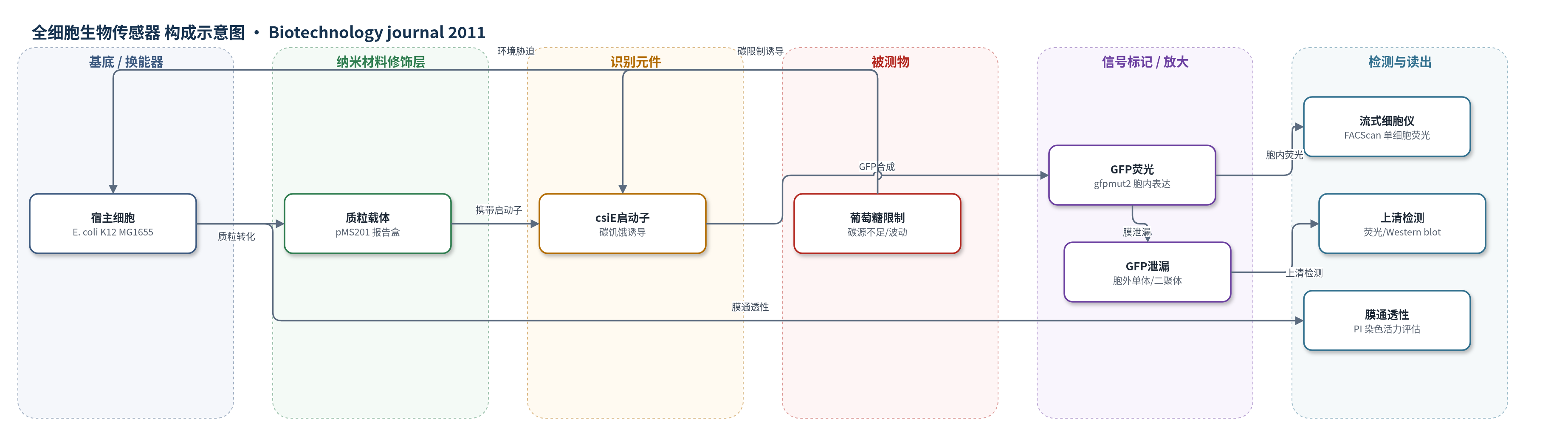
点击图片查看大图 · 依据论文自动绘制
传感器类型
全细胞生物传感器
检测对象
葡萄糖限制/波动(glucose limitation/fluctuations)、碳源限制(carbon limitation)、生物反应器混合缺陷(mixing deficiencies);样品基质:E. coli 发酵培养液及上清(chemostat、fed-batch、SDR)
检测原理
该传感器以 E. coli K12 MG1655 为全细胞换能器,质粒 pMS201 携带受 rpoS 调控的 csiE 启动子与 GFP(gfpmut2)报告基因。当培养液中葡萄糖/碳源受限时,csiE 启动子被诱导,驱动 GFP 转录翻译,胞内 GFP 荧光随碳限制程度增强;葡萄糖过量或稀释率升高时诱导减弱。流式细胞仪以 488 nm 激发、530 nm 发射检测单细胞荧光,实现碳限制的单细胞读出。同时,碳限制与膜应力使细胞膜通透性增加,GFP 进入上清,上清荧光、SDS-PAGE/Western blot 可检测 GFP 单体与二聚体;泄漏量与 PI 染色反映的膜通透性相关,可用于评估细胞活力。无外源信号放大,依赖全细胞表达与泄漏累积。SDR 中葡萄糖梯度使细胞经历随机波动,降低 GFP 诱导,随机水动力学模型用于模拟暴露频率。
检测灵敏度
未报告 LOD、线性范围、灵敏度斜率或相关系数。
效应效果
恒化器中,稀释率由 0.02 h-1 升至 0.2 h-1 时 GFP 荧光下降但仍高于基础水平,反向调节可恢复;加入 5 g/L 葡萄糖脉冲后荧光快速降至基础水平。SDR 中单细胞葡萄糖波动(约 0.01–0.25 g/L)降低 GFP 诱导,最大诱导时间由正常补料分批的 14 h 延至 23 h。正常补料分批中 GFP 泄漏更早(7 h)且量更高,Western blot 显示 37 kDa 荧光 GFP 与 60 kDa 二聚体更丰富;SDR 中泄漏较低,PI 染色提示膜通透性更低、活力更好。作者认为 GFP 泄漏可并行评估工艺条件下微生物活力与规模缩小效应。
传感器的构成
- 换能器/宿主细胞:E. coli K12 MG1655 全细胞,作为活体传感单元,将碳限制转化为 GFP 表达与泄漏
- 遗传识别元件:csiE 碳饥饿诱导启动子(受 rpoS 调控),响应葡萄糖/碳源限制
- 报告信号元件:GFP(gfpmut2 变体)编码序列,诱导后产生 488 nm 激发、530 nm 发射荧光
- 载体:pMS201 质粒(4260 bp),携带 csiE-GFP 报告盒与卡那霉素抗性基因
- 培养/样品基质:定义矿物盐培养基(含葡萄糖、K2HPO4、NaH2PO4·2H2O、Na2SO4、(NH4)2SO4、NH4Cl、柠檬酸铵、硫胺素、卡那霉素、微量元素、FeCl3·6H2O、EDTA、MgSO4),维持细胞并建立碳限制
- 泄漏信号层:胞外上清中的 GFP 单体/二聚体,反映膜通透性与细胞活力
- 读出系统:FACScan 流式细胞仪、Victor3 V Wallac 分光荧光计、SDS-PAGE/Western blot/ECL、PI 染色,检测胞内/胞外 GFP 与膜通透性
中文摘要
混合缺陷可通过专用全细胞微生物生物传感器进行检测。本研究利用碳限制条件下诱导的 csiE 启动子构建该传感器。在恒化器中,稀释率由 0.02 h-1 上调至 0.2 h-1 或反向下调时,csiE 生物传感器均表现出可逆响应;葡萄糖限制伴随绿色荧光蛋白(GFP)向胞外介质泄漏。为检验微生物生物传感器对大规模底物波动的响应,开展了规模缩小反应器(SDR)实验。单细胞水平表征显示,葡萄糖波动会降低 GFP 诱导。基于随机水动力学模型的模拟表明,SDR 中生物传感器暴露于葡萄糖梯度的变异性与频率。与 SDR 相比,在混合良好的补料分批培养中观察到更显著的 GFP 泄漏。GFP 泄漏似乎与更高的膜通透性相关,支持波动环境中细胞活力更好的先前研究。结果表明,GFP 泄漏可与常规 GFP 生物传感器功能并行使用,用于评估工艺条件下的微生物活力。
英文摘要
Mixing deficiencies can be potentially detected by the use of a dedicated whole cell microbial biosensor. In this work, a csiE promoter induced under carbon-limited conditions was involved in the elaboration of such biosensor. The cisE biosensor exhibited interesting response after up and down-shift of the dilution rate in chemostat mode. Glucose limitation was accompanied by green fluorescent protein (GFP) leakage to the extracellular medium. In order to test the responsiveness of microbial biosensors to substrate fluctuations in large-scale, a scale-down reactor (SDR) experiment was performed. The glucose fluctuations were characterized at the single cell level and tend to decrease the induction of GFP. Simulations run on the basis of a stochastic hydrodynamic model have shown the variability and the frequencies at which biosensors are exposed to glucose gradient in the SDR. GFP leakage was observed to a great extent in the case of a culture operated in well-mixed fed-batch mode, by comparison with those operated in SDR. GFP leakage seems to be correlated to a higher membrane permeability, confirming previous studies highlighting a better cell viability in cultures operated in a fluctuating environment. Our results suggest that GFP leakage could be used in parallel to the normal GFP biosensor function in order to assess microbial viability in process conditions.