组成图示
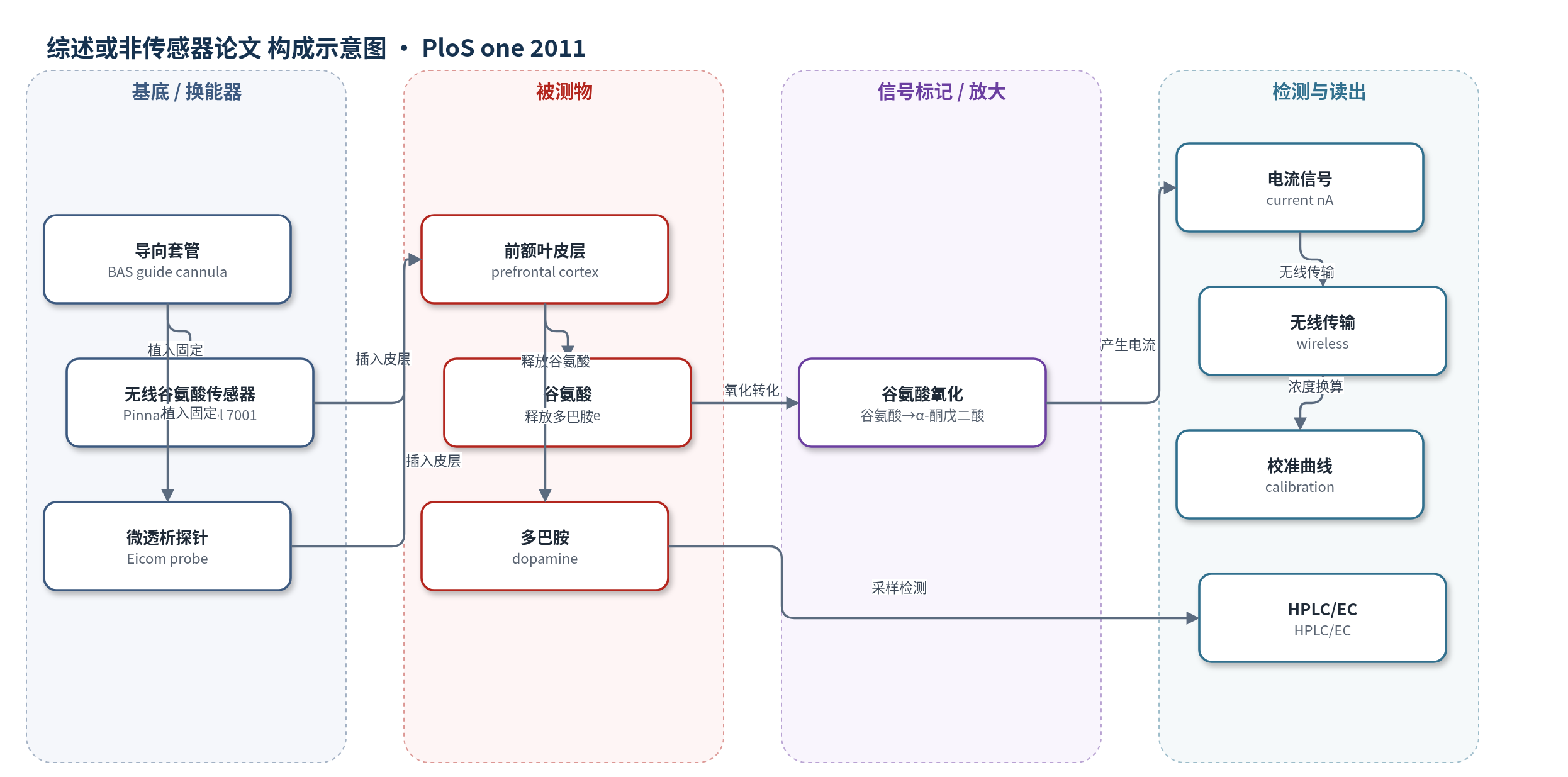
点击图片查看大图 · 依据论文自动绘制
传感器类型
综述或非传感器论文
检测对象
谷氨酸(glutamate)、多巴胺(dopamine),样品基质:大鼠前额叶皮层细胞外液/微透析液
检测原理
谷氨酸生物传感器(Pinnacle model 7001)经导向套管植入大鼠前额叶皮层。细胞外谷氨酸在传感器界面被氧化为α-酮戊二酸,产生与谷氨酸浓度相关的电流;电流经无线传输采集,按体外校准曲线转换为浓度。多巴胺采用微透析探针采样,透析液经HPLC/EC检测,峰面积按标准曲线定量。该检测未使用HCR、RCA或CRISPR-Cas等放大策略,信号直接反映皮层神经递质外流随药物处理的变化。
检测灵敏度
原文未报告LOD、线性范围、灵敏度斜率或相关系数。
效应效果
行为学上,SB-269970单独无作用,但逆转MK-801诱导的DNMTP正确率下降(p<0.0002),并加重东莨菪碱缺陷(p<0.0003)。谷氨酸生物传感器显示MK-801使10–60 min谷氨酸升高(p=0.000001–0.04),SB-269970在15、20、35 min显著降低MK-801诱导升高(p<0.05、0.02、0.04)。微透析显示MK-801使30–105 min多巴胺升高(p=0.000004–0.000075),SB-269970无影响。药代动力学未改变MK-801血浆/脑暴露,支持药效学机制。
传感器的构成
- 换能器探头:无线谷氨酸生物传感器(Pinnacle Technologies model 7001),实时检测皮层谷氨酸并输出电流信号
- 植入定位:导向套管(guide cannula, BAS),固定于大鼠前额叶皮层,用于插入传感器
- 催化转化:谷氨酸被转化为α-酮戊二酸(原文未给出具体酶名),产生与谷氨酸浓度相关的电化学响应
- 信号读出:电流(nA)按体外校准曲线转换为谷氨酸浓度
- 干扰控制:体外校准验证谷氨酸敏感性与抗干扰能力(如抗坏血酸 ascorbate)
- 平行检测:微透析探针(Eicom)采集多巴胺,HPLC/EC 定量
中文摘要
本研究评估选择性5-HT7受体拮抗剂SB-269970在大鼠工作记忆缺陷模型中的作用,并考察其是否调节皮层谷氨酸或多巴胺神经传递。在大鼠延迟非匹配位置任务中,SB-269970(10 mg/kg)显著逆转MK-801(0.1 mg/kg)诱导的缺陷,但加重东莨菪碱(0.06 mg/kg)诱导的缺陷。利用无线谷氨酸生物传感器和微透析分别监测自由活动大鼠前额叶皮层,SB-269970可归一化MK-801诱导的谷氨酸外流升高,但不改变多巴胺细胞外水平。药代动力学显示SB-269970不影响MK-801的血浆和脑浓度,提示其作用为药效学机制。结果表明5-HT7受体拮抗剂可能通过选择性归一化谷氨酸能神经传递逆转NMDA受体功能低下相关认知缺陷。
英文摘要
The role of 5-HT₇ receptor has been demonstrated in various animal models of mood disorders; however its function in cognition remains largely speculative. This study evaluates the effects of SB-269970, a selective 5-HT₇ antagonist, in a translational model of working memory deficit and investigates whether it modulates cortical glutamate and/or dopamine neurotransmission in rats. The effect of SB-269970 was evaluated in the delayed non-matching to position task alone or in combination with MK-801, a non-competitive NMDA receptor antagonist, and, in separate experiments, with scopolamine, a non-selective muscarinic antagonist. SB-269970 (10 mg/kg) significantly reversed the deficits induced by MK-801 (0.1 mg/kg) but augmented the deficit induced by scopolamine (0.06 mg/kg). The ability of SB-269970 to modulate MK-801-induced glutamate and dopamine extracellular levels was separately evaluated using biosensor technology and microdialysis in the prefrontal cortex of freely moving rats. SB-269970 normalized MK-801 -induced glutamate but not dopamine extracellular levels in the prefrontal cortex. Rat plasma and brain concentrations of MK-801 were not affected by co-administration of SB-269970, arguing for a pharmacodynamic rather than a pharmacokinetic mechanism. These results indicate that 5-HT₇ receptor antagonists might reverse cognitive deficits associated with NMDA receptor hypofunction by selectively normalizing glutamatergic neurotransmission.