组成图示
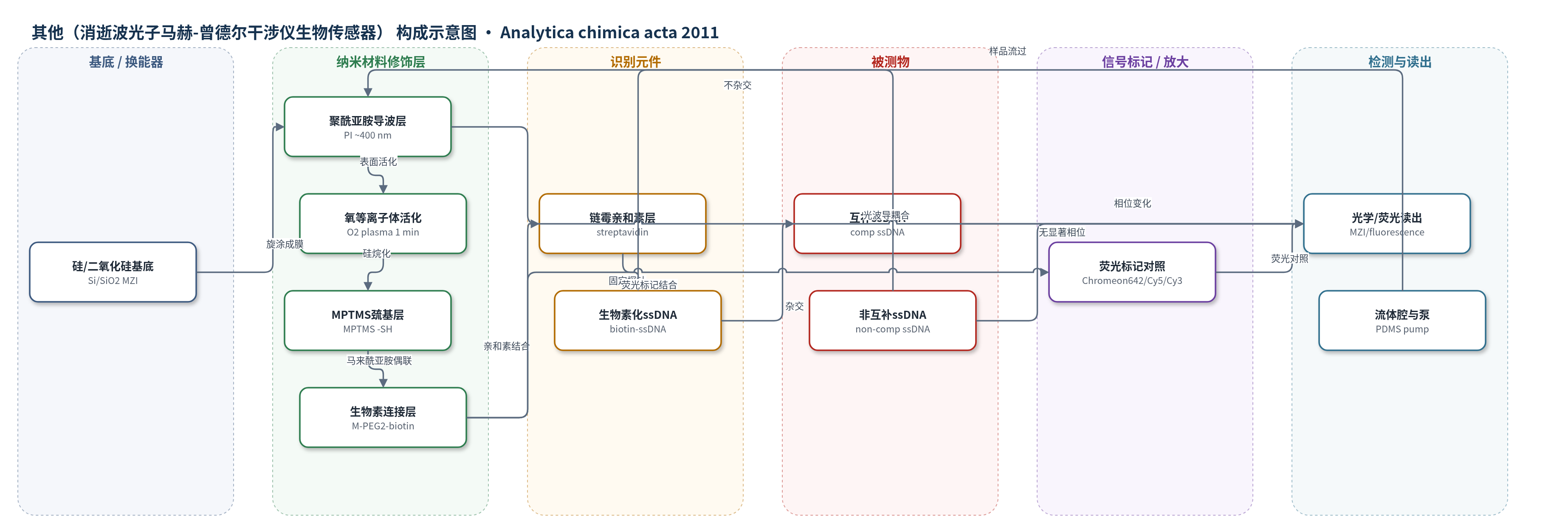
点击图片查看大图 · 依据论文自动绘制
传感器类型
其他(消逝波光子马赫-曾德尔干涉仪生物传感器)
检测对象
链霉亲和素(streptavidin, SA)、单链DNA(single-stranded DNA, ssDNA);样品基质为150 mM PBS缓冲液。
检测原理
氧等离子体在聚酰亚胺(PI)表面引入反应性含氧基团,3-巯基丙基三甲氧基硅烷(MPTMS)经缩合形成C-O-Si键并暴露巯基;马来酰亚胺-PEG2-生物素(M-PEG2-biotin)与巯基反应引入生物素,链霉亲和素(SA)非共价结合生物素,再固定生物素化单链DNA(biotin-ssDNA)。检测时,1310 nm激光经光纤端面耦合进入PI波导,Y结将光分为测量臂和参考臂,参考臂被Ormoclad包覆,测量臂暴露于样品。被测物与表面识别层结合后,改变测量臂有效折射率,使两臂相位差变化,输出光强呈正弦调制;通过反演相位-时间曲线实现无标记实时检测。SA浓度越高,结合质量越大,相位变化越大;互补ssDNA杂交产生可分辨相位,非互补ssDNA无显著相位。该方案未使用酶或核酸放大。
检测灵敏度
原文未报告MZI的LOD、线性范围、灵敏度斜率或R^2;仅报告可检测Chromeon 642-streptavidin低至0.1 μg/mL(1.6 nM),测量浓度范围0.1–50 μg/mL(1.6–833 nM)。
效应效果
表面功能化重现性13.9% RSD(n=10),SA密度144±20 fmol mm−2;BSA封闭将非特异结合从63±25 fmol mm−2抑制,封闭后约80±22 fmol mm−2。AFM粗糙度Ra<0.60 nm,未损伤波导。MZI对Chromeon 642-streptavidin在0.1–50 μg/mL(1.6–833 nM)呈浓度依赖,50 μg/mL约500 s饱和;封闭后信号降40%,最大相位3.5°,未封闭7.5°。无标记SA结合约4°,120 s饱和。DNA中biotin-ssDNA固定0.3°,互补杂交0.27°,非互补无显著相位。作者认为低成本一次性聚酰亚胺MZI可用于医疗筛查和动力学检测。
传感器的构成
- 基底/换能器:硅晶圆(Si wafer)覆盖5 μm二氧化硅(SiO2),经光刻和反应离子刻蚀形成马赫-曾德尔干涉仪(MZI)波导结构;聚酰亚胺(PI, Pyralin PI-2771)旋涂约400 nm作为导波层。
- 表面活化层:氧等离子体(O2 plasma)处理1 min,在PI表面引入反应性含氧基团,提高亲水性和后续硅烷化结合能力。
- 硅烷修饰层:3-巯基丙基三甲氧基硅烷(MPTMS)酸性水溶液处理1 h,通过C-O-Si共价键连接,提供末端巯基(-SH)。
- 生物素连接层:马来酰亚胺-PEG2-生物素(M-PEG2-biotin)5 μM处理1 h,马来酰亚胺与巯基反应,引入生物素(biotin)识别位点。
- 识别/固定元件:链霉亲和素(streptavidin, SA)非共价结合生物素,形成高密度SA层,用于固定生物素化单链DNA(ssDNA)。
- 识别探针:生物素标记单链DNA(biotin-ssDNA)结合SA,作为DNA杂交捕获探针。
- 封闭剂:牛血清白蛋白(BSA)100 μg/mL PBS封闭非特异结合位点,用于降低非特异结合。
- 信号标记/对照:Chromeon 642标记链霉亲和素(Chromeon 642-streptavidin)及Cy5/Cy3标记ssDNA用于荧光对照;MZI检测本身为无标记实时检测。
- 流体与读出:PDMS流体腔、电子注射泵、1310 nm可调谐激光器、光纤端面耦合和MZI相位读出。
中文摘要
本研究针对用于消逝波光子生物传感器的薄膜聚酰亚胺旋涂硅片,优化了由硅烷化、生物素化和链霉亲和素结合组成的表面功能化流程,以构建生物特异性配体固定平台。聚酰亚胺膜作为导波层,对光学质量、膜厚和表面粗糙度要求较高。作者先在氧等离子体活化的聚酰亚胺表面结合3-巯基丙基三甲氧基硅烷(MPTMS),再用马来酰亚胺-PEG2-生物素(M-PEG2-biotin)衍生化末端巯基,最后固定链霉亲和素。功能化过程通过不同荧光标记进行监测,以优化各化学衍生化步骤;X射线光电子能谱(XPS)和原子力显微镜(AFM)用于表征表面化学组成、链霉亲和素覆盖密度和粗糙度。该方案获得144 fmol mm−2的链霉亲和素表面密度,重现性良好(13.9% RSD,n=10),且未损伤表面。将该修饰应用于聚酰亚胺基马赫-曾德尔干涉仪(MZI)传感器,实现了链霉亲和素结合的实时测量,验证了MZI生物传感器功能;随后利用链霉亲和素表面固定生物素化单链DNA,并监测选择性DNA杂交,证明聚酰亚胺基消逝波光子器件可用于生物传感。
英文摘要
The process of surface functionalization involving silanization, biotinylation and streptavidin bonding as platform for biospecific ligand immobilization was optimized for thin film polyimide spin-coated silicon wafers, of which the polyimide film serves as a wave guiding layer in evanescent wave photonic biosensors. This type of optical sensors make great demands on the materials involved as well as on the layer properties, such as the optical quality, the layer thickness and the surface roughness. In this work we realized the binding of a 3-mercaptopropyl trimethoxysilane on an oxygen plasma activated polyimide surface followed by subsequent derivatization of the reactive thiol groups with maleimide-PEG(2)-biotin and immobilization of streptavidin. The progress of the functionalization was monitored by using different fluorescence labels for optimization of the chemical derivatization steps. Further, X-ray photoelectron spectroscopy and atomic force microscopy were utilized for the characterization of the modified surface. These established analytical methods allowed to derive information like chemical composition of the surface, surface coverage with immobilized streptavidin, as well as parameters of the surface roughness. The proposed functionalization protocol furnished a surface density of 144 fmol mm(-2) streptavidin with good reproducibility (13.9% RSD, n=10) and without inflicted damage to the surface. This surface modification was applied to polyimide based Mach-Zehnder interferometer sensors to realize a real-time measurement of streptavidin binding validating the functionality of the MZI biosensor. Subsequently, this streptavidin surface was employed to immobilize biotinylated single-stranded DNA and utilized for monitoring of selective DNA hybridization. These proved the usability of polyimide based evanescent photonic devices for biosensing application.