组成图示
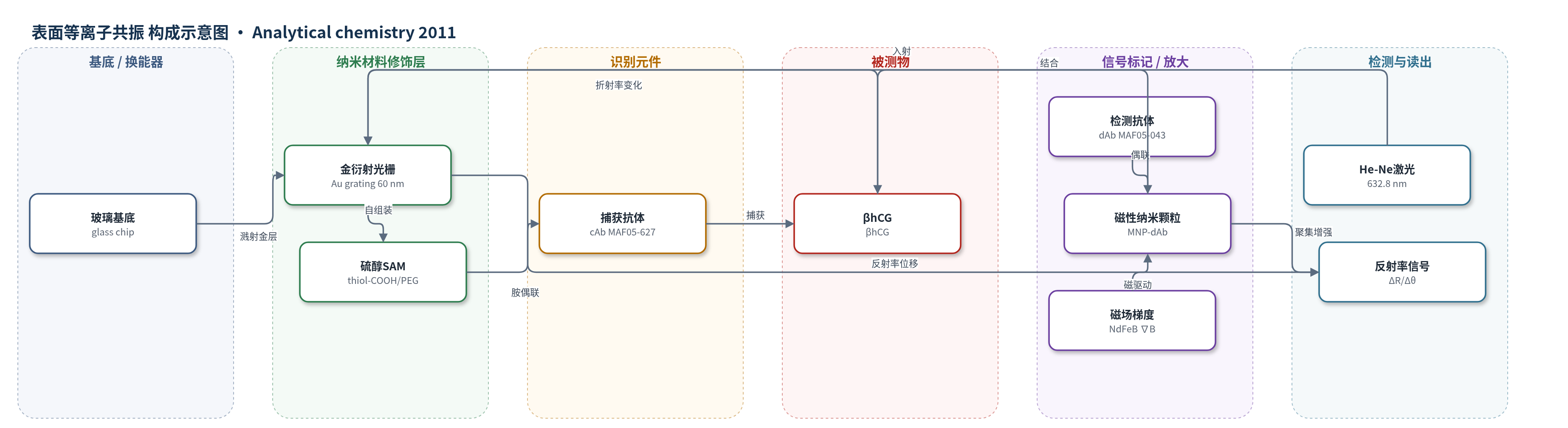
点击图片查看大图 · 依据论文自动绘制
传感器类型
表面等离子共振(SPR)生物传感器
检测对象
β人绒毛膜促性腺激素(βhCG, β human chorionic gonadotropin);样品基质为 PBST 缓冲液加标样品
检测原理
传感芯片表面固定捕获抗体 cAb,样品中 βhCG 被特异性捕获;与 βhCG 另一表位结合的检测抗体 dAb 预先偶联在氧化铁磁性纳米颗粒 MNP 上,形成 MNP-dAb。MNP-dAb 与表面 βhCG 结合后,因 MNP 质量大、折射率高,使金表面附近局部折射率显著增加;同时外部 NdFeB 磁铁产生垂直于芯片的磁场梯度,将 MNP-dAb 快速拖曳并聚集到传感表面,克服扩散限制,提高结合速率与表面覆盖。GC-SPR 中 632.8 nm He-Ne 激光经金衍射光栅激发表面等离子体,结合事件引起反射率角位移/反射率变化 ΔR/Δθ,由光电二极管和锁相放大器读出。βhCG 浓度越高,捕获并标记的 MNP-dAb 越多,反射率变化越大。
检测灵敏度
LOD: 0.45 pM (format d);LOD: ∼0.9 pM (format e);LOD: 4.5 pM (format c);LOD: 45 pM (format b);LOD: 6 nM (format a);校准浓度范围: 0.45 pM–45 nM
效应效果
传感器特异性良好:空白样品中 MNP-dAb 在磁场梯度下聚集后,经 PBST 洗涤反射率与共振角恢复初始水平,表明非特异结合可忽略;45 nM βhCG 样品产生明显共振角位移 Δθ=0.45°。在 4.5 nM βhCG 下,直接检测 ΔR=0.06±0.017,抗体放大 ΔR=0.2±0.017,MNP 扩散放大 ΔR=1.02±0.015,磁场驱动 MNP 放大 ΔR=6.4±0.021,较直接检测提高约 102 倍。芯片可再生,单芯片完成 15 次以上检测循环。LOD 0.45 pM 与表面等离子增强荧光 0.6 pM 相当,优于 SPR 夹心法 0.13 nM 和 SP 增强衍射 0.2 nM 约 3 个数量级。作者认为可用于细菌、病毒等大分子分析物。
传感器的构成
- 基底/换能器:玻璃传感芯片(glass sensor chip),承载光栅与金层,用于 GC-SPR 光学换能
- 金属衍射光栅:金层(Au, 60 nm)溅射于 UV 固化聚合物(NOA72)转移的光栅上,激发表面等离子体并产生反射率角位移
- 自组装单分子层:硫醇-COOH 与硫醇-PEG(thiol-COOH/thiol-PEG, 1:9, 1 mM)在金表面形成 SAM,提供羧基并降低非特异吸附
- 识别元件:捕获抗体 cAb(MAF05-627)通过 EDC/NHS 胺偶联固定于 SAM,特异性捕获 βhCG
- 信号标记/放大元件:检测抗体 dAb(MAF05-043)偶联到氧化铁磁性纳米颗粒 MNP(fluidMAG-ARA,铁氧化物核,多糖壳,d≈220 nm),形成 MNP-dAb,识别另一表位并放大折射率变化
- 外部操控/放大:NdFeB 磁铁产生磁场梯度(∇B=0.10 T mm^-1),透过芯片驱动 MNP-dAb 快速聚集到表面
- 封闭剂:乙醇胺(ethanolamine, 1 M, pH 8.5)封闭 MNP 上未反应活性酯,减少非特异结合
中文摘要
本文提出一种基于光栅耦合表面等离子共振(GC-SPR)的高灵敏生物传感器,将磁性纳米颗粒(MNP)免疫分析引入 SPR 检测。氧化铁 MNP 与识别不同表位的抗体共同修饰传感表面和标记颗粒:传感芯片上的金属衍射光栅表面固定捕获抗体,MNP 上偶联检测抗体。MNP 既作为载体,在透过传感芯片施加的磁场梯度驱动下将目标分析物快速递送至传感表面,又作为标记物增大目标物结合引起的局部折射率变化。作者以 β 人绒毛膜促性腺激素(βhCG)免疫检测评估该方案,比较扩散驱动与磁场梯度驱动的质量传输对灵敏度的影响。结果表明,与常规直接检测 SPR 相比,MNP 增强 GC-SPR 的 βhCG 检测灵敏度提高约 4 个数量级,检出限低于皮摩尔水平。
英文摘要
A highly sensitive surface plasmon resonance (SPR) biosensor employing magnetic nanoparticle (MNP) assays is presented. In the reported approach, MNPs simultaneously served as "vehicles" for rapid delivery of target analyte from a sample to the sensor surface and as labels increasing the measured refractive index changes that are associated with the binding of target analyte. An optical setup based on grating-coupled surface plasmon resonance (GC-SPR) was used with a magnetic field gradient applied through the sensor chip for manipulating with MNPs on its surface. Iron oxide MNPs and a sensor surface with metallic diffraction grating were modified with antibodies that specifically recognize different epitopes of the analyte of interest. The sensitivity of the biosensor was investigated as a function of mass transport of the analyte to the sensor surface driven by diffusion (free analyte) or by the magnetic field gradient (analyte bound to MNPs). Immunoassay-based detection of β human chorionic gonadotropin (βhCG) was implemented to evaluate the sensitivity of the MNP-enhanced GC-SPR biosensor scheme. The results reveal that the sensitivity of βhCG detection was improved by 4 orders of magnitude compared with the regular SPR sensor with direct detection format, and a limit of detection below pM was achieved.