组成图示
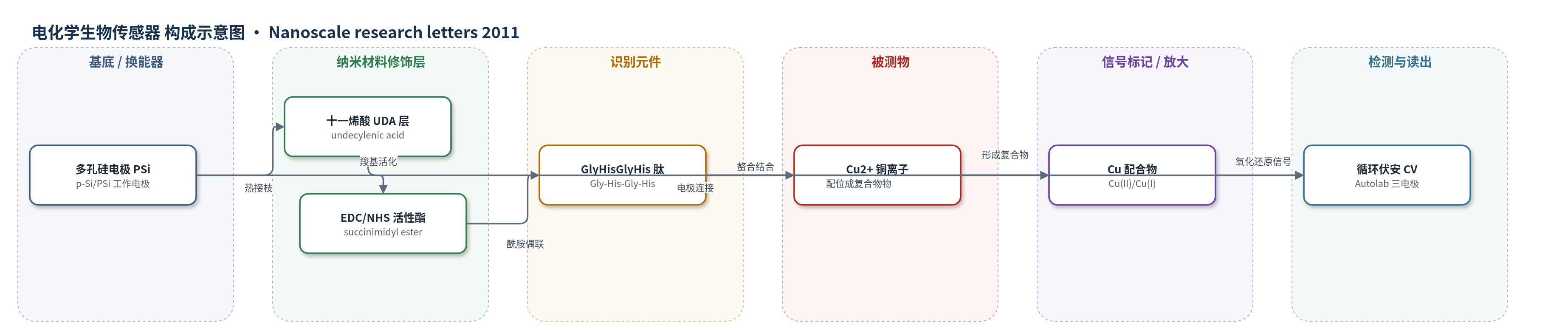
点击图片查看大图 · 依据论文自动绘制
传感器类型
电化学生物传感器
检测对象
铜离子(Cu2+,Cu(II));样品基质:醋酸缓冲水溶液(积累液 pH 8,读出液为无铜醋酸铵 pH 4)。
检测原理
该传感器以多孔硅电极为换能器,表面共价固定 GlyHisGlyHis 肽。检测时,电极先在含 Cu2+ 的醋酸缓冲液(pH 8)中于开路电位预积累,肽中组氨酸残基与 Cu2+ 配位,形成表面 Cu-GlyHisGlyHis 复合物;随后在无铜醋酸铵电解液(pH 4)中进行循环伏安扫描。表面复合物发生 Cu(II)/Cu(I) 准不可逆氧化还原反应,产生与表面结合铜量相关的峰电流密度。峰电流随积累液中 Cu2+ 浓度按 Langmuir 关系 I = I∞KC/(1+KC) 增加,其中 K 为表观稳定常数,I∞ 为表面饱和极限电流。高亲和常数使传感器适用于低浓度范围。
检测灵敏度
原文未报告 LOD、线性范围、灵敏度斜率或相关系数;校准浓度范围: 10^-7–10^-3 M;I∞: 13.44 μA cm-2;K: 3 × 10^5 M-1。
效应效果
论文未报告选择性、抗干扰、稳定性、重现性(RSD)、实际样品加标回收率或与 ELISA/HPLC/qPCR 等方法的对比。实验表现方面,未积累铜的修饰电极在测试窗口内电化学不活跃;铜积累后 CV 出现 Cu(II)/Cu(I) 峰。峰电流密度随 Cu2+ 浓度呈 Langmuir 非线性,拟合 I∞ = 13.44 μA cm-2,K = 3 × 10^5 M-1。Laviron 分析得到电子转移系数 α = 0.77、异相速率常数 k° = 1.56 s-1。FT-IR 与 XPS 证实各步接枝及 Si-C 共价键形成。作者认为该策略可用于溶液中金属离子的快速、简便检测,高亲和预示低浓度检测潜力。
传感器的构成
- 基底/换能器电极:p 型硅片(p-Si)经电化学刻蚀制备多孔硅(PSi)电极,提供高比表面与电化学换能。
- 修饰层:十一烯酸(undecylenic acid)经热氢化硅烷化接枝形成 Si-C 键和羧基终止单分子层。
- 活化层:EDC/NHS 处理形成琥珀酰亚胺酯(succinimidyl ester)活性酯,用于肽偶联。
- 识别元件:GlyHisGlyHis 肽(Gly-His-Gly-His)通过酰胺键共价固定,组氨酸残基螯合 Cu2+。
- 信号源:Cu(II)/Cu(I) 表面配合物,作为氧化还原信号产生 CV 峰电流。
- 电解液/读出介质:醋酸缓冲液(pH 8)用于 Cu2+ 积累;无铜醋酸铵(pH 4)用于 CV 读出。
中文摘要
本文报道将甘氨酰-组氨酰-甘氨酰-组氨酸(GlyHisGlyHis)肽通过多步温和反应共价固定于多孔硅(PSi)表面。首先通过氢化硅烷化将烯烃前体接枝到氢端 PSi 表面,形成羧基终止单分子层;随后用 N-羟基丁二酰亚胺(NHS)和肽偶联碳二亚胺 EDC 活化,再与肽的氨基连接形成酰胺键。采用 FT-IR 和 XPS 表征各功能化步骤。利用肽与金属离子形成稳定配合物的特性,实现肽修饰 PSi 生物传感器对金属离子的识别。在铜离子存在下对修饰 PSi 电极进行电化学研究,循环伏安曲线显示对应 Cu(II)/Cu(I) 电对的准不可逆过程。测定了表面复合物的异相速率常数、电子转移系数和表观稳定常数。结果表明,接枝于多孔硅表面的肽可用于溶液中金属离子的快速、简便检测。
英文摘要
In this work, a Glycyl-Histidyl-Glycyl-Histidine (GlyHisGlyHis) peptide is covalently anchored to the porous silicon PSi surface using a multi-step reaction scheme compatible with the mild conditions required for preserving the probe activity. In a first step, alkene precursors are grafted onto the hydrogenated PSi surface using the hydrosilylation route, allowing for the formation of a carboxyl-terminated monolayer which is activated by reaction with N-hydroxysuccinimide in the presence of a peptide-coupling carbodiimide N-ethyl-N'-(3-dimethylaminopropyl)-carbodiimide and subsequently reacted with the amino linker of the peptide to form a covalent amide bond. Infrared spectroscopy (FT-IR) and X-ray photoelectron spectroscopy are used to investigate the different steps of functionalization.The property of peptides to form stable complexes with metal ions is exploited to achieve metal-ion recognition by the peptide-modified PSi-based biosensor. An electrochemical study of the GlyHisGlyHis-modified PSi electrode is achieved in the presence of copper ions. The recorded cyclic voltammograms show a quasi-irreversible process corresponding to the Cu(II)/Cu(I) couple. The kinetic factors (the heterogeneous rate constant and the transfer coefficient) and the stability constant of the complex formed on the porous silicon surface are determined. These results demonstrate the potential role of peptides grafted on porous silicon in developing strategies for simple and fast detection of metal ions in solution.