组成图示
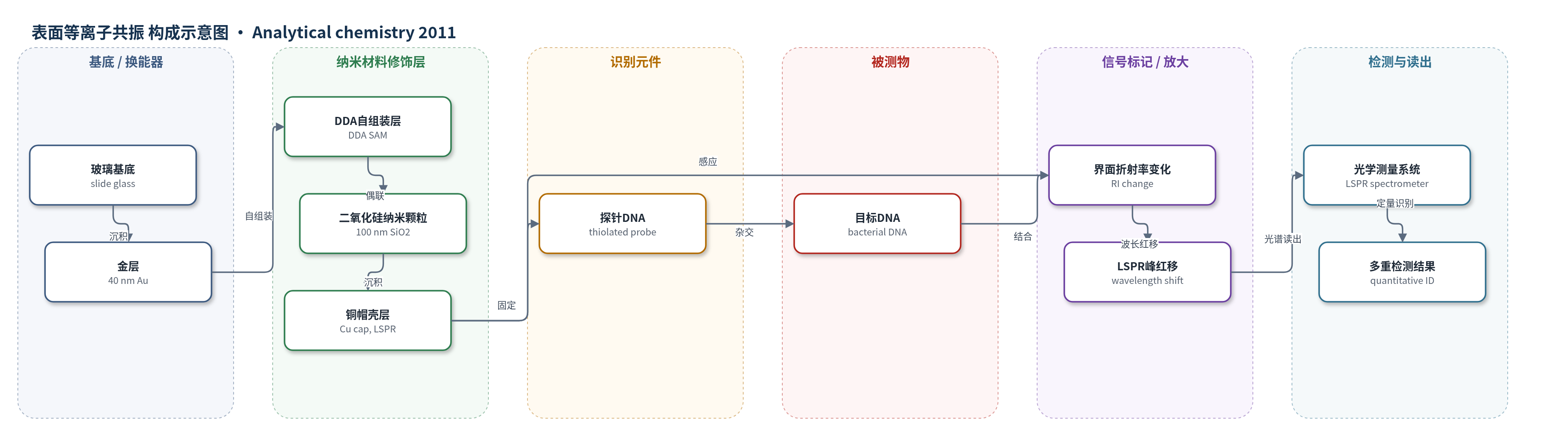
点击图片查看大图 · 依据论文自动绘制
传感器类型
表面等离子共振(SPR)生物传感器
检测对象
病原菌目标DNA(target DNA,PCR扩增产物):V. vulnificus、Salmonella spp.、S. aureus、S. epidermidis、E. faecalis、K. oxytoca、N. gonorrhea;样品基质:参考菌株基因组DNA及临床样本(血液、脓液、痰液、尿液)分离菌DNA。
检测原理
芯片表面固定巯基化探针DNA。当病原菌PCR扩增的目标DNA加入后,与互补探针发生特异性杂交,在铜帽纳米颗粒阵列界面形成双链DNA层。该生物分子层使铜帽壳层周围局部折射率升高,激发局域表面等离子共振(LSPR)条件改变,导致LSPR消光峰波长向长波方向红移。目标DNA浓度越高,杂交形成的界面DNA层越厚,折射率变化越大,波长红移越大;长链目标DNA因质量更大,产生更明显的红移。系统通过光学测量记录LSPR峰位置变化,实现无标记、定量、多重检测。
检测灵敏度
LOD: 10 fM (50 zmol);线性范围: 10^-14–10^-9 M;灵敏度: 67.8 nm per RI unit;LOD: 1 pM (V. vulnificus, Salmonella spp., S. aureus, S. epidermidis);LOD: 100 fM (E. faecalis, K. oxytoca);LOD: 10 fM (N. gonorrhea)
效应效果
该芯片对七种病原菌目标DNA表现出高序列特异性,交叉杂交与非特异性吸附引起的波长变化可忽略。在5 μL样品中,短链目标DNA检测限为1 pM,E. faecalis和K. oxytoca为100 fM,N. gonorrhea及长链目标DNA可达10 fM(50 zmol)。在10^-14–10^-9 M范围内获得稳定、定量、可重复信号,三次测量误差棒表示标准差。环境条件下连续孵育仅约0.06 nm/天红移,稳定性良好。七个盲法临床样本(血液、脓液、痰液、尿液)与培养法比较均正确识别。作者认为其无标记、低成本、一次性芯片,适合临床诊断、个性化医疗和生物防御。
传感器的构成
- 基底:载玻片玻璃(slide glass)与40 nm金(Au)层,提供支撑、导电及自组装固定界面。
- 自组装层:4,4'-二硫代二丁酸(DDA)自组装单分子层(SAM),在金表面提供羧基用于偶联纳米颗粒。
- 纳米颗粒芯层:100 nm二氧化硅(SiO2)纳米颗粒,经γ-APTES氨基化并用EDC活化,与DDA偶联形成有序阵列。
- 铜帽壳层:电子束沉积铜(Cu)帽状薄膜,形成LSPR光学换能层;乙酸处理去除Cu氧化物。
- 识别元件:巯基化探针DNA(thiolated probe DNAs),固定于芯片表面,特异性结合目标DNA。
- 信号读出:LSPR光学测量系统,通过LSPR峰波长红移输出无标记信号。
中文摘要
提出并开发了一种基于局域表面等离子共振(LSPR)的光学生物传感器,其核心为多斑点铜帽纳米颗粒阵列(MC-NPA)芯片。铜薄膜作为壳层,以帽状结构有序覆盖在作为芯的二氧化硅纳米颗粒顶部,形成“铜帽纳米颗粒阵列芯片”。通过控制沉积铜壳厚度,系统研究了该纳米结构的等离子体光学性质,并定量评估了芯片对体相折射率(RI)变化的灵敏度。结果显示,MC-NPA芯片的折射率灵敏度为67.8 nm/RIU,LSPR光谱峰波长对周围介质(包括生物分子层)的折射率变化敏感。利用该芯片可定量多重检测参考菌株和临床样本中的目标DNA,检测限达10 fM(50 zmol)。该光学生物传感器采用简单、低成本的光学装置和一次性芯片,为LSPR检测提供了独特方法。
英文摘要
A localized surface plasmon resonance (LSPR)-based optical biosensor in connection with a multispot copper-capped nanoparticle array (MC-NPA) chip was proposed and developed. The copper (Cu) films, used as a shell, formed a "cap-like" layer on the top of the silica nanoparticles, used as a core, in an orderly fashion, to form the surface called a "Cu-capped nanoparticle array chip". The plasmonic properties of this nanostructure type were initially investigated while controlling the shell thickness of the deposited Cu. Also, we quantified the sensitivity of MC-NPA chip to changes in bulk refractive index (RI). As a result of its LSPR properties, the MC-NPA chip displayed a sensitivity of 67.8 nm per RI unit, and the wavelength shift of the LSPR spectrum peak was sensitive to the RI of the surrounding bulk medium, such as the biomolecular layers. Using MC-NPA chips, multiplex sensing of target DNAs from reference bacteria and clinical samples was possible in a quantitative manner with a detection limit of 10 fM (50 zmol). The optical biosensor developed in this study represents a unique approach to performing LSPR that utilizes a simple and cost-effective optical setup with disposable chips.