组成图示
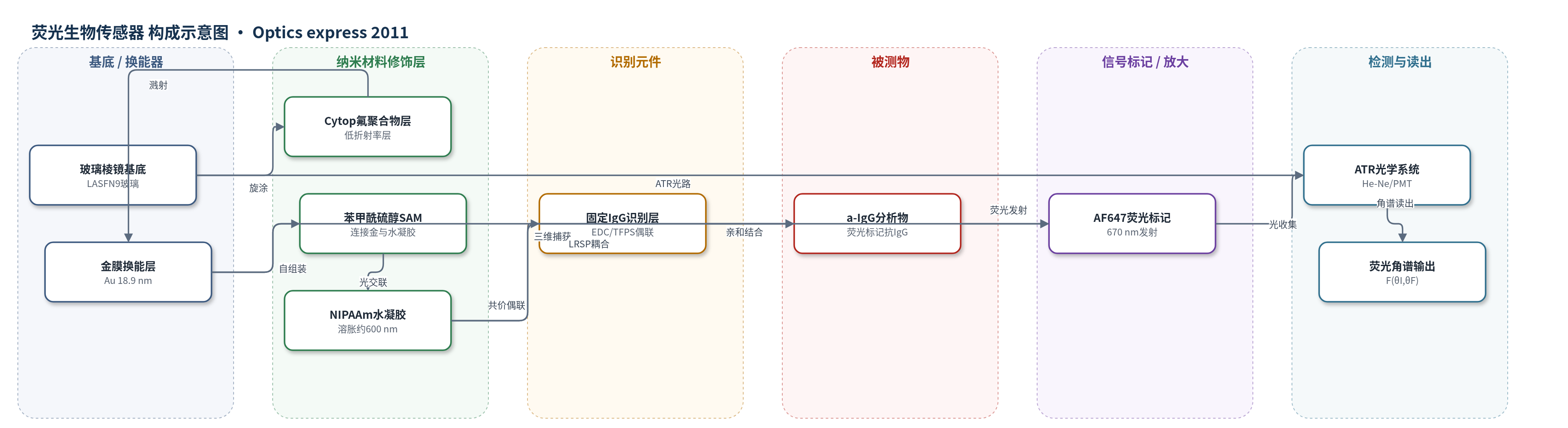
点击图片查看大图 · 依据论文自动绘制
传感器类型
荧光生物传感器
检测对象
抗小鼠免疫球蛋白G(anti-mouse IgG, a-IgG),样品基质为 PBS-T 缓冲液/水样
检测原理
He-Ne 激光经 Kretschmann ATR 棱镜激发金膜中的长程表面等离子体(LRSP)。LRSP 倏逝场穿透 Cytop/Au/水凝胶界面,在 NIPAAm 水凝胶内形成扩展增强电场,激发被固定 IgG 捕获的 AF647 标记 a-IgG。荧光分子发射的 670 nm 光部分耦合回 LRSP 模式,再经反向 Kretschmann 构型出射为方向性荧光锥。a-IgG 浓度增加使水凝胶内荧光标记物增多,激发与耦合发射的荧光强度增大。相比常规 SP,LRSP 损耗低、穿透深度大(约542 nm),峰值荧光增强约37倍,角分布更窄,可在更低角度读出,降低背景并利于角度复用。
检测灵敏度
原文未报告 LOD、线性范围、灵敏度斜率或相关系数。
效应效果
论文未报告选择性、抗干扰、长期稳定性、重现性 RSD、实际样品加标回收率,也未与 ELISA/HPLC/qPCR 等现有方法直接对比。实验以标准差表征重复性:直接激发下 LRSP 峰值荧光强度约为常规 SP 的 1.9±1.2 倍,且发射峰半高宽 FWHM 窄 6 倍;经 LRSP 激发后峰值荧光强度较直接激发提高 37±10 倍,常规 SP 提高 16±8 倍,LRSP 与 SP 峰值比为 4.4。模拟显示 LRSP 穿透深度约 542 nm、平均场强增强约 37,常规 SP 为 180 nm、增强约 8。作者主张 LRSP 可在更低角度激发与发射,简化器件,窄方向性峰利于背景滤除和角度复用。
传感器的构成
- 基底/棱镜:LASFN9 玻璃,用于 ATR 光路激发与收集
- 低折射率介质层:Cytop 氟聚合物(CTL-809M,约655 nm),与样品侧折射率匹配以支持 LRSP
- 金属换能层:金膜(Au,约18.9 nm),支持 LRSP 并增强/耦合荧光
- 自组装单分子层:苯甲酰硫醇(benzophenone-thiol)SAM,连接金表面与水凝胶
- 结合基质:NIPAAm 基光交联水凝胶(含羧基,干厚约60 nm,PBS-T 中溶胀约600 nm),三维捕获生物分子
- 识别元件:小鼠 IgG(mouse IgG),经 EDC/TFPS 与水凝胶羧基共价偶联,捕获 a-IgG
- 信号标记物:Alexa Fluor 647 标记抗小鼠 IgG(AF647-a-IgG,染料/蛋白比4.5),产生 670 nm 荧光
- 封闭剂:乙醇胺(1 M,pH 8.5),封闭未反应活性酯基
中文摘要
本文讨论一种利用长程表面等离子体(LRSP)高效激发和收集荧光标记生物分子荧光的生物传感器方案。该方案属于等离子体增强荧光(PEF)新途径,采用 Kretschmann 衰减全反射(ATR)构型进行实验与理论研究。所采用的层结构由低折射率氟聚合物层、薄金膜以及溶胀于水样中的大结合容量 N-异丙基丙烯酰胺(NIPAAm)基三维水凝胶基质组成。借助该层结构,LRSP 的扩展场可探测结合基质中距金表面数百纳米至微米范围内的生物分子结合事件。与常规表面等离子体增强荧光光谱(SPFS)和表面等离子体耦合发射(SPCE)相比,观察到荧光光强角分布更窄、峰值强度更大,并可在更低角度实现激发与发射。
英文摘要
A biosensor scheme that employs long range surface plasmons (LRSPs) for the efficient excitation and collection of fluorescence light from fluorophore-labeled biomolecules captured in a three-dimensional hydrogel matrix is discussed. This new approach to plasmon-enhanced fluorescence (PEF) is experimentally and theoretically investigated by using the Kretschmann configuration of attenuated total reflection (ATR) method. A layer structure supporting LRSPs that consists of a low refractive index fluoropolymer layer, a thin gold film and a large binding capacity N-isopropylacrylamide (NIPAAm)-based hydrogel matrix swollen in an aqueous sample is employed. By using this layer architecture, the extended field of LRSPs probes the binding of biomolecules in the binding matrix at up to micrometer distances from the gold surface. With respect to regular surface plasmon-enhanced fluorescence spectroscopy (SPFS) and surface plasmon-coupled emission (SPCE), a narrower angular distribution of the fluorescence light intensity, a larger peak intensity and the excitation and emission at lower angles were observed.