组成图示
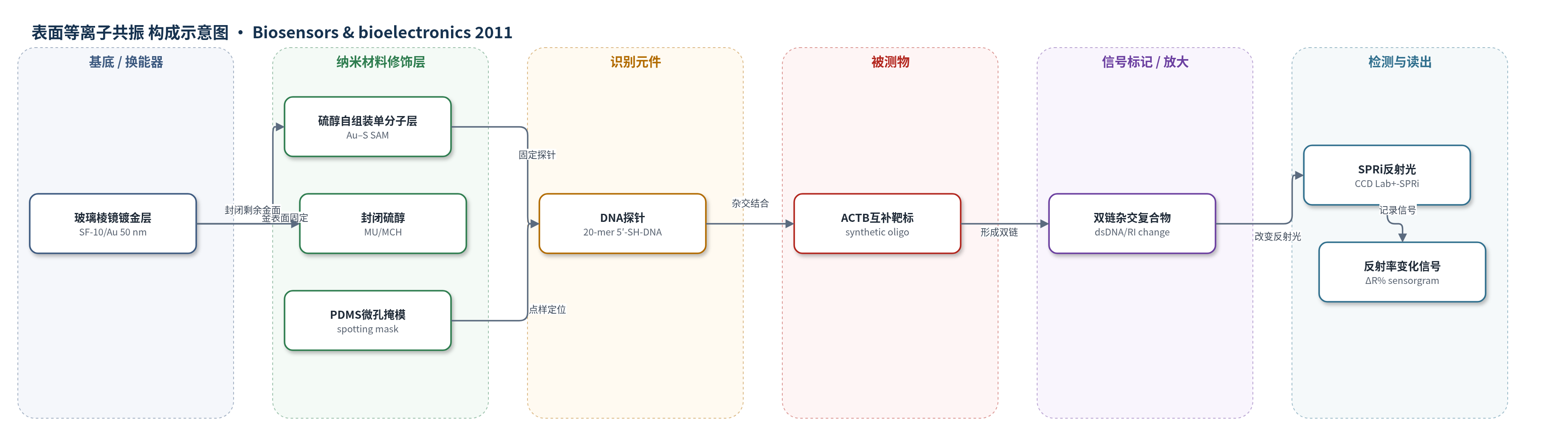
点击图片查看大图 · 依据论文自动绘制
传感器类型
表面等离子共振(SPR)生物传感器
检测对象
人 β-肌动蛋白基因片段(Homo sapiens actin beta, ACTB)互补合成寡核苷酸;样品基质:杂交缓冲液 HS(合成寡核苷酸溶液)
检测原理
该传感器基于表面等离子共振成像(SPRi)的无标记光学换能。偏振光经棱镜入射到金膜表面,在特定条件下激发表面等离子体波,反射光强度对界面折射率变化敏感。5′-硫醇化 DNA 探针通过 Au–S 键在金表面形成自组装单分子层,剩余金面用 MU/MCH 封闭以降低非特异吸附。当互补靶标寡核苷酸流过流池并与探针杂交时,表面形成双链 DNA(dsDNA),使界面质量与折射率增加,改变 SPR 共振条件。CCD 在固定角度记录反射光强度变化,得到 ΔR% 传感器图。靶标浓度越高,表面杂交量越大,ΔR% 越大。文中未使用 HCR、RCA 或酶催化沉积等信号放大策略,信号主要来自探针-靶标杂交引起的界面折射率变化。
检测灵敏度
校准浓度范围: 2 nM–250 nM(Fig. 1;方法部分另述 2–500 nM);原文未报告 LOD、线性范围、灵敏度斜率或 R^2。
效应效果
该文未报告 RSD、实际样品加标回收率、长期稳定性或与 ELISA/HPLC/qPCR 的定量对比,也未在复杂生物基质中评估抗干扰;实验以合成互补寡核苷酸为靶标,重点验证探针设计策略。SPRi 校准显示探针计算得分与响应一致:Probe 1 和 Probe 2(总得分 0.936)在 2–250 nM 范围内信号最高,Probe 3(0.725)居中,Probe 4(0.500)和 Probe 5(0.255)最低。UV 熔解实验表明 Probe 1 在 25–80°C 无二级结构熔解曲线,Probe 2 熔解温度最高(64°C),Probe 4 最低(49°C),Probe 3 和 Probe 5 分别为 56°C 和 59°C。作者认为该理性设计方法可标准化核酸探针选择,提高亲和传感性能,并可扩展至 miRNA 等 RNA 检测及其他换能平台。
传感器的构成
- 基底/换能器:SF-10 玻璃棱镜镀金层(50 nm Au),作为 SPR 换能基底。
- 识别元件:5′-硫醇化 DNA 探针(5′-SH-(CH2)6-DNA,20-mer),通过 Au–S 自组装单分子层固定并杂交靶标。
- 封闭剂:11-巯基-1-十一醇(MU)与 6-巯基-1-己醇(MCH)混合硫醇,封闭剩余金表面降低非特异吸附。
- 杂交缓冲液:HS(300 mM NaCl、0.02 M Na2HPO4、0.1 mM EDTA、pH 7.4、0.05% Tween 20),维持杂交环境并减少非特异结合。
- 再生液:100 mM HCl,解离表面 dsDNA 实现探针再生。
- 点样掩模:PDMS 微孔掩模,用于探针阵列定位与固定。
- 信号标记物:无标记(label-free),无外源标记,直接由 SPR 反射光变化读出。
中文摘要
核酸传感在基础与应用化学研究中备受关注,成功构建核酸传感器的关键之一是探针设计及其在芯片表面的固定。本文证明,理性选择生物探针会显著影响传感器的分析性能。作者采用一种简单且免费可用的计算程序,对给定靶序列进行探针设计,并将结果直接应用于核酸传感。研究建立了一套优化且可重复的计算机辅助探针设计策略,并以光学换能实验加以验证。其中,表面等离子共振成像(SPRi)作为原理验证平台,可实现实时、无标记、多分析物同步检测。作者筛选出 5 条硫醇化 DNA 探针,通过成熟的硫醇化学固定于金芯片表面,并以人 β-肌动蛋白(ACTB)基因片段为模型体系进行杂交检测。同时,通过 UV 熔解实验和 Mfold 软件评估探针二级结构强度与折叠状态,以解释传感器行为。SPRi 实验结果与计算评分高度一致,表明该理性探针设计方法对开发具有优化性能的核酸生物传感器探针具有良好应用前景。
英文摘要
Development of nucleic acid-based sensing attracts the interest of many researchers in the field of both basic and applied research in chemistry. Major factors for the fabrication of a successful nucleic acid sensor include the design of probes for target sequence hybridization and their immobilization on the chip surface. Here we demonstrate that a rational choice of bioprobes has important impact on the sensor's analytical performances. Computational evaluations, by a simple and freely available program, successfully led to the design of the best probes for a given target, with direct application to nucleic acid-based sensing. We developed here an optimized and reproducible strategy for in silico probe design supported by optical transduction experiments. In particular Surface Plasmon Resonance imaging (SPRi), at the forefront of optical sensing, was used here as proof of principle. Five probes were selected, immobilized on gold chip surfaces by widely consolidated thiol chemistry and tested to validate the computational model. Using SPRi as the transducting component, real-time and label free analysis was performed, taking the Homo sapiens actin beta (ACTB) gene fragment as model system in nucleic acid detection. The experimental sensor behavior was further studied by evaluating the strength of the secondary structure of probes using melting experiments. Dedicated software was also used to evaluate probes' folding, to support our criteria. The SPRi experimental results fully validate the computational evaluations, revealing this approach highly promising as a useful tool to design biosensor probes with optimized performances.