组成图示
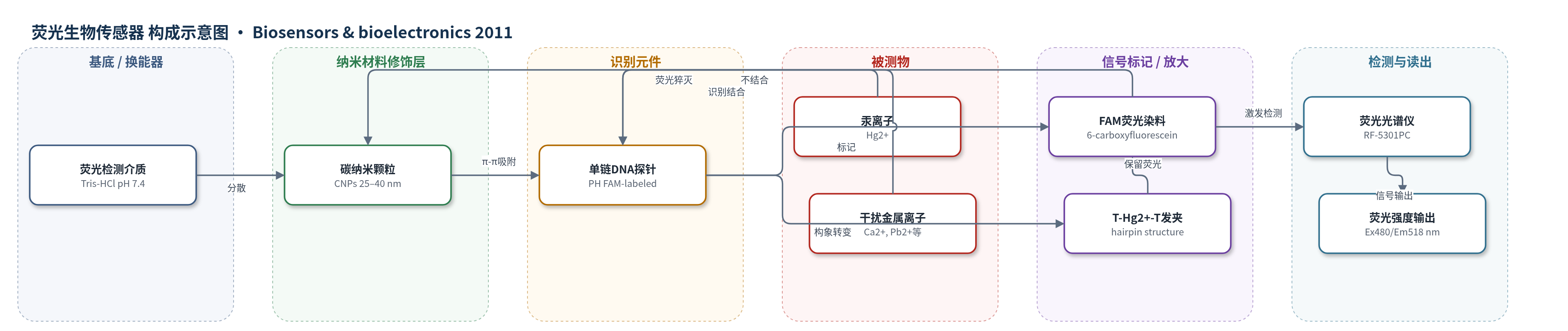
点击图片查看大图 · 依据论文自动绘制
传感器类型
荧光生物传感器
检测对象
汞(II)离子(Hg2+);样品基质:Tris-HCl缓冲液、湖水(lake water)
检测原理
FAM标记的T富集ssDNA探针PH在无Hg2+时以单链形式通过碱基与CNP的π–π堆积吸附于碳纳米颗粒表面,FAM与CNP之间发生电子转移/荧光猝灭,荧光强度低。加入Hg2+后,Hg2+特异性桥接T–T形成T–Hg2+–T碱基对,诱导PH折叠为发夹结构;发夹结构不再有效吸附于CNP,FAM脱离猝灭环境,荧光恢复。荧光强度随Hg2+浓度增加而升高,在0–250 nM呈线性,10 μM时趋于饱和。该体系无酶催化放大,主要依靠CNP猝灭-释放的荧光开关和DNA构象选择性识别实现信号转换。
检测灵敏度
LOD: 10 nM;线性范围: 0–250 nM;校准范围: 0–10 μM;高浓度线性范围: 0.5–10 μM
效应效果
该CNP荧光传感器对Hg2+特异性高。4 μM Hg2+与50 μM Ca2+、Cd2+、Co2+、Cu2+、Fe2+、Fe3+、Mg2+、Mn2+、Ni2+、Pb2+、Zn2+共存时干扰小;所有干扰离子存在下,4 μM Hg2+荧光仍比无Hg2+高2.5倍。探针-CNP复合物超声后仅少量释放,稳定性好。湖水加标30、60、120 nM时,本方法测得26.23±6.90、61.86±2.74、123.79±4.72 nM,与ICP-MS的30.05±0.45、60.23±0.55、121.85±0.64 nM一致;最低可检测30 nM,满足WHO限值。作者认为其比SWCNT/GO易制备,适用于环境水样。
传感器的构成
- 荧光检测介质:20 mM Tris-HCl缓冲液(含100 mM NaCl、5 mM KCl,pH 7.4),作为CNPs分散与荧光反应环境。
- 纳米材料修饰层:碳纳米颗粒(CNPs,candle soot-derived carbon nanoparticles,25–40 nm),通过π–π堆积吸附ssDNA并猝灭FAM荧光。
- 识别元件:FAM标记的Hg2+特异性单链DNA探针(PH,5′-TTC TTT CTT CCC CTT GTT TGT T-FAM-3′),与Hg2+形成T–Hg2+–T发夹结构。
- 信号标记物:6-羧基荧光素(FAM)荧光染料,标记于PH 3′端,作为荧光报告基团。
- 样品前处理层:阴离子交换树脂(anion exchange resin)柱,用于湖水样品中油类及有机/生物杂质去除。
中文摘要
本文报道了以蜡烛烟灰制备的碳纳米颗粒(CNPs)作为新型荧光传感平台,用于高灵敏、高选择性地检测水溶液中的汞(II)离子(Hg2+)。据作者所知,这是首次将蜡烛烟灰来源的 CNPs 用于此类传感器。该策略基于:荧光标记的单链 DNA(ssDNA)探针通过 DNA 碱基与 CNP 之间的 π–π 堆积作用吸附于 CNP 表面,导致荧光染料发生显著猝灭;而在 Hg2+ 存在时,T–Hg2+–T 诱导探针形成发夹结构,使其不能吸附于 CNP,从而保留染料荧光。该方法检出限低至 10 nM,对其它金属离子具有显著特异性,并在大量干扰离子存在下仍表现出优异选择性。最后,作者以湖水而非纯缓冲液进行 Hg2+ 检测,以评估其实际应用潜力,表明该平台经进一步开发后有望用于真实样品分析。
英文摘要
In this article, carbon nanoparticles (CNPs) were used as a novel fluorescent sensing platform for highly sensitive and selective Hg(2+) detection. To the best of our knowledge, this is the first example of CNPs obtained from candle soot used in this type of sensor. The general concept used in this approach is based on that adsorption of the fluorescently labeled single-stranded DNA (ssDNA) probe by CNP via π-π stacking interactions between DNA bases and CNP leads to substantial dye fluorescence quenching; however, in the presence of Hg(2+), T-Hg(2+)-T induced hairpin structure does not adsorb on CNP and thus retains the dye fluorescence. A detection limit as low as 10nM was achieved. The present CNP-based biosensor for Hg(2+) detection exhibits remarkable specificity against other possible metal ions. Furthermore, superior selectivity performance was observed when Hg(2+) detection was carried out in the presence of a large amount of other interference ions. Finally, in order to evaluate its potential practical application, Hg(2+) detection was conducted with the use of lake water other than pure buffer and it is believed that it holds great promise for real sample analysis upon further development.